Caught a Swarm?
How to Catch a Bee Swarm and Track Its Hive
A few summers ago, at a property where I keep no hives, I noticed something strange around midday. A handful of bees were buzzing at my kitchen window — persistent, confused, flying in circles against the glass. One of them fell right into my soup.
I couldn’t figure it out at first. Then I walked around the house and found a ventilation opening for the gas line — no mesh screen, just an open gap in the wall. Scout bees had found it and decided it was a promising new home.
I watched them carefully for the rest of that afternoon, suspecting what was coming. The next morning, while I was in the garden, I looked up to see a massive cloud of bees moving overhead — a full swarm, thousands of them, flying in formation above the garden. My heart sank. They flew low, clearly searching, clearly drawn by the scouts that had visited the day before.
And then — fortunately — they kept moving. They chose another location. I never saw them settle. But I understood in that moment exactly how close I had come to finding a swarm living inside my kitchen wall. The scouts had visited. They had inspected. And 24 hours later, the swarm followed.
That experience taught me more about swarm behaviour than any book. It is why I now check every gap and opening at any property near an apiary every spring — and why I want to share what I know about scout bees, swarm catching, and what to do when you see bees “inspecting” your house.
📋 In This Article
- Scout Bees vs The Swarm — How to Know If Bees Are Inspecting Your House
- The First Stop — Why Swarms Land Near the Apiary First
- Step-by-Step: How to Catch a Bee Swarm in Your Garden
- Equipment You Need to Catch a Bee Swarm
- Beekeeping Detective — How to Find Which Hive the Swarm Came From
- The Flour Method — An Old Beekeeper’s Trick
- When to Call a Professional — For Canadian Homeowners
- FAQ — Bee Swarm Catching Questions & Answers
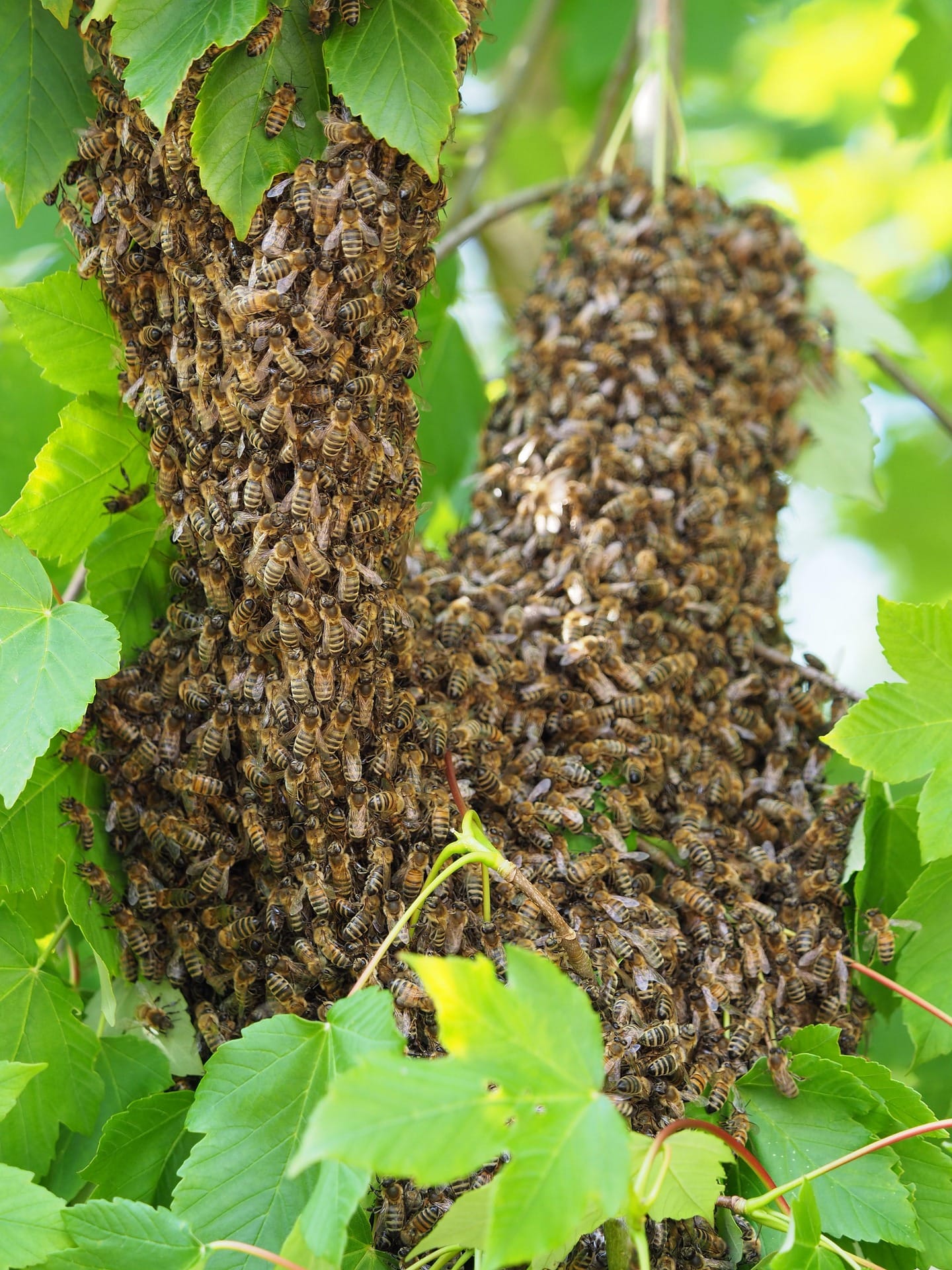
A bee swarm hanging from a branch in your garden is one of nature’s most spectacular sights — and one of beekeeping’s greatest opportunities. Swarm season in Ontario and Alberta runs from late May through June, when colonies that outgrew their hives send their old queen and half their population off to find a new home. For beekeepers, a swarm is a free new colony. For homeowners, it is a brief, manageable event — if you know what to do in the first 24-48 hours.
Scout Bees vs The Swarm — How to Know If Bees Are Inspecting Your House
The most valuable swarm warning sign that most people — including many beekeepers — miss completely is the scout bee visit. Before a swarm ever arrives, a small advance party of scout bees inspects potential new homes in the surrounding area. Understanding scout bee behaviour can give you 24-48 hours of advance warning before a swarm arrives at your property.
Scout bees behave very differently from regular forager bees. While foragers fly in purposeful straight lines to and from flowers, scout bees hover, circle, and inspect — crawling into gaps, measuring cavities with their bodies, and spending time at openings that a regular bee would fly past. If you see 5-20 bees doing this behaviour at gaps in your wall, chimney openings, roof eaves, or ventilation holes — you are watching a house inspection in progress.
Scout bees communicate their findings back to the swarm cluster through the waggle dance — the same dance foragers use to communicate flower locations. A cavity that scores well gets vigorous dances, recruiting more scouts to verify. Once consensus is reached among scouts, the swarm departs for the chosen location within hours.
What to do when you see scout bees: Act immediately. Seal any gaps or openings in your house walls, eaves, roof, and foundation with steel wool, foam, or mesh screening. Remove any old hive material from cavities — the scent of old wax and propolis is extremely attractive to scouts. If you are a beekeeper, set up a bait hive (swarm trap) nearby with lure pheromone — redirect the scouts to a box you control before the swarm decides to move into your wall.
WiseBee Tip — Check Ventilation Openings Every Spring
Gas line vents, dryer exhausts, roof vents, and any opening above 10cm² in a wall cavity are potential scout bee targets. Walk around your house every spring in May and confirm all openings have intact mesh screens. A piece of hardware cloth secured over an open vent costs pennies and prevents a swarm from establishing in your wall — an event that can cost hundreds to remove.
The First Stop — Why Bee Swarms Land Near the Apiary First
If you are a beekeeper who just watched your colony swarm, you may find the cluster hanging from a branch just 3-5 metres from your hives. This is not a coincidence — it is deliberate biology, and it gives you your best opportunity to catch the swarm before it moves on.
How Long Does a Swarm Stay in One Place?
A swarm cluster typically stays at its first landing for 1-3 days while scout bees evaluate permanent home options. In warm, settled weather the process moves faster — a swarm can depart for its final destination within hours. In cool, overcast conditions scouts fly less efficiently and the swarm may remain in the same spot for 2-3 days. Check the swarm regularly — once scouts have reached consensus the entire cluster launches and moves with surprising speed. If you plan to catch it, act on Day 1.
Step-by-Step: How to Catch a Bee Swarm in Your Garden
Put On Your Protective Gear — Even Though Swarms Are Gentle
Swarming bees are remarkably docile — they have no hive, no brood, and no honey stores to defend, and their honey stomachs are full making them physically calmer. Most swarm catches can be done with minimal protective gear. However, if the swarm has been hanging for more than 24 hours and scouts are returning agitated, or if you are working in a confined space near the cluster, wear at minimum a veil. A full suit gives you confidence to work calmly — and calm movement is the most important technique in swarm catching.
Position Your Box Directly Beneath the Cluster
Place your nuc box, hive body, or cardboard box directly beneath the hanging swarm with the opening facing up. If the cluster is on a low branch, hold the box as close to the cluster as possible. Do not shake the branch yet — assess the situation first. Is the cluster on the end of a flexible branch you can shake? Or on a rigid surface like a fence post or wall that requires a different technique?
The Sharp Shake — The Most Effective Technique
For a swarm on a branch: hold the box directly beneath with one hand. With the other, grip the branch firmly and give one sharp, decisive downward shake — not a gentle wobble but a sudden, firm movement that dislodges the entire cluster at once. The goal is to drop the bulk of the swarm, including the queen, into the box in one motion. A slow shake loses bees gradually; a fast shake drops them all together.
The Golden Rule — Watch Where the Bees Go
This is the most important observation in swarm catching: after the shake, watch the bees. If the queen landed in the box, worker bees will begin fanning at the box entrance, exposing their Nasonov gland (a scent gland at the tip of the abdomen), and calling other bees into the box with pheromone signals. You will see bees walking deliberately into the box rather than flying chaotically. If bees start flying back up to the original perch location — the queen is still up there and you need to repeat the shake.
Leave the Box Open Until Dusk
Once the majority of bees are in the box and you can see the Nasonov fanning behaviour, leave the box in place with the entrance open until dusk. Stragglers and foragers that were away from the cluster will return to the queen’s scent and enter the box. At dusk, when all flying activity has ceased, close the entrance with a piece of foam or a mesh screen and move the box to your apiary location. Install a frame feeder with 1:1 syrup immediately — the swarm has used significant food reserves during the swarm flight.
High Branch Swarms — Do Not Climb
Never climb a ladder to catch a swarm. Working at height with thousands of bees while maintaining the balance and calm movement swarm catching requires is genuinely dangerous. For swarms above 3-4 metres, use a long-handled bucket on a pole to scoop the cluster, or contact your local beekeeping association — experienced swarm catchers have extension equipment for high swarms. A swarm that cannot be safely reached is better left to find its own home than to risk a serious fall.
Equipment You Need to Catch a Bee Swarm
Beekeeping Detective — How to Find Which Hive the Swarm Came From
For beekeepers with multiple hives, a swarm is also a mystery to solve: which colony sent the swarm? Identifying the parent hive is important because it tells you which colony needs immediate management attention — it may have remaining swarm cells that will trigger more swarms, or it may be severely depleted of population and need support.
The Inspection Method — Reading the Evidence
Walk your apiary and do a quick visual assessment of each hive entrance without opening. The parent hive shows a distinctive pattern: dramatically reduced forager traffic at the entrance compared to its normal activity level. A hive that lost a swarm may have shed 40-60% of its flying bee population — the difference is visible within an hour of the swarm departing. The parent hive entrance looks suddenly quiet compared to neighbouring hives of similar strength.
When you do open the suspected parent hive, look for: multiple capped queen cells (or recently opened cells with the cap torn off from the side — indicating a virgin queen has already emerged), reduced bee population on the frames, and a brood pattern that may show a gap — the old queen stopped laying before departing.
The Flour Method — An Old Beekeeper’s Trick
The flour method is one of the most ingenious and satisfying techniques in traditional beekeeping — a simple, low-tech way to trace a swarm back to its parent hive with near-certainty.
The Flour Method — Step by Step
Scoop a small cup of bees from the freshly caught swarm into a jar or container. Gently dust them with plain white flour — a light coating, enough to make them visibly white. Release the flour-dusted bees near your apiary, ideally upwind of your hives. Then watch the entrances of each hive carefully. Within a few minutes, flour-dusted bees will begin returning home — and the hive they enter is the parent colony from which the swarm originated. This works because forager bees always return to their home hive regardless of recent events.
Why the Flour Method Works
Forager bees in a swarm are programmed to return to their original hive location — it is an instinct that persists even when the colony has left that location. The flour simply makes individual bees visible at a distance so you can track their flight path. Use plain white wheat flour only — never powdered sugar (ferments quickly and attracts ants) and never any scented powder. Release bees within 200m of your apiary for reliable results.
When to Call a Professional — For Canadian Homeowners
For homeowners in Ontario and Alberta who have found a swarm cluster in their garden and have no beekeeping equipment, the best action is often to contact a local beekeeper rather than attempt removal alone.
Important — Swarming Bees Are Not Dangerous
A swarm cluster hanging from a branch is about the gentlest bee encounter possible. Swarming bees have no hive, no brood, and no honey stores to defend. Their honey stomachs are full — a physical state that makes bees significantly calmer and less likely to sting. Unless provoked by direct contact or being swatted at, a fresh swarm cluster can be observed from a metre away without any risk. Do not spray water, insecticides, or attempt to knock the cluster down — this will agitate bees without solving the situation and may provoke defensive behaviour.
Who to Contact in Ontario and Alberta
Most local beekeeping associations maintain a swarm removal list — beekeepers who will come to your property and remove the swarm free of charge in exchange for keeping the bees. This is genuinely a win-win: you get the swarm removed safely and professionally, the beekeeper gets a free new colony worth $150-350 CAD.
Ontario: Contact the Ontario Beekeepers’ Association (OBA) — ontariobee.com — for your regional swarm removal contact list. Many Ontario local associations maintain their own swarm hotlines in May and June.
Alberta: Contact the Alberta Beekeepers Commission — albertabeekeepers.com — or Worker and Hive in Calgary for local swarm removal resources. Many Alberta beekeepers actively seek swarms in May and June to replace winter losses.
Never Use Insecticide on a Bee Swarm
Killing a swarm with insecticide is illegal in many Canadian municipalities and is always ecologically destructive. Honeybees are essential pollinators — a swarm cluster is a healthy, relocatable colony that a local beekeeper will remove for free within hours of being contacted. Insecticide also leaves chemical residues in any cavity the bees entered that can harm future bee populations. Contact a beekeeper first — removal is almost always free and fast during swarm season.
FAQ — Bee Swarm Catching Questions & Answers
Scout bees inspecting a potential nest site behave very differently from regular forager bees. Instead of flying purposefully to and from flowers, scout bees hover in front of gaps and openings, crawl inside to measure the cavity, circle back to inspect from different angles, and spend several minutes at one location. If you see 5-20 bees doing this behaviour at gaps in your walls, roof eaves, chimney, or ventilation openings — you are watching house-hunting scouts. Act within 24-48 hours: seal all gaps with steel wool or hardware cloth mesh immediately. Once scouts report back and consensus is reached, the swarm follows quickly.
A bee swarm typically stays at its first landing location for 1-3 days while scout bees evaluate permanent home options. In warm, settled weather the process moves faster — a swarm can depart for its final destination within hours of landing. In cool, cloudy conditions scouts fly less efficiently and the swarm may remain for 2-3 days. The swarm departs suddenly and completely when scouts reach consensus — one moment the cluster is there, the next it has lifted and moved. If you plan to catch the swarm, act on Day 1. A swarm still present on Day 3 is unusual and may indicate the queen is damaged or that no suitable home has been found.
A fresh bee swarm cluster is among the least dangerous bee encounters possible. Swarming bees have no hive, no brood, and no honey stores to defend — the three triggers for defensive stinging behaviour are all absent. Their honey stomachs are full, which physically increases their calm temperament. Most experienced beekeepers handle fresh swarms with bare hands and no veil. However, after 24-48 hours without food, a swarm becomes more defensive as hunger increases stress. Do not swat at swarm bees or use any spray near the cluster — provocation at close range is the main cause of stings from otherwise calm swarms.
You know you caught the queen when bees start fanning at the entrance of your catch box — exposing their Nasonov gland (a scent organ at the tip of their abdomen) and releasing orientation pheromone that calls other bees into the box. You will see bees walking deliberately into the box rather than flying chaotically, and the number of bees in the air gradually decreasing as they enter the box. If bees are flying back up to the original perch location on the branch rather than into the box, the queen is still on the branch and you need to repeat the shake. The queen’s pheromones are the only force that keeps a swarm together — if bees are following the box, the queen is in the box.
After catching a swarm: leave the box in place with the entrance open until dusk so stray bees can return to the queen’s scent. At dusk, close the entrance with foam or mesh and move the box to your apiary location. Install the swarm in a proper hive box with frames — drawn comb is ideal as it allows the queen to begin laying immediately. Install a frame feeder with 1:1 sugar syrup immediately — the swarm has consumed significant reserves and needs carbohydrate support. Place a pollen substitute patty on the frames for protein. Do not expect honey production from a swarm colony the same season — focus on establishing the colony and building adequate winter stores. Check for eggs at Day 10 to confirm the queen is laying.
Final Thoughts on Catching a Bee Swarm
A bee swarm is not an emergency — it is an opportunity. For beekeepers, it is a free colony that can be caught in minutes with the right equipment and technique. For homeowners, it is a brief, harmless visit from one of nature’s most remarkable insects, resolvable with a single phone call to a local beekeeper who will arrive grateful for the chance to collect it.
The scout bee story I shared at the beginning of this article is the lesson I carry into every spring: the swarm does not arrive without warning. Watch for the scouts in May and June, protect your openings, and if you see that cloud of bees moving overhead — know that somewhere nearby a beekeeper would very much like to make their acquaintance. 🐝🌿🍯
Found a swarm or spotted scout bees? 🐝
Ask our AI beekeeping assistant — describe what you’re seeing and we’ll tell you whether it’s scouts, a swarm, and exactly what to do next.
🐝 Ask Bee Now — It’s Free🐝 WiseBee Disclosure
Affiliate Disclosure: This article contains Amazon affiliate links. If you purchase through our links, we earn a small commission at no extra cost to you. Learn more →
Disclaimer: This article is for educational purposes only and does not constitute professional apicultural or veterinary advice. Always consult a qualified beekeeper for guidance specific to your situation. Full disclaimer →