Wind Protection for Bee Hives in Alberta:
How to Secure and Storm‑Proof Your Apiary
📋 In This Article
- Why Alberta Wind Is a Unique Beekeeping Challenge
- How to Secure Bee Hives in High Winds — The Layered Approach
- Bee Hive Straps for Storms — Types and Best Options
- Anchoring Bee Hives in Windy Areas — Ground Anchors and Stands
- Windbreaks for Bee Hives in Alberta — Natural and Built Options
- Storm-Proofing Beehives Alberta — Pre-Storm Checklist
- Chinook-Specific Considerations for Alberta Beekeepers
- What to Do After a Storm — Damage Assessment
- FAQ — Wind Protection for Bee Hives Alberta
- Best Hive Straps and Anchoring Products on Amazon Canada
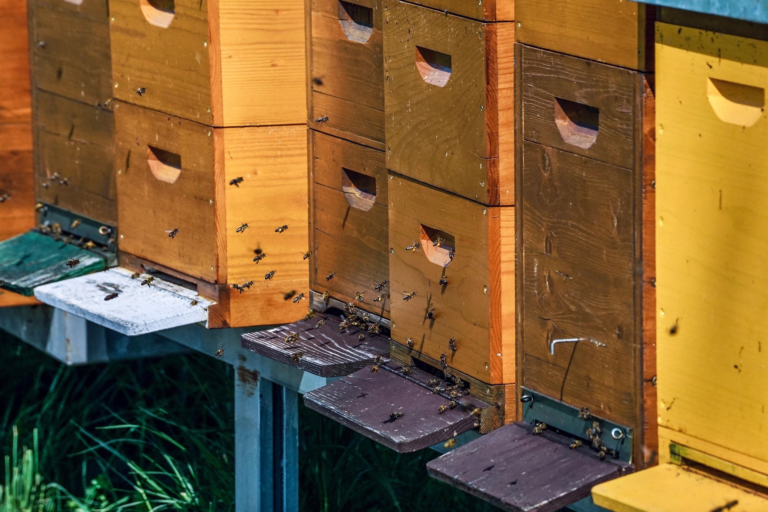
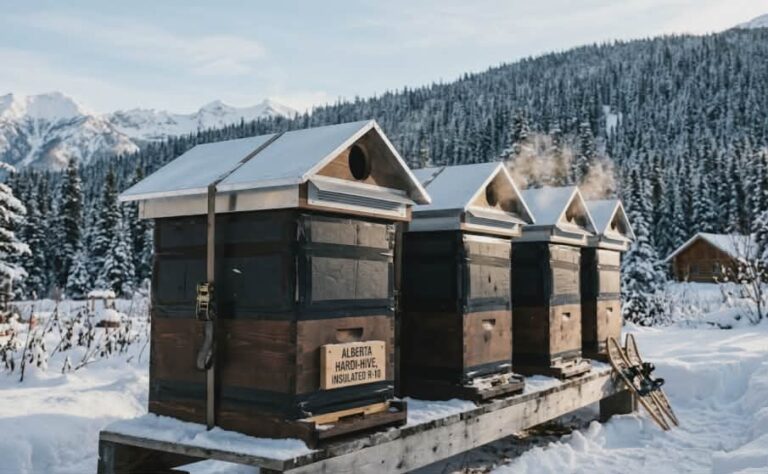
Wind protection for bee hives in Alberta is not optional — it is a core apiary management requirement. Alberta’s prairie winds, sudden Chinook events, and intense summer thunderstorms create conditions that can tip, scatter, and destroy unprotected hives within minutes. A single unanchored hive tipped by an Alberta storm can kill tens of thousands of bees, destroy drawn comb, and set a colony back by weeks. This guide covers every method for securing, anchoring, and storm-proofing your Alberta apiary.
Why Alberta Wind Is a Unique Beekeeping Challenge
Alberta wind presents challenges that beekeepers in Ontario, BC, or Maritime Canada rarely encounter. The combination of Alberta’s open prairie landscape — with minimal natural windbreaks across large areas — and the province’s meteorological position creates several distinct wind threats that demand specific protection strategies.
A standard Langstroth hive with two deep brood boxes, two honey supers, and a telescoping cover has significant wind resistance — particularly when the supers are not yet full and the hive is top-heavy. The center of gravity shifts upward as supers are added throughout the honey season, making an early-July hive near the peak of its height significantly more vulnerable to tipping than the same hive in April with only brood boxes.
How to Secure Bee Hives in High Winds — The Layered Approach
Securing bee hives in high winds in Alberta requires a layered approach — no single method provides adequate protection on its own. The most storm-resistant Alberta apiaries combine three layers of protection: hive straps, ground anchoring, and windbreaks working together.
Bee Hive Straps for Storms — Types and Best Options
Bee hive straps are the first and most essential line of defence against Alberta storm wind. A strap prevents individual boxes from separating when wind lifts the top components — even if the entire hive moves, the boxes stay together and the colony survives. Not all hive straps are equal in Alberta’s demanding conditions.
| Strap Type | Alberta Rating | Pros | Cons | Best For |
|---|---|---|---|---|
| Ratchet Strap | ⭐⭐⭐⭐⭐ | Maximum tension, adjustable, re-usable | Slightly more complex to apply | All Alberta locations — standard choice |
| Polypropylene Hive Strap | ⭐⭐⭐⭐ | Purpose-built for hives, quick install | UV degrades faster than polyester | Sheltered Alberta locations |
| Bungee Cord | ⭐⭐ | Easy, cheap | Stretches in wind — not adequate for Alberta storms | Not recommended for Alberta |
| Metal Hive Clip | ⭐⭐⭐⭐ | Permanent, no adjustment needed | Limits hive configuration flexibility | Fixed permanent Alberta apiary setups |
How to Apply Hive Straps Correctly for Alberta Conditions
Applying bee hive straps correctly for Alberta storm protection is as important as choosing the right strap. Run the first strap around the hive from front to back — wrapping under the bottom board and over the outer cover. Tighten until the cover cannot be lifted by hand. For Chinook-prone locations (foothill areas west of Calgary, Lethbridge corridor, Peace River region), add a second strap running from side to side perpendicular to the first. This cross-strapping pattern provides resistance to wind from any direction — critical when Chinooks arrive from the southwest and summer thunderstorms from the northwest on the same day.
WiseBee Tip: Check Straps After Every Major Wind Event
Alberta’s repeated wind cycles cause hive straps to gradually work loose — particularly ratchet straps which can release under cyclic loading if not properly secured. After every wind event above 70 km/h, walk your apiary and re-tension all straps. Mark strap positions with a permanent marker so you can see at a glance if a strap has shifted. Replace UV-degraded straps every 2-3 years — Alberta’s intense summer UV breaks down polypropylene webbing faster than in most other Canadian provinces.
Anchoring Bee Hives in Windy Areas — Ground Anchors and Stands
Anchoring bee hives in windy areas of Alberta addresses what hive straps cannot — preventing the entire hive stand from moving, tipping, or sliding under sustained wind load. A hive whose boxes are perfectly strapped together but whose stand slides across the ground in a Chinook event is still a disaster.
Best Methods for Anchoring Bee Hives in Alberta
Place a cinder block or patio paving stone at each corner of the hive stand, flush against the stand legs. A standard cinder block weighs approximately 18kg — four blocks add 72kg of stabilizing weight at the base of the stand. This is the simplest and most accessible method for stopping hives from tipping over in wind across Alberta apiaries.
Partially bury the blocks or push them into soft soil for additional stability. Stack two blocks on each corner side facing the prevailing wind for locations experiencing sustained winds above 70 km/h.
For maximum security in exposed Alberta locations — ridge-top apiaries, open field positions, or Chinook corridor locations — anchor hive stands directly to the ground using heavy-duty stakes driven at 45-degree angles and connected to the stand legs with galvanized wire or heavy-duty zip ties. Use tent pegs or purpose-made ground anchors rated for at least 200kg pull-out resistance.
This method is particularly effective for metal hive stands that lack the weight of wooden stands. Run cables from stand corners to ground stakes at approximately 45 degrees — this creates a guy-wire effect that resists both lateral wind pressure and lifting forces from updrafts.
Hive height directly determines tip-over risk. A taller hive has a higher center of gravity and a greater moment arm for wind forces. In Alberta’s most exposed locations, keeping hive stacks as low as practical is one of the most effective wind protection strategies available. Use medium honey supers rather than deep supers to reduce individual box height. Position hives on short, low stands (20-30cm) rather than tall stands. In exposed winter locations, temporarily move hives to ground-level pallets until spring when height can be restored for ventilation.
Windbreaks for Bee Hives in Alberta — Natural and Built Options
Windbreaks for bee hives in Alberta are the most impactful long-term investment in apiary wind protection. A properly positioned windbreak reduces sustained wind speed by 50-70% on the leeward side — dramatically reducing the load on hive straps and anchors and improving colony performance by reducing the energy bees expend fighting wind at the hive entrance.
Windbreak Placement for Maximum Alberta Bee Hive Protection
Position windbreaks on the northwest and west sides of your Alberta apiary — these are the primary prevailing wind directions across most of the province. The windbreak should be placed at a distance of approximately 5-7 times the windbreak height from the hives — this is the zone of maximum wind reduction on the leeward side. A 2-metre caragana hedge creates a protected zone extending approximately 10-14 metres to the east — enough for a row of 4-6 hives.
Don’t Block South-Facing Sun Exposure
When installing windbreaks for bee hives in Alberta, do not position dense windbreaks on the south or southeast sides of your apiary — these directions are critical for winter sun warming the hive and stimulating spring activity. Alberta beekeepers need their hives facing south or southeast in full sun for maximum winter and spring colony performance. Windbreaks on the north, northwest, and west sides protect from prevailing winds while preserving essential solar exposure.
Storm-Proofing Beehives in Alberta — Pre-Storm Checklist
Storm-proofing beehives in Alberta requires both permanent preparations and pre-storm actions when severe weather is forecast. Alberta’s Environment and Climate Change Canada weather alerts for severe thunderstorms, high winds, and Chinook events give beekeepers advance notice to take additional protective steps before extreme conditions arrive.
✅ Permanent Storm-Proofing (Year-Round)
- Ratchet straps on all hives — front-to-back and side-to-side in Chinook zones
- Cinder block corner weights on all hive stands
- Windbreak on northwest/west side of apiary installed or growing
- Telescoping outer covers secured with brick, stone, or strap
- Hive stands staked or weighted at all four legs
- Low-profile hive configuration — medium supers preferred over deep
- Hive location survey — remove any overhanging branches that could fall on hives
✅ Pre-Storm Actions (24-48 Hours Before Severe Weather)
- Re-tension all ratchet straps — cyclic loading loosens them over time
- Add additional weight to outer covers — extra bricks or paving stones
- Remove any partially empty supers that make hive top-heavy without adding weight
- Close or reduce upper entrances — prevent wind-driven rain from entering
- Secure nearby equipment — empty supers, nuc boxes, feeders that could become projectiles
- Check all stakes and ground anchors — ensure seated firmly in soil
- Photograph apiary from multiple angles — insurance documentation if damage occurs
Chinook-Specific Considerations for Alberta Beekeepers
Chinook winds create a unique set of challenges for Alberta beekeepers that differ from standard thunderstorm wind protection. Chinooks arrive rapidly — sometimes accelerating from calm conditions to 100+ km/h within hours — and come from a specific southwest to west direction along the Rocky Mountain foothills.
The Chinook Paradox — Warm Wind, Cold Aftermath
Chinooks create an additional challenge beyond pure wind damage: the rapid temperature swing. A Chinook can raise temperatures from -20°C to +10°C within hours, causing bees to break cluster and begin flying — consuming winter stores during unseasonable activity. When the Chinook ends and temperatures crash again, bees caught outside can die and those inside may have consumed critical stores. After any Chinook event between November and March, heft your hives to check if stores have been significantly depleted by unexpected activity.
What to Do After a Storm — Damage Assessment
After any severe wind event in Alberta — whether a thunderstorm microburst, sustained Chinook, or blizzard — a systematic apiary assessment is essential. The order of operations matters: safety first, then colony welfare, then equipment recovery.
Do not approach the apiary during the storm — Alberta thunderstorm microbursts and Chinooks can include lightning and flying debris. Once conditions are safe, walk the apiary perimeter and identify any tipped hives, scattered boxes, or displaced covers. Note but do not yet approach any hive that has tipped — bees inside will be highly defensive immediately after disturbance.
Put on full protective gear before approaching any tipped hive. Light your smoker — defensive bees from a tipped hive are extremely aggressive. Reassemble boxes in the correct order (bottom board, brood boxes, supers, inner cover, outer cover). Do not attempt a full inspection at this stage — the colony is highly stressed. Simply reassemble the stack, apply smoke generously, secure with straps, and close up. Inspect for queen survival at a full inspection 48 hours later when the colony has calmed.
Collect any frames that fell from tipped supers immediately — exposed honey will trigger robbing from other colonies in the apiary and from wasps within minutes of the storm passing.
Document Everything for Insurance
Alberta farm insurance policies may cover beehive storm damage — particularly for commercial beekeepers. Photograph all damage before reassembling anything. Note the date, time, and Environment Canada weather data for the storm event. Keep all damaged equipment for potential insurance assessment. Some Alberta beekeeping associations maintain information on insurance options for apiary storm damage — contact the Alberta Beekeepers Commission for current information.
FAQ — Wind Protection for Bee Hives Alberta
To stop hives from tipping over in wind in Alberta, use three combined methods: install ratchet straps around each hive (front-to-back minimum, side-to-side for Chinook zones), place cinder blocks at each corner of the hive stand to add base weight and prevent stand movement, and install a windbreak on the northwest and west sides of your apiary. Ratchet straps prevent individual boxes from separating but will not stop the entire hive from tipping if the stand moves — ground anchoring addresses this. A windbreak reduces the wind load reaching the hives by 50-70%, making both straps and anchors more effective.
The best bee hive straps for Alberta storms are heavy-duty ratchet straps rated for at least 500 lbs (227 kg) load capacity with polyester webbing — polyester resists UV degradation from Alberta’s intense summer sun better than polypropylene. The strap should be at least 2.5cm (1 inch) wide. For Chinook-prone locations in the foothills west of Calgary and in the Lethbridge corridor, use two straps per hive at 90 degrees (cross-strapping) to resist wind from any direction. Inspect and re-tension straps seasonally and replace UV-degraded straps every 2-3 years. Bungee cords are not adequate for Alberta storms — they stretch under wind load and allow boxes to separate.
Place windbreaks for bee hives on the northwest and west sides of your Alberta apiary — these are the primary prevailing wind directions across most of the province, and the direction from which Chinook events approach. Position the windbreak at a distance of 5-7 times its height from the hives for maximum wind reduction. Do not install dense windbreaks on the south or southeast sides — Alberta hives need full southern sun exposure for winter warmth and spring stimulation. The best windbreak species for Alberta bee hives are spruce or fir for year-round protection, or caragana for fast-establishing prairie conditions. Immediate options include stacked pallet walls or hay bale barriers while trees establish.
To anchor bee hives in a windy Alberta location: place cinder blocks (approximately 18kg each) at each corner of the hive stand — four blocks add 72kg of stabilizing base weight. For maximum security in exposed locations (ridge tops, open fields, Chinook corridor), drive heavy-duty ground stakes at 45-degree angles from each stand corner and connect to the stand legs with galvanized wire — this creates a guy-wire effect that resists both lateral wind pressure and lifting updrafts. For metal hive stands, additional weight is critical — they lack the mass of wooden stands. In winter, partially bury the stand legs or place paving stones around the base to prevent frost heaving that can destabilize stands over the Alberta winter.
When a bee hive tips over in an Alberta storm: do not approach until the storm has fully passed and conditions are safe. Put on full protective gear and light your smoker before approaching — bees from a tipped hive are extremely defensive. Collect any fallen frames immediately to prevent robbing from other colonies. Reassemble boxes in correct order using smoke generously, secure immediately with ratchet straps, and close up without a full inspection. Leave the colony undisturbed for 48 hours to calm, then do a full inspection to confirm queen survival and assess damage. Photograph all damage before reassembling for insurance documentation purposes.
Yes — properly applied ratchet straps are effective against Alberta Chinook winds when combined with adequate ground anchoring. Straps prevent individual boxes from separating and the hive from opening up in wind. However, straps alone cannot prevent the entire hive from tipping if the hive stand moves — this is why ground anchoring with cinder blocks or stakes is equally important. In Chinook-prone locations (foothills west of Calgary, Lethbridge area), use two ratchet straps per hive at 90 degrees — one front-to-back and one side-to-side — to provide resistance against the southwest Chinook wind direction as well as other seasonal wind directions. Re-tension straps before every forecast Chinook event.
Best Hive Straps and Wind Protection Products on Amazon Canada
Final Thoughts on Wind Protection for Bee Hives in Alberta
Wind protection for bee hives in Alberta is not a one-time task — it is an ongoing management discipline. The combination of ratchet straps, cinder block corner weights, ground anchors in exposed locations, and a properly positioned windbreak gives your Alberta apiary the best available defence against the province’s diverse wind threats: sustained prairie winds, Chinooks, and summer thunderstorm microbursts.
Invest in this protection early and inspect it regularly. A bee hive that survives an Alberta Chinook or summer storm intact is a productive colony all season. A hive tipped on a July night can lose its queen, chill its brood, and spill months of accumulated honey into the soil — a loss that no amount of autumn feeding can fully recover. Protect your hives and they will reward you. 🐝🌪️🏔️🍯
Questions about protecting your Alberta apiary? 🐝
Ask our AI beekeeping assistant — describe your location, hive setup and prevailing wind direction and we’ll advise on the right protection strategy for your Alberta apiary.
🐝 Ask Bee Now — It’s Free🐝 WiseBee Disclosure
Affiliate Disclosure: This article contains Amazon affiliate links. If you purchase through our links, we earn a small commission at no extra cost to you. Learn more →
Disclaimer: This article is for educational purposes only and does not constitute professional apicultural or veterinary advice. Always consult a qualified beekeeper for guidance specific to your situation. Full disclaimer →