Late Summer Varroa Control in Alberta:
Managing Mites as Temperatures Drop
Formic Pro can be used in early August Alberta (August 1-15) when daytime temperatures are still consistently above 20°C and nights have not yet dropped below 10°C regularly. After mid-August, Alberta’s prairie nights frequently fall to 5-10°C — cold enough to trigger partial clustering behaviour where bees form a loose cluster around the queen for warmth. When bees cluster at night, they stop distributing formic acid vapour through the hive uniformly, concentrating it in the cluster area and leaving peripheral brood frames undertreated. This uneven distribution dramatically reduces treatment efficacy. Additionally, formic acid evaporation slows significantly below 10°C, reducing the active vapour concentration. For late August and September Alberta Varroa treatment, Apivar is the correct and reliable choice regardless of temperature.
Apivar is the standard Alberta August Varroa treatment for four reasons specific to prairie conditions. First, it has no temperature requirements — amitraz releases from the strip through contact with bees regardless of ambient temperature, making it reliable across Alberta’s wide day-to-night temperature swings. Second, it provides long-term protection through the 42-56 day treatment period, covering both August and September as temperatures continue falling. Third, it integrates perfectly with Alberta’s compressed autumn calendar — strips installed August 1-10 are removed in mid-September, just before October wrapping begins. Fourth, it requires minimal hive disturbance during the critical winter bee generation period — strips are installed once and left in place, unlike repeated oxalic acid treatments or formic acid that require monitoring and potential reapplication.
The absolute deadline for effective Varroa treatment in Alberta is August 20th for any temperature-sensitive treatment, and September 1st for Apivar. Treatment installed after September 1st faces two compounding problems: first, the winter bee generation raised in August has largely already been parasitized during development — treatment cannot repair damage already done to bees already raised. Second, Alberta’s September temperatures create increasingly cold nights that slow even Apivar’s contact-based action as bee cluster tightening reduces strip contact. The beekeeper who installs Apivar on September 15th is treating the same colony that will be wrapped on October 15th — only 30 days of treatment rather than the full 42-56 day protocol, leaving a proportion of mites untreated before winter.
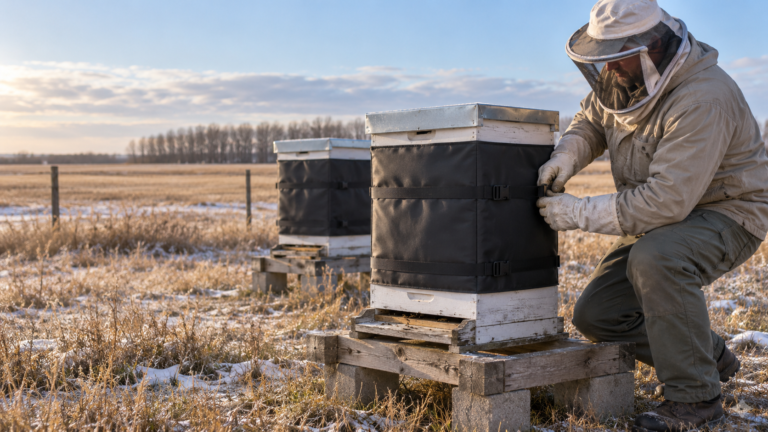
When Alberta night temperatures drop below 10°C, bees respond by forming a loose thermoregulation cluster — a behaviour that begins weeks before the formal winter cluster forms in October. In this partial clustering mode, bees concentrate on the warmest central frames and reduce movement to outer frames. This has direct treatment consequences: for vapour-based treatments (formic acid, thymol/Apiguard), the cluster restricts vapour distribution — outer frames receive less treatment exposure than central ones, leaving mites in peripheral brood populations partially protected. For Apivar, the effect is more subtle but still relevant — bees that contact the strip while clustering in the central frames distribute amitraz through grooming behaviour, but the reduction in whole-colony movement means distribution to outer frame populations is slower and less complete. This is why early August treatment in Alberta consistently produces better mite reduction outcomes than late August or September treatment, even with Apivar.
📋 In This Article
- The Alberta Climate Factor — Why Cold Nights Change Everything
- Alberta vs Ontario — Why the Same Treatment Works Differently
- Measure First — Alcohol Wash in Alberta August
- Apivar — The Alberta August Standard
- Formic Pro — Early August Only Window
- Oxalic Acid — The Brood Break Option
- The Alberta Treatment Decision Guide
- The Alberta Apivar Calendar — August to October Wrapping
Late summer Varroa control in Alberta operates under a constraint that Ontario beekeepers rarely face until October: cold nights. By mid-August, Alberta prairie temperatures regularly drop to 5-10°C after sunset — cold enough to change bee behaviour, alter treatment evaporation rates, and compress the effective treatment window weeks earlier than in eastern Canada. Understanding how temperature affects each Varroa treatment option is not an academic exercise in Alberta — it is the difference between a winter treatment that works and one that fails quietly while mites continue reproducing in the brood.
The Alberta Climate Factor — Why Cold August Nights Change Everything
Alberta sits at latitudes between 49° and 60° North — significantly further north than most of Ontario’s beekeeping regions. At this latitude, summer days are long and warm, but the thermal mass that keeps southern Ontario nights mild does not exist on the open prairie. Without the moderating influence of the Great Lakes or ocean proximity, Alberta temperatures can swing 20°C or more between afternoon high and overnight low in August.
Alberta vs Ontario — Why the Same Varroa Treatment Works Differently
- Night temps below 10°C by Aug 15
- Partial clustering disrupts vapour distribution
- Formic Pro window closes mid-August
- Apivar must be installed by Sept 1 max
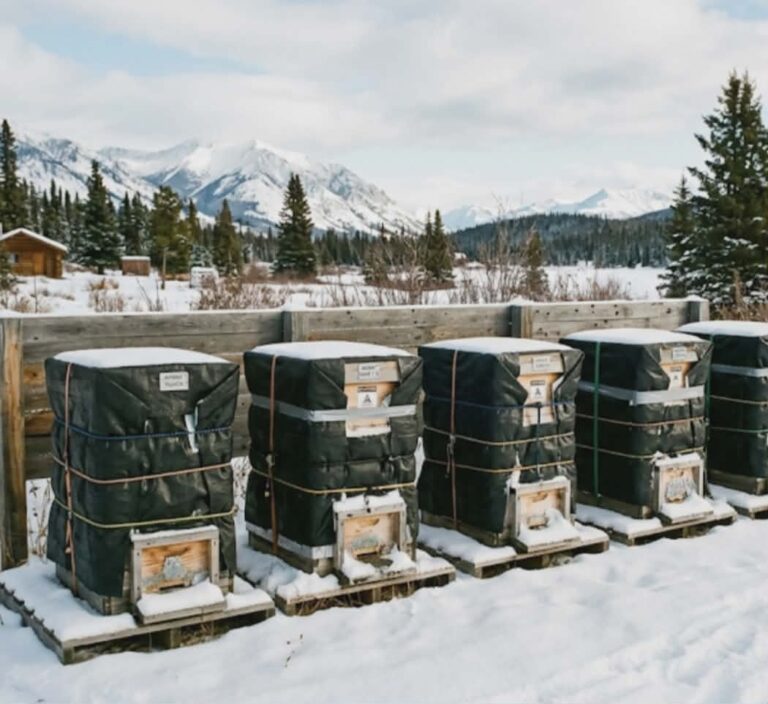
- October wrapping = hard treatment deadline
- No fall flow — 100% feeding required post-treatment
- Night temps above 12°C through August
- No partial clustering until late September
- Formic Pro viable entire August period
- Apivar can be installed through mid-September
- Late October wrapping allows more flexibility
- Goldenrod flow supplements post-harvest nutrition
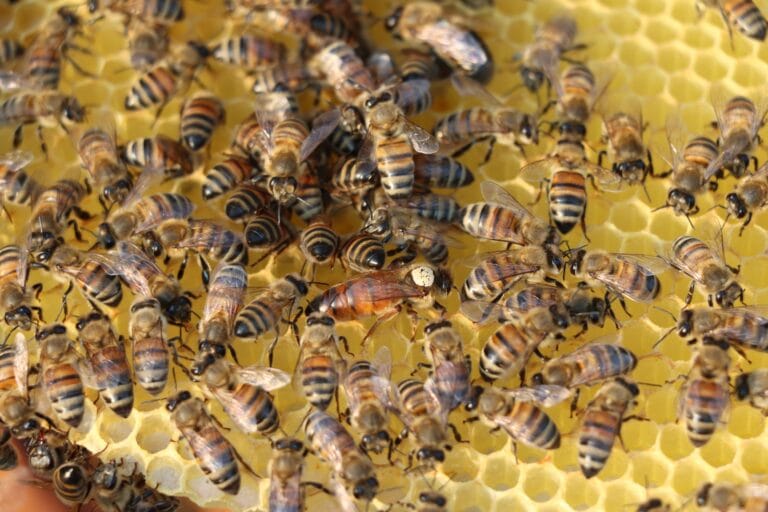
When Alberta night temperatures drop below 10°C, bees begin forming what researchers call a loose thermoregulation cluster — not the tight winter cluster, but a concentrated group of bees on the central frames around the queen, generating heat through metabolic activity. This is a normal, seasonal behaviour that begins weeks before formal winter clustering in October.
The problem for vapour-based Varroa treatments (formic acid, thymol) is that clustered bees stop moving freely through the hive. Normally, bees walk across every frame continuously — distributing formic acid vapour throughout the brood nest by contact and air movement. In partial cluster mode, this circulation slows dramatically: central frames receive concentrated vapour exposure, outer frames receive almost none. Mites in peripheral brood frames survive the treatment at much higher rates, reducing the overall kill percentage from 85-90% to potentially 50-60% — insufficient for meaningful winter protection.
Apivar is less affected by clustering because it works through direct contact — any bee that walks across a strip picks up amitraz and distributes it through grooming. However, Alberta’s cold August nights still reduce Apivar efficacy slightly compared to warmer conditions, because fewer bees are active and moving across the strip surface per hour during cold nights. This is why early August Apivar installation in Alberta consistently outperforms late August installation even though both are within the temperature range where Apivar functions.
Measure First — Alcohol Wash Protocol for Alberta August
Every Alberta beekeeper should do a mid-July alcohol wash — before honey supers come off — and a post-harvest wash in early August. These two data points tell you your mite trajectory and whether your colonies need the most aggressive treatment approach or a standard Apivar protocol.
Apivar (Amitraz Strips) — The Alberta August Standard Treatment
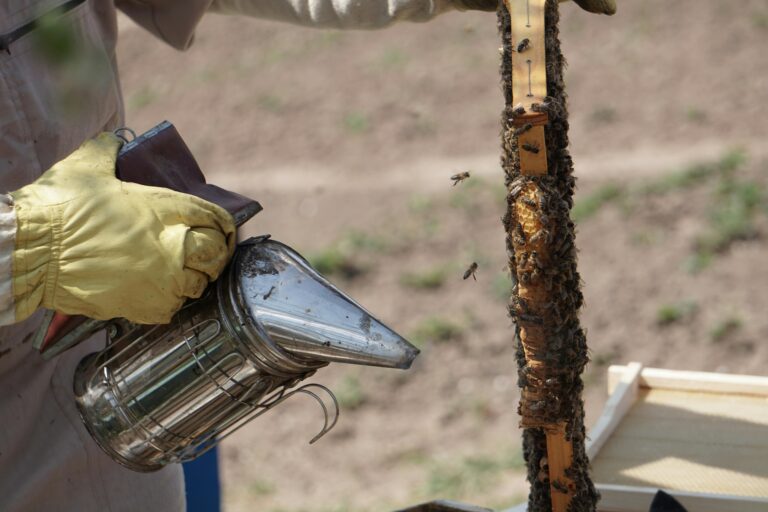
Apivar is Alberta’s most reliable late-summer Varroa treatment because its contact-based mechanism is not dependent on vapour evaporation or temperature-driven bee activity. Amitraz is released from the plastic strip matrix through slow diffusion — a process that continues at temperatures well below what formic acid or thymol require for effective evaporation. Even when Alberta nights drop to 3-5°C and bees are loosely clustered, those bees still contact Apivar strips during the warmth of the afternoon when they resume normal within-hive activity, picking up and distributing amitraz throughout the colony.
For Alberta, the ideal Apivar installation date is August 1-10 — the same day honey supers come off. This timing ensures the 42-56 day treatment cycle completes in mid-September, just before October wrapping begins. Strips installed later than August 20th may not complete their full cycle before colonies must be wrapped, leaving a proportion of mites untreated in colonies that are then sealed for 6 months.
Placement is critical in cold Alberta conditions: position both strips between the two most active brood frames in the centre of the brood nest — not near the outer wall. In Alberta August, bees cluster toward the centre of the brood nest during cold nights. Centrally placed strips maximize contact during both warm daytime activity and cold-night clustering behaviour.
Formic Pro — The Early August Window (August 1-15 Only)
Formic Pro’s key advantage over Apivar — penetration of capped brood to kill mites under the wax cappings — makes it a valuable early August tool for Alberta beekeepers dealing with high mite loads who need the fastest and most complete mite reduction available. A colony at 4%+ infestation benefits significantly from formic acid’s ability to kill reproducing mites inside sealed cells, which Apivar cannot reach until those cells open naturally over a 21-day brood cycle.
The Alberta window for Formic Pro is narrow: August 1-15, and only if the 14-day forecast shows nights consistently above 10°C. Below 10°C at night, formic acid evaporation from the pads slows significantly and — more importantly — bees begin partial clustering that prevents even distribution of vapour through the brood nest. The partial clustering problem is the more significant limitation in Alberta: a colony where bees cluster on central frames during cold nights will receive concentrated formic acid vapour in the cluster area and almost none on outer frames, dramatically reducing the whole-colony mite kill.
If your canola supers come off in the first week of August during a warm period with nights above 12°C, Formic Pro is an excellent choice for high-mite-load colonies — faster acting and more complete in the first cycle than Apivar. If nights have already dropped below 10°C or forecasts show cooling within the 14-day window — use Apivar without hesitation.
The Queen Loss Risk at Low Alberta Temperatures — An Additional Formic Pro Concern
The Canadian Formic Pro label specifies a minimum temperature as well as a maximum — and cold Alberta nights create a subtle but real additional risk. When formic acid evaporation slows due to cold nights, the treatment period extends unpredictably and unevenly. If a warm Alberta afternoon then follows several cold nights, acid that has accumulated in the hive can volatilize rapidly at higher-than-expected concentrations — creating brief spikes that stress or kill the queen even when daytime temperatures are technically within the label range. This temperature variability risk is unique to Alberta and the primary reason Apivar is recommended as the default August Alberta treatment even when early-month temperatures seem adequate for Formic Pro.
Oxalic Acid Vaporization — The Brood Break Option in Alberta
Oxalic acid vaporization is temperature-independent — it works at any Alberta August temperature because the acid is delivered as vapour from a heated vaporizer rather than relying on ambient temperature for evaporation. This makes it technically viable throughout Alberta’s August regardless of cold nights. However, its fundamental limitation applies equally in Alberta: it only kills mites on adult bees (phoretic mites), leaving all mites inside capped brood cells completely protected.
For Alberta beekeepers who have deliberately created a brood break split in early August for Varroa management purposes, oxalic acid vaporization on Day 9-11 of the broodless queenless half is a powerful single-treatment intervention — 90-95% mite kill in one application. This combined technique (brood break + oxalic acid) is the most aggressive single Varroa reduction method available in Alberta August, and is appropriate for colonies with mite loads above 4-5% where rapid reduction is critical before the winter bee generation is completely compromised.
For standard full colonies with active brood in Alberta August, oxalic acid vaporization as a standalone treatment is not recommended — the brood-protected mite reservoir will simply replenish phoretic mite populations within days. Use Apivar or Formic Pro for colonies with active brood.
The Alberta August Varroa Treatment Decision Guide
The Alberta Apivar Calendar — August Installation to October Wrapping
Why the Alberta Apivar Timeline Is Tighter Than Ontario
An Ontario beekeeper who installs Apivar on August 15th has 60+ days before October 15th wrapping — more than enough for the 42-56 day treatment cycle. An Alberta beekeeper installing Apivar on August 15th has approximately 45 days before October 1st wrapping — barely enough for the minimum 42-day cycle with no buffer for cold spells that slow treatment efficacy. Every day of August treatment delay in Alberta compresses the treatment cycle against a fixed October wrapping deadline that cannot be moved. Install Apivar August 1-10 and the calendar works perfectly. Install August 20th and you are already compromising treatment duration.
Final Thoughts on Late Summer Varroa Control in Alberta
Late summer Varroa control in Alberta is constrained by a climate that simply does not allow the luxury of choosing the theoretically optimal treatment at the theoretically optimal time. Alberta’s August nights decide the protocol, not the beekeeper’s preference. When nights stay above 10°C in early August — Formic Pro for high-mite-load colonies requiring brood penetration. When nights cool below 10°C or after August 15th — Apivar without hesitation or delay.
The beekeeper who installs Apivar on August 5th, removes strips on September 16th, confirms mite load below 1% with a post-treatment alcohol wash, and begins wrapping October 1st has given their Alberta colonies the strongest possible biological foundation for surviving the prairie winter. The beekeeper who delays — waiting for a more convenient time, a better treatment option, or clearer mite data — finds that the October wrapping deadline arrived before the treatment completed, and that the February colony collapse they are discovering was decided not by the cold, but by the mites that were allowed to reproduce unchecked in August when the window was still open. 🐝🪲🏔️❄️
Unsure which treatment fits your Alberta August conditions? 🐝
Ask our AI beekeeping assistant — describe your mite count, night temperatures, and current date and we’ll recommend the right Alberta Varroa treatment protocol for your specific situation.
🐝 Ask Bee Now — It’s Free🐝 WiseBee Disclosure
Affiliate Disclosure: This article contains Amazon affiliate links. If you purchase through our links, we earn a small commission at no extra cost to you. Learn more →
Disclaimer: This article is for educational purposes only and does not constitute professional apicultural or veterinary advice. Always consult a qualified beekeeper for guidance specific to your situation. Full disclaimer →