Varroa Mite Life Cycle: How Varroa Mites Reproduce and Spread
The parasite lives on your bees and inside your brood — and understanding where it is at any given moment is the foundation of every management decision
🔍 Quick Answers
📚 Varroa Management Series
📋 In This Article
Varroa destructor is the most significant parasitic threat to managed honey bee colonies in Canada and across most of the beekeeping world. Unlike most external parasites, Varroa cannot reproduce independently — it depends entirely on honey bee brood to complete its life cycle.
This dependence is both the mite’s vulnerability and its strength. It means Varroa populations are tied to the colony’s own brood cycle: they build as the colony raises young bees, and they slow when brood rearing stops. It also means that treatments designed to reach mites on adult bees cannot protect against mites concealed inside sealed cells.
Understanding where Varroa is in its cycle — on adult bees or inside capped brood — is the first step toward making informed decisions about monitoring and treatment timing. That is the purpose of this article.
1. What Is Varroa destructor?
How to Identify a Varroa Mite
Adult female Varroa mites are small, flat, oval-shaped parasites with a reddish-brown colour. They measure roughly 1–1.8 mm across — large enough to see with the naked eye on an adult bee or in an opened brood cell, but small enough to be overlooked without careful inspection.
Male mites are smaller and paler and are found only inside sealed brood cells. They die shortly after mating and are rarely observed by beekeepers.
Why Varroa Depends on Honey Bees
Varroa evolved in association with the Asian honey bee (Apis cerana) and was first identified in the western honey bee (Apis mellifera) in the mid-twentieth century. The western honey bee has not developed the same behavioural defences as its Asian relative, which is one reason Varroa has been so damaging to colonies worldwide.
The mite feeds on honey bees — both larvae and adults — and can only reproduce inside a sealed brood cell. Without access to honey bee brood, it cannot complete its life cycle. Adult mites that remain on bees without entering a brood cell do not reproduce and eventually die.
2. The Life Cycle: Four Key Stages
The Varroa life cycle alternates between two main phases: a phoretic phase on adult bees, and a reproductive phase inside capped brood cells. The term “phoretic” (from the Greek for carrying) refers to the mite being transported by the bee — though research has shown that mites also feed on adult bees during this phase, so they are not simply passive passengers.
Varroa Life Cycle — Four Stages
Stage 1 — Varroa Mites on Adult Bees
Between reproductive cycles, adult female mites ride on adult bees. They are most often associated with nurse bees — bees that tend brood — because these bees spend time in the brood nest, giving the mite access to cells that are about to be capped.
During this phase, mites can transfer between bees. They can also be carried into neighbouring colonies by drifting bees (bees that enter the wrong hive) or by robber bees (bees that enter a weaker colony to steal stores). This is one of the primary ways Varroa spreads between colonies and between apiaries.
An important caveat: during periods of abundant capped brood, a substantial proportion of the mite population is inside sealed cells rather than on adult bees. A sticky board count or visual check during peak brood season will only show the mites that happen to be in their phoretic phase — not the total population.
Stage 2 — Entering a Brood Cell
A female mite enters a brood cell containing a nearly mature larva, shortly before worker bees cap the cell. She hides in the larval food at the bottom of the cell. Once the cell is sealed, the mite moves to the developing bee and begins feeding.
This transition into a capped cell is the point at which the mite becomes inaccessible to treatments that act on mites present on adult bees — including oxalic acid in standard vaporization or trickling form.
Stage 3 — Feeding and Reproduction Inside the Capped Cell
Once the cell is sealed, the foundress mite begins feeding on the developing bee and laying eggs. The sequence inside the cell follows a consistent pattern:
- The foundress lays a first (unfertilized) egg, which develops into a male mite.
- Subsequent eggs develop into female mites.
- The male and female offspring develop through nymphal stages to adulthood.
- Mating occurs inside the sealed cell between the male and his sisters.
Not every egg produces a successfully reproducing daughter. The number that reach maturity and emerge from the cell as viable, mated females depends on the length of the capped period and the specific conditions inside the cell. Not every reproductive cycle results in the same number of surviving offspring.
Stage 4 — Mites Emerge With the Adult Bee
When the adult bee chews through the cell cap and emerges, the foundress mite and any mature mated daughters leave the cell with her. These mites move onto adult bees and will eventually seek a new brood cell to repeat the cycle.
Male mites die inside the cell after mating and do not emerge. Immature females that have not yet completed development may also die inside the cell.
3. Worker Brood vs. Drone Brood: Why the Difference Matters
Why Varroa Preferentially Uses Drone Brood
When drone brood is available, Varroa mites enter drone cells at a higher rate than worker cells. The reason is developmental timing: drone brood remains capped for longer than worker brood, giving Varroa offspring more time to develop and successfully mate before the adult bee emerges.
| Feature | Worker Brood | Drone Brood |
|---|---|---|
| Typical capped period | Approximately 12 days | Approximately 14–15 days |
| Varroa reproductive opportunity | More limited — less time for offspring to mature | Greater — longer window for offspring development |
| Mite preference | Used for reproduction when drone brood is absent | Preferred when available |
| Potential surviving daughters per cycle | Generally fewer (averages of 1–2 reported in research) | Generally more (averages of 2–3 reported in research) |
The figures above are averages drawn from research, not guaranteed outcomes. Actual numbers per reproductive cycle depend on the foundress mite, brood conditions, and whether offspring development is completed before the bee emerges.
What This Means for Beekeepers
The Varroa preference for drone brood has two practical implications. First, examining drone brood — by uncapping a section of drone cells and inspecting for mites — can be an informative way to detect mite presence, because drone cells are likely to contain a higher proportion of infested cells than worker cells.
Second, removing capped drone brood before it emerges (drone brood removal) is sometimes used as a management tool. The Ontario government’s treatment guidance lists it as a cultural control method that can support a broader Varroa management plan. It should not be used as a substitute for monitoring or for other control strategies — it can reduce the mite’s reproductive opportunities but cannot eliminate an established mite population on its own.
4. How the Mite Population Grows with the Brood Cycle
When the Colony Is Raising Abundant Brood
More capped brood means more available reproductive sites for Varroa. Each successful reproductive cycle adds mated female mites to the colony’s population. If Varroa is not adequately controlled, the population can increase steadily through the spring and summer brood season, reaching its seasonal peak in late summer when colony brood rearing is still active but beginning to wind down.
This is why a mite count taken early in the season may look reassuringly low, while a count taken in August can reveal a much higher level — the population has been compounding with each brood cycle.
What Happens When Brood Production Declines
As autumn approaches and the colony reduces brood rearing, fewer new cells are available for mite reproduction. Mites that cannot enter a brood cell remain on adult bees in their phoretic phase. With no new reproductive cycles possible, the mite population stops growing — but it does not immediately decline.
A colony entering winter with a high mite load carries those mites into the broodless period. This is significant because the adult bees that form the winter cluster — the bees that must survive until spring — were raised alongside those mites during the late-summer brood cycle. Their health at the time they were developing as pupae determines how well they function as winter bees.
Why Seasonal Timing Differs Across Canada
The timeline of brood rearing and its seasonal decline varies significantly across Canada. In Alberta and the Prairie provinces, colonies typically cease brood rearing earlier in autumn and may be broodless by November. In British Columbia’s Fraser Valley or in southern Ontario, some colonies may carry brood later into the season. The timing also depends on the colony’s genetics and local conditions.
5. How Varroa Damages Honey Bees
Feeding on Developing and Adult Bees
Varroa feeds on honey bees during both the reproductive phase (inside capped cells) and the phoretic phase (on adult bees). Research has clarified that the mite’s primary feeding target is the bee’s fat body — a tissue involved in energy metabolism, immune function, and the production of proteins important for brood rearing and overwintering.
This is a revision of earlier descriptions that characterized Varroa primarily as feeding on haemolymph (bee blood). The fat body connection is significant because it helps explain why mite infestation can impair bees in ways that go beyond what a simple external wound would cause.
Varroa and Honey Bee Viruses
Varroa is associated with the transmission of several honey bee viruses. The most studied of these is Deformed Wing Virus (DWV), which can cause bees to emerge with crumpled or vestigial wings — a visible sign of severe infestation. Other viruses linked to Varroa infestation include Sacbrood virus and several others that affect bee development and longevity.
The relationship between Varroa and viruses is not simply one of mechanical transmission. Research has shown that Varroa can amplify viral titre in affected bees, meaning that infested bees may carry a higher viral load than uninfested bees in the same colony.
Why Winter Bees Are Especially Vulnerable
Worker bees raised in late summer and autumn — the generation that must carry the colony through winter — have a physiologically distinct profile from summer bees. They are longer-lived, have more developed fat bodies, and play a critical role in feeding developing brood and maintaining cluster warmth through the coldest months.
High Varroa infestation during the period when winter bees are being raised can compromise their fat body development and shorten their effective lifespan. A colony that loses its winter bees to Varroa-related damage before spring arrives cannot recover — there is no new generation of workers to replace them until brood rearing resumes and the first spring bees emerge.
This is why autumn Varroa management — the focus of Part 3 of this series — is considered one of the most critical interventions in the annual beekeeping calendar.
6. Can You See Varroa Without Testing?
Why Visual Inspection Is Not Enough
It is possible to see Varroa mites without any equipment — a large, reddish-brown mite on a pale adult bee is visible to the naked eye. Some beekeepers spot them on bees held against a light background, or notice them while uncapping cells. Deformed Wing Virus — causing bees to emerge with shrivelled wings — is another visible indicator of significant infestation.
However, the absence of visible mites does not mean a colony is uninfested. During peak brood season, the majority of mites in a heavily infested colony can be inside sealed cells, invisible to the beekeeper. A colony can look and behave normally while carrying a mite load that will cause serious problems for the winter generation of bees.
Validated Monitoring Methods
Beekeepers use several methods to estimate Varroa infestation levels. Each has different characteristics:
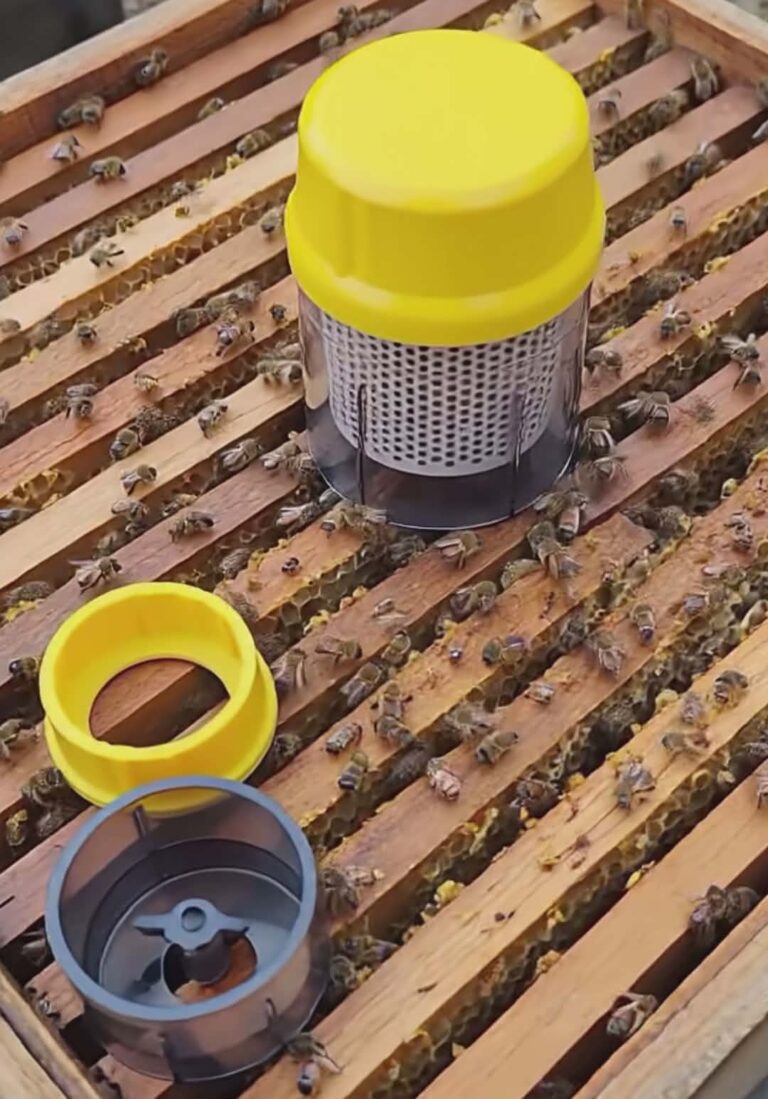
- Alcohol wash: A sample of adult bees is placed in alcohol, which causes mites to separate from the bees. The mites are then counted and expressed as a percentage of the bee sample. This is one of the most accurate methods for estimating the phoretic mite load.
- Sugar roll: A non-lethal alternative to the alcohol wash. A bee sample is rolled in icing sugar, which causes mites to dislodge. Less accurate than alcohol wash but does not kill the bees.
- Sticky board: A board coated with an adhesive placed beneath a screened bottom board collects mites that fall naturally from bees. The count is expressed as mites per day. Useful for detecting mite presence and tracking trends, but more difficult to use for estimating absolute infestation levels compared to an adult bee sample.
- Drone brood inspection: Uncapping a section of drone brood and examining cells for mites. Provides a qualitative sense of infestation and can reveal mite presence, but is more variable than a standardized adult bee sample.
7. What the Life Cycle Means for Management
The biology of Varroa’s life cycle has direct implications for how management decisions are made. This section summarizes the key takeaways — the treatment details belong in Parts 3 and 4.
- Varroa reproduces inside capped brood. A treatment that acts on mites on adult bees cannot reach mites inside sealed cells. The proportion of the population that is accessible depends on how much brood is present.
- The mite population changes over the season. A single mite count in spring or early summer does not represent the colony’s infestation level in August. Regular monitoring throughout the season gives a more accurate picture.
- Drone brood offers more reproductive opportunities. When drone brood is present, mite populations can grow more quickly. Drone brood management can be part of an integrated strategy.
- Monitoring requires validated methods. Visual inspection alone cannot establish infestation level. An alcohol wash or equivalent method is the standard approach for generating a count that can be compared against threshold guidelines.
- Treatment timing matters. The most effective window for certain treatments is when mite exposure to the active compound is highest. Understanding the brood cycle — and specifically when the colony is broodless or near-broodless — helps identify that window.
8. Frequently Asked Questions
How long does the Varroa mite life cycle take?
Why does Varroa prefer drone brood over worker brood?
Do Varroa mites live on adult bees?
Can a hive have Varroa mites even if I cannot see any?
Does Varroa stop reproducing when the colony has no brood?
The next step is learning how to measure mite levels accurately before deciding whether and when to act.
📚 Continue the Varroa Series
🔗 Related WiseBee Guides
Ready to check your mite levels?
Part 2 covers how to do an alcohol wash, how to read a sticky board, and how to interpret results using current Canadian guidelines.
Read Part 2: Monitoring →Sources & Further Reading
- Ontario Government — Varroa Mites: Life Cycle and Management Overview
- USDA Agricultural Research Service — Varroa Mite Life Cycle and Reproduction
- UF/IFAS Extension — Varroa Mite Identification and Life Cycle
- Michigan State University — Varroa Mite Reproductive Biology
- Canadian Food Inspection Agency — Honey Bee Producer Biosecurity Guide
- PMC Research — Varroa, DWV, and Winter Bee Longevity
WiseBee is a participant in the Amazon Associates Program. Links to Amazon in this article include an affiliate tag; WiseBee may earn a commission on qualifying purchases at no additional cost to you. All product recommendations are independent of affiliate arrangements. Amazon.ca links automatically redirect users to their local Amazon store.
🐝 WiseBee Disclosure
Affiliate Disclosure: This article contains Amazon affiliate links. If you purchase through our links, we earn a small commission at no extra cost to you. Learn more →
Disclaimer: This article is for educational purposes only and does not constitute professional apicultural or veterinary advice. Always consult a qualified beekeeper for guidance specific to your situation. Full disclaimer →