Complete Varroa Treatment Guide
for Ontario Beekeepers (2026)
📋 In This Article
- Why Ontario’s Calendar Is Different
- Mite Thresholds — When to Treat (OMAFRA Guidelines)
- Monitoring Methods: Alcohol Wash vs Sticky Board
- Spring Treatment — April (Pre-Honey Flow)
- Summer/Fall Treatment — August (The Critical Phase)
- Winter Cleanup — November/December (Broodless Period)
- Full Treatment Comparison Table
- Treatment Rotation & Resistance Prevention
- Safety Equipment — Non-Negotiable
- Products on Amazon Canada
- FAQ — Ontario Beekeepers’ Most Common Questions
Varroa destructor is the single greatest threat to Ontario beehives — and managing it in Canada requires a completely different calendar than beekeepers in warmer climates follow. Ontario’s long winters mean your “winter bees” must be 100% healthy from August onwards. Miss the late summer treatment and your colony may not survive to see April.
Why Ontario’s Calendar Is Different
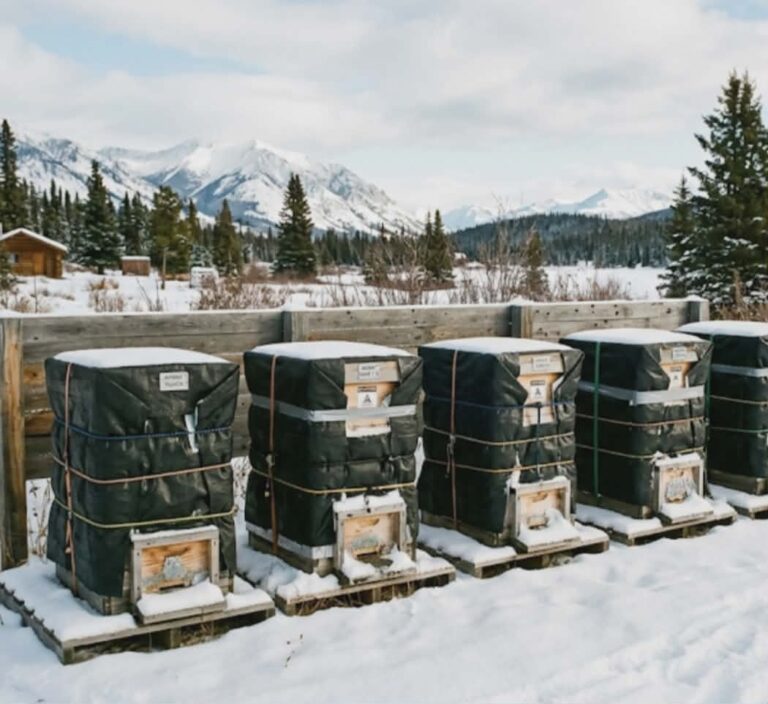
Beekeeping in Ontario operates on a tighter timeline than almost anywhere else in North America. The active beekeeping season runs roughly from late April to early October — only about 5 months. Compare that to beekeepers in the southern US who may have 9–10 months of active season, and you begin to understand why every treatment window in Ontario matters enormously.
The most critical insight for Ontario beekeepers: the bees that will survive your winter are born in August and September. These so-called “winter bees” have a different physiology than summer bees — they live 4–6 months instead of 6 weeks, and they’re the ones that will maintain the winter cluster and raise the first spring brood.
The Ontario Winter Bee Problem
If Varroa mites parasitize your August and September brood, the resulting winter bees will be weakened, short-lived, and unable to maintain the cluster through a Canadian winter. A colony that looks healthy in October can be dead by January — not from cold, but from Varroa damage to its winter bee population. This is why the late summer treatment is the most important of the year in Ontario.
Ontario’s weather is also, as any local beekeeper will tell you, a roller coaster — particularly in April and May. This directly affects which treatments are safe and effective at different times of year, since formic acid-based treatments have strict temperature requirements that Ontario’s volatile spring weather makes difficult to manage.
OMAFRA & OBA Guidelines
The Ontario Ministry of Agriculture, Food and Rural Affairs (OMAFRA) and the Ontario Beekeepers’ Association (OBA) both publish Integrated Pest Management (IPM) guidelines for Varroa. All treatments mentioned in this article are approved by the Canada Food Inspection Agency (CFIA) for use in Canada. Always follow label directions — using treatments off-label is illegal in Canada.
Mite Thresholds — When to Treat (OMAFRA Guidelines)
Treating based on calendar dates alone is not sufficient — you need to monitor your actual mite levels and treat based on thresholds. OMAFRA and the OBA recommend the following intervention thresholds for Ontario:
Spring threshold (April–June): Treat if alcohol wash shows 2 or more mites per 100 bees.
Late summer threshold (July–August): Treat if alcohol wash shows 3 or more mites per 100 bees. This is your most critical window.
Monitoring Methods: Alcohol Wash vs Sticky Board
Alcohol Wash (Recommended — Most Accurate)
The alcohol wash is the gold standard for Varroa monitoring recommended by OMAFRA and the OBA. Collect approximately 300 bees (about half a cup) from a brood frame — not the queen — into a jar of isopropyl alcohol or windshield washer fluid. Shake for 60 seconds, pour through a mesh strainer, and count the mites that fall through. Divide mite count by 3 to get mites per 100 bees.
Sticky Board / Mite Drop (Easier — Less Precise)
A sticky board slides under a screened bottom board and catches mites that naturally fall off bees over 24–72 hours. Count the mites and divide by the number of days to get a daily mite drop.
WiseBee Tip: Use Both Methods Together
Use a sticky board for ongoing monthly monitoring — it’s quick and non-lethal. When the sticky board shows a rising trend, follow up with an alcohol wash to get an accurate percentage before deciding on treatment.
Spring Treatment — April (Pre-Honey Flow)
In Ontario, April is a “do or die” month for Varroa management. As the queen ramps up egg-laying for the dandelion and fruit tree flow, mite populations explode alongside brood production. A colony that starts April with even a moderate mite load will be in serious trouble by June.
Ontario’s spring weather — that famous roller coaster — limits your treatment options. Temperature-sensitive treatments like formic acid can be dangerous when April swings between 0°C nights and 20°C afternoons. This is why Apivar is the dominant spring treatment choice across Ontario.
Apivar is the most reliable spring treatment in Ontario precisely because it works regardless of temperature. Two strips are placed between brood frames for 42–56 days, slowly releasing amitraz that kills phoretic mites on contact.
Golden Rule: Apivar strips must be removed at least 2 weeks before honey supers are added. Plan backward from your expected super date.
Treatment Rotation — Don’t Use Apivar Every Year
Varroa mites in Ontario have shown increasing resistance to amitraz (Apivar) when used as the sole treatment year after year. The OBA recommends a maximum of two consecutive Apivar treatments before switching.
Formic Pro is the only CFIA-approved treatment that penetrates capped brood cells and kills mites reproducing inside. It also leaves no chemical residues in wax or honey.
Ontario temperature warning: Formic acid is ineffective below 10°C and dangerous to queens above 30°C. Always check the 14-day forecast before applying.
Oxalic acid dribble in spring is an emergency option when mite counts are high but brood is already present. It kills phoretic mites but cannot reach mites inside capped brood cells.
Use this in April only if you missed the late fall broodless treatment. Follow up with Apivar or Formic Pro for a complete treatment.
Summer/Fall Treatment — August (The Critical Phase)
This is the most important treatment of the entire Ontario beekeeping year. The late summer treatment, applied in August immediately after the last honey harvest, directly protects the winter bees being raised in August and September.
A colony that enters October with a high mite load has already lost its fight for winter survival. No amount of feeding or insulation will compensate for Varroa-damaged winter bees.
Formic Pro is the preferred late summer treatment because it penetrates capped brood cells — killing mites where they reproduce. In August, when colonies have heavy brood, this is crucial.
August temperatures in Ontario are usually within Formic Pro’s effective range (10–25°C), though heat waves above 30°C are increasingly common. Monitor the forecast carefully and postpone treatment during heat waves to protect your queen.
Thymovar uses thymol — the active component of thyme essential oil — to control Varroa. It’s a good rotation option for beekeepers wanting to alternate away from Formic Pro or Apivar.
Best used in August when temperatures are reliably in the 15–25°C range. Remove honey supers before application — thymol can taint honey with a herbal flavor at high concentrations.
Winter Cleanup — November/December (Broodless Period)
The broodless period in late fall — typically November in most of Ontario — offers the single most effective window for oxalic acid treatment. A single well-timed treatment can reduce mite loads by 95% or more.
Vaporization heats oxalic acid crystals until they turn to gas, which penetrates every part of the hive. It’s faster than dribbling, more effective, and doesn’t require opening the hive in cold weather.
For Ontario beekeepers, aim for the first week of November when outdoor temperatures are consistently below 10°C but above -10°C.
Safety Equipment is Non-Negotiable for Oxalic Acid
Oxalic acid vapour is extremely hazardous to your lungs and eyes. Always wear: a full-face respirator with acid gas cartridges (minimum N95 standard), chemical-resistant gloves, and eye protection. Do not vaporize in enclosed spaces.
Full Treatment Comparison Table — Ontario Season Guide
| Treatment | Best Month | Temp Range | Kills in Brood | With Supers | Type |
|---|---|---|---|---|---|
| Apivar (Amitraz) | April | Any ✅ | Partial | No | Chemical |
| Formic Pro (Spring) | April–May | 10–25°C ⚠️ | Yes | Yes | Organic |
| Formic Pro (Summer) | August | 10–25°C ⚠️ | Yes | Yes | Organic |
| Thymovar | Aug–Sep | 15–30°C ⚠️ | Partial | No | Natural |
| Oxalic Acid (Dribble) | Nov–Dec | Above 0°C ✅ | No | No | Organic |
| Oxalic Acid (Vapour) | Nov–Dec | Above -10°C ✅ | No (broodless) | No | Organic |
| Apistan (Fluvalinate) | — | Any | No | No | ⚠️ Resistance |
Treatment Rotation & Resistance Prevention
Varroa mites can develop genetic resistance to chemical treatments — particularly to synthetic acaricides like amitraz (Apivar) and fluvalinate (Apistan). Apistan resistance is already widespread in Ontario mite populations.
Apistan (fluvalinate) has become ineffective across much of Ontario due to decades of resistance development. The OBA and OMAFRA strongly advise against relying on it as your primary treatment in 2026.
Recommended Ontario Rotation Schedule
Year 1: Spring → Apivar | Summer → Formic Pro | Winter → Oxalic Acid Vapour. Year 2: Spring → Formic Pro | Summer → Thymovar | Winter → Oxalic Acid Vapour. Year 3: Return to Year 1.
Safety Equipment — Non-Negotiable
Varroa treatments — particularly organic acids — require proper personal protective equipment (PPE). This is not optional in Canada.
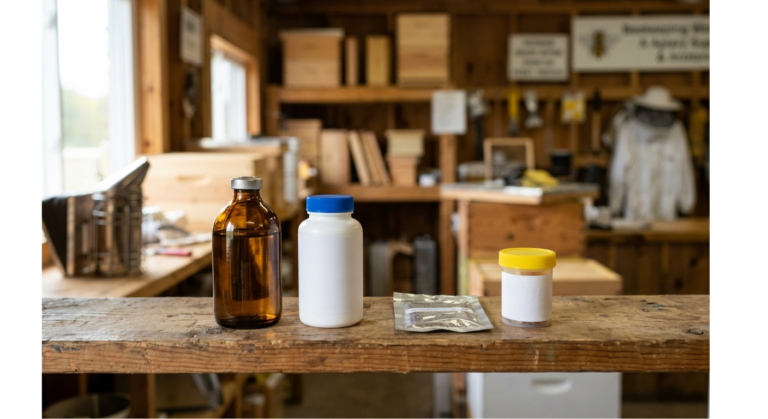
All Treatment Products on Amazon Canada
FAQ — Ontario Beekeepers’ Most Common Varroa Questions
The most critical treatment in Ontario occurs in late August, immediately after the summer honey harvest is complete. This protects the “winter bees” — the bees born in August and September who will maintain the winter cluster until spring. A second “cleanup” treatment with oxalic acid is recommended in November or December when the colony has no capped brood.
A third treatment in April addresses spring mite buildup before the dandelion and fruit tree flow.
Yes — according to CFIA regulations in Canada, Formic Pro is one of the few approved treatments that can be applied while honey supers are on the hive, because it leaves no chemical residues in wax or honey.
However, be cautious with temperatures above 30°C — which are increasingly common in Ontario summers. Temperatures above 30°C during Formic Pro treatment can cause queen mortality and brood damage.
In Ontario, OMAFRA and the OBA recommend treatment if an alcohol wash shows more than 2 mites per 100 bees in spring, or 3 mites per 100 bees in late summer (July–August). If you exceed 3 mites per 100 bees in August, treatment is urgent.
Over the past two decades, Varroa mites in Ontario and across Canada have developed significant genetic resistance to fluvalinate — the active ingredient in Apistan. Most Ontario beekeeping associations no longer recommend Apistan as a primary treatment.
Instead, rotate between organic acid treatments (Formic Pro, Oxalic Acid) and amitraz-based products (Apivar) to prevent resistance to any single treatment class.
Absolutely yes. Oxalic acid vaporization is extremely hazardous to the respiratory system and eyes. In Ontario’s often damp, cool conditions, inhaling oxalic acid vapour is particularly dangerous and can cause permanent lung damage.
Always use: a full-face respirator with acid gas cartridges rated for oxalic acid (minimum N95, preferably P100 with OV/P100 combination cartridges), chemical-resistant gloves, and splash-proof eye protection. Never vaporize in a closed space like a garage or barn.
Final Thoughts
Varroa management in Ontario is not a single event — it’s a year-round Integrated Pest Management program with three distinct treatment windows, each serving a specific purpose. Monitor monthly, treat when thresholds are exceeded, rotate your treatments to prevent resistance, and never skip the August treatment.
The Ontario beekeepers who consistently overwinter strong colonies are not the ones with the most expensive equipment or the most hives — they’re the ones who take Varroa seriously, monitor regularly, and act decisively when counts are high. Make 2026 the year you get ahead of it. 🐝🍯
Not sure which treatment to use? 🐝
Ask our AI beekeeping assistant — tell us your mite count, the current month, and your hive setup and we’ll recommend the right treatment for your Ontario colony.
🐝 Ask Bee Now — It’s Free🐝 WiseBee Disclosure
Affiliate Disclosure: This article contains Amazon affiliate links. If you purchase through our links, we earn a small commission at no extra cost to you. Learn more →
Disclaimer: This article is for educational purposes only and does not constitute professional apicultural or veterinary advice. Always consult a qualified beekeeper for guidance specific to your situation. Full disclaimer →