Best Beehive Winter Wraps:
Insulating Your Hive for Cold Winters
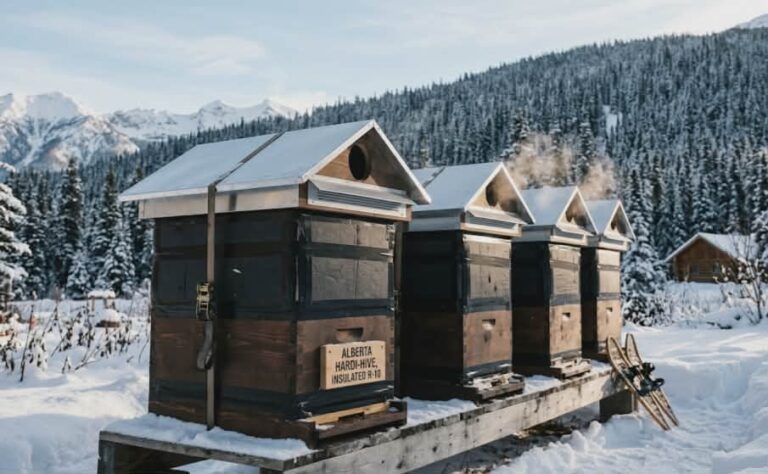
There is no single best wrap for every hive — the right choice depends on your hive configuration (8 or 10 frame, single or double deep), your local winter severity, wind exposure, and ventilation setup. For most beekeepers overwintering wooden Langstroth hives outdoors in cold continental climates (Canadian Prairies, Upper Midwest, Northern Plains, Northeast US), an insulated polypropylene wrap such as the Bee Cozy is the most widely used and practically verified option. It provides both wind protection and meaningful insulation (R8 fibreglass inner layer), fits standard Langstroth equipment, and is reusable for multiple seasons. For milder cold-climate winters or sheltered locations, a Velcro-closure insulated vinyl wrap with R4–R5 insulation is a practical lower-cost alternative. DIY foam panels covered in polyethylene are a viable option when standard wrap sizes don’t fit or when insulating groups of hives.
In cold climates — sustained temperatures below -10°C (14°F), significant wind exposure, or prolonged winter confinement periods — wrapping wooden Langstroth hives reduces heat loss and lowers the energy cost of maintaining cluster warmth. This translates directly into less honey consumed through winter and a stronger colony in spring. Research confirms that hive covers reduce food consumption and improve overwinter survival. That said, a wrap is not a substitute for adequate winter stores, low Varroa loads, a healthy queen, and a strong enough cluster to generate warmth. In milder climates (USDA Zone 6 and warmer) or where hives are well-sheltered from wind, wrapping may not produce a measurable benefit and is generally not standard practice.
Zone 3 covers extreme winter cold — average annual minimum temperatures of -40°C to -34°C (-40°F to -30°F). This includes northern Minnesota, northern Wisconsin’s Northwoods, Montana’s mountain regions, and most of the Canadian Prairies. In these conditions, maximum insulation is appropriate for outdoor-wintered wooden Langstroth hives. The Bee Cozy’s R8 fibreglass inner layer is the most commonly used commercial option at this severity. For additional protection, some beekeepers in Zone 3 also add top insulation (a quilt box or insulated inner cover) alongside the lateral wrap. Groups of four hives sharing a block of rigid foam insulation is another documented approach used in the Canadian Prairies for this climate range. However, no wrap level overcomes inadequate stores or high Varroa — colony preparation matters more than the R-value of the wrap.
Zone 4 covers average annual minimum temperatures of -34°C to -29°C (-30°F to -20°F) — including much of Minnesota, Wisconsin, Michigan’s Upper Peninsula, Vermont, Maine, New Hampshire, upstate New York, and central Canada. In Zone 4, an insulated polypropylene wrap (Bee Cozy or equivalent with R4–R8) is standard for exposed outdoor hives. Wind protection matters as much as insulation in this zone: a well-insulated wrap on a hive in a naturally sheltered location with established windbreaks often performs comparably to a higher-rated wrap in an exposed position. Top insulation above the cluster is a worthwhile addition in Zone 4, particularly for single-story configurations where the cluster is closer to the cold overhead surface.
Zone 5 covers average annual minimum temperatures of -29°C to -23°C (-20°F to -10°F) — including southern Minnesota, southern Wisconsin, Ohio, Pennsylvania, northern Indiana, central New York, and Ontario’s more moderate regions. In Zone 5, whether to wrap depends strongly on hive placement and local conditions. A sheltered apiary with natural or built windbreaks may not require heavy insulation wrapping. An exposed location on open ground benefits from it. If wrapping, a mid-range insulated wrap (R4–R5) is generally adequate for Zone 5 conditions, though an R8 product is never a disadvantage and may be preferred for beekeepers who use the same wrap across multiple locations or climates. Zone 5 is also where indoor overwintering (cold room or cellar) becomes a practical option some commercial beekeepers use instead of outdoor wrapping.
A wrap can contribute to condensation problems if it is installed in a way that blocks the hive’s ventilation. A winter colony produces heat, water vapour, and CO₂ that must have a route to escape. If the wrap covers both the lower entrance and any upper entrance or ventilation opening, moisture accumulates inside. This is why every well-designed commercial wrap includes a pre-cut entrance opening, and why installation instructions emphasize keeping both upper and lower entrances clear. The wrap itself — polypropylene, vinyl, or foam — does not generate condensation; it is sealing the ventilation that does. Pair any lateral wrap with intact upper ventilation (quilt box vents, inner cover notch, or a small upper entrance) and the condensation risk is no greater than with an unwrapped hive.
📋 In This Article
- How Winter Beehive Wraps Work
- What Type of Winter Wrap Is Best for Your Hive?
- How Climate Affects Your Wrap Choice
- What to Look for When Buying
- Best Beehive Winter Wraps — Reviewed
- Bee Cozy Winter Wrap — Detailed Review
- Winter Wraps Compared
- Commercial Wrap vs. DIY Insulation
- Using a Wrap Without Creating Moisture Problems
- Do You Need Top Insulation Too?
- Common Winter Wrap Mistakes
- Which Winter Wrap Is Best for You?
Winter wraps work. Research confirms that covered hives consume less food and show higher overwinter survival than uncovered controls — even in areas not subject to extreme cold. But there is no single best wrap for every beekeeper. What works depends on your hive’s configuration, your local winter severity, your wind exposure, and the ventilation setup already in place.
How Winter Beehive Wraps Work
A wooden Langstroth hive body provides minimal insulation against sustained cold. The winter cluster generates its own heat by metabolizing honey stores, but thin wooden walls dissipate that heat rapidly to the surrounding air. A winter wrap reduces this heat loss by adding an insulating and wind-resistant layer around the exterior — the cluster’s generated warmth stays inside longer, which directly reduces the rate at which stores are consumed.
Reduces These Risks
- Slows heat loss through the hive walls
- Reduces wind-driven cold penetration
- Protects the hive exterior from weather and ice
- Lowers honey consumption rate through winter
- Works alongside top insulation and ventilation
Cannot Replace These
- Adequate winter food stores
- A strong enough cluster to generate heat
- Varroa and disease management
- Upper ventilation — wraps must not seal the hive
- A healthy laying queen going into fall
A Wrap Amplifies Good Preparation — It Doesn’t Replace It
A wrap on a colony with low Varroa, adequate stores, and a strong cluster is a meaningful advantage through a cold winter. The same wrap on a colony entering winter with high mite loads and depleted stores will not change the outcome. Prioritize colony preparation first; the wrap choice is the last decision, not the first.
What Type of Winter Wrap Is Best for Your Hive?
UV-treated polypropylene exterior with a fibreglass or aerofoil inner insulating layer. Pre-sized for Langstroth 8 and 10 frame equipment. The Bee Cozy (R8) is the leading example. Reusable 3–5+ seasons. Entrance opening built in. Quick to install.
Vinyl or fabric exterior with an inner foam insulating layer, typically R4–R5. Velcro or snap closure. Available in 8 and 10 frame. Lower cost per hive than premium poly wraps. Entrance opening included in most models.
Bubble-style or foil-faced layered insulation cut and wrapped around the hive. Flexible and cuttable to any size. More useful as a supplement than as a primary insulation system in severe cold. Entrance must be cut to size.
Rigid foam (Styrofoam or extruded polystyrene) cut to hive dimensions, covered with polyethylene or tar paper. Configurable R-value by foam thickness. Well-documented practice in Canadian Prairie operations. Requires cutting, fitting, and securing each season.
How Climate Affects Your Winter Wrap Choice
USDA Plant Hardiness Zones describe average annual extreme minimum temperatures — a useful starting point for wrap selection. Note that zones reflect temperature extremes, not duration of cold or wind exposure, which are equally important for hive winter management. A Zone 4 hive on open prairie with sustained winds needs more wind protection than a Zone 4 hive in a sheltered woodland location.
Northern Prairies, northern Minnesota, Montana mountains, Northwoods. Maximum insulation warranted. Bee Cozy R8 or DIY foam blocks standard. Top insulation strongly recommended alongside lateral wrap.
Wisconsin, Michigan UP, Vermont, Maine, Ontario north, central Canada. Insulated commercial wrap standard. Wind protection as important as R-value. Top insulation adds meaningful benefit.
Southern Minnesota, Ohio, Pennsylvania, upstate New York, southern Ontario. Wrapping beneficial for exposed hives; sheltered hives with windbreaks may manage without. R4–R5 adequate in most cases.
Wind Exposure Matters as Much as Temperature
A hive on open flat ground in Zone 5 with constant wind can lose more cluster warmth than a hive in a sheltered Zone 3 location with a good windbreak. When selecting a wrap, consider both the temperature range and the wind conditions at your specific apiary location. A natural windbreak — dense conifers, a hill, a building — on the prevailing wind side reduces wind-chill effect significantly and works alongside any wrap you install.
What to Look for When Buying a Beehive Winter Wrap
🌡️ Insulation Value (R-value)
Products that state an R-value allow comparison. Confirm whether the listing includes an inner insulating layer — a plain black polypropylene sleeve with no inner layer is a wind barrier, not an insulator. R4–R5 suits moderate cold; R8 suits severe cold and exposed locations.
💨 Wind Resistance
The wrap material and closure system must withstand your local winter winds without shifting. Velcro can loosen; overlapping seams held by the wrap’s tension tend to stay in place. Check reviews for reports of wraps coming loose in wind events.
📐 Hive Fit — Measure First
8-frame and 10-frame wraps are not interchangeable. Single-storey (one deep) and double-storey (two deeps) wraps are sized differently. A loose wrap creates gaps; an undersized wrap tears. Measure your hive’s exterior dimensions before ordering.
🌬️ Entrance and Vent Access
The wrap must leave the lower entrance, any upper entrance, and quilt box vents unblocked after installation. Verify that the entrance opening in the product description aligns with your hive’s entrance position. A blocked entrance is worse than no wrap.
💧 Moisture Resistance
The outer layer must resist water absorption through the winter. Polypropylene and vinyl exteriors handle this well. Natural fibre materials become heavy and lose insulating value when wet — avoid them as outer layers.
♻️ Reusability — Cost Per Season
Calculate cost per season per hive, not just purchase price. A $50 wrap used for 5 seasons costs $10/season. Annual tar paper at $5/hive costs $5/season but requires labour each year. At scale, labour cost often favours the reusable wrap.
Best Beehive Winter Wraps — Reviewed
Made by NOD Apiary Products in Canada, the Bee Cozy is the most widely used purpose-built winter hive wrap in North American cold-climate beekeeping. Its construction combines a UV-treated polypropylene outer shell with an R8 fibreglass inner insulating layer. It is not neoprene and not plain plastic — the R8 fibreglass layer is what distinguishes it from simpler black sleeve wraps. The product has been in use for over 25 years and is specifically designed for standard Langstroth equipment under Canadian and northern US winter conditions.
It comes in four configurations (1-storey and 2-storey × 8-frame and 10-frame) and includes an inner cover pad that provides some above-cluster insulation. Installation is simple: roll air out, slide over the hive with the seam facing front, and the seam opening creates the entrance tunnel without any cutting required. The wrap is reusable for multiple seasons when stored properly between winters.
✓ Advantages
- Highest insulation rating among commercial wraps (R8)
- Purpose-designed for cold-climate Langstroth equipment
- Includes inner cover pad for above-cluster insulation
- No cutting required — seam creates entrance opening
- Reusable for multiple seasons
- Available for 8 and 10 frame, single and double deep
— Limitations
- Higher upfront cost than simpler alternatives
- If mice damage the wrap, moisture enters the insulating layer
- Must select exact version — 8 and 10 frame are not interchangeable
- Primarily designed for two-story configurations; single-storey version fits one deep only
Several manufacturers produce insulated hive wraps with Velcro closures and vinyl or heavy fabric exteriors backed by a foam insulating layer rated at R4 or R5. These wraps are designed to cover two standard deep boxes, fit 8-frame or 10-frame equipment, and install in a few minutes. The Velcro closure allows mid-winter adjustment and spring removal without cutting or wrestling the wrap off the hive.
R4–R5 provides meaningful insulation for Zone 4–5 conditions and is adequate for many Zone 3 locations when the hive is in a sheltered position with good windbreak protection. It is a lower cost option than the Bee Cozy, and the trade-off is primarily the lower insulation rating and the need to ensure the Velcro holds firmly through winter wind events. Check and retighten the closure after any significant wind or ice storm. Verify that the entrance opening aligns with your specific hive body before ordering — position varies between products.
✓ Advantages
- Lower cost than premium polypropylene wraps
- Velcro closure — easy to adjust mid-winter
- R4–R5 insulation — genuine thermal value
- Available in 8 and 10 frame sizes
- Reusable for multiple seasons
— Limitations
- Lower insulation than Bee Cozy (R4–R5 vs R8)
- Velcro can loosen in strong wind — check after storms
- No included inner cover pad
- Entrance opening position varies by product — verify fit
Tar paper (15 lb roofing felt) has been used to wrap beehives for well over a century. It is inexpensive, available at every hardware store, and straightforward to apply. Black tar paper absorbs some solar heat on sunny winter days, and stapling it tightly around the hive body seals cracks and chinks where cold air enters. For these reasons it remains in common use, particularly among beekeepers managing larger numbers of hives where cost per hive matters significantly.
The important limitation is that tar paper is primarily a wind barrier, not a thermal insulator. It does not have a meaningful R-value. In Zone 3 conditions with sustained -30°C temperatures, tar paper alone is substantially weaker protection than an R8 insulated wrap. It is most effective when combined with rigid foam insulation panels underneath, when used to wrap groups of hives that share body heat, or when the apiary has excellent natural wind protection. Plan to replace it annually or every two seasons as UV degradation and freeze-thaw cycling cause it to become brittle and tear.
✓ Advantages
- Very low cost — a roll covers many hives
- Available at any hardware store
- Seals cracks and wind gaps effectively
- Black surface aids solar heat gain on clear days
— Limitations
- Minimal insulation — wind barrier only
- Degrades in UV and freeze-thaw — replace frequently
- Labour-intensive: staple all edges every season
- Insufficient alone for Zone 3 exposed individual hives
Bee Cozy Winter Wrap — Detailed Review
Construction and Materials
The Bee Cozy is made by NOD Apiary Products (NOD Global), a Canadian manufacturer. The outer shell is UV-treated polypropylene — durable, water-resistant, and stable through freeze-thaw cycling. The inner insulating layer is R8 fibreglass. This construction is confirmed by the manufacturer and by verified retailers including Mann Lake and Dancing Bee Equipment. Common online descriptions referring to the Bee Cozy as “neoprene” are inaccurate — the material is polypropylene and fibreglass, not neoprene rubber.
Available Configurations — Select Carefully
The Bee Cozy is sold in four distinct versions that cannot be substituted for each other:
- →1-Storey, 10-frame — single deep box, 10-frame, includes 10-frame inner cover pad
- →1-Storey, 8-frame — single deep box, 8-frame, includes 8-frame inner cover pad
- →2-Storey, 10-frame — double deep (two boxes), 10-frame, includes 10-frame inner cover pad
- →2-Storey, 8-frame — double deep (two boxes), 8-frame, includes 8-frame inner cover pad
Bee Cozy Installation — Four Key Steps
1. Install once temperatures are consistently below 10°C (50°F) and bees are no longer foraging. 2. Roll excess air out of the wrap before sliding it over the colony. 3. Keep the wrap seam to the front — the seam creates a tunnel where top and bottom entrances sit. 4. Tip the hive slightly forward so any moisture drains away from the entrance. Allow one day for the wrap to fully re-expand after removing it from storage.
Best Beehive Winter Wraps Compared
| Feature | Bee Cozy | Insulated Vinyl Wrap | Tar Paper | DIY Foam + Poly |
|---|---|---|---|---|
| Insulation | R8 fibreglass | R4–R5 | Minimal | By thickness |
| Wind protection | Yes | Yes | Yes | Yes |
| Moisture resistance | UV polypropylene | Vinyl | Some — degrades | Poly cover required |
| Reusable | 3–5+ seasons | Multiple seasons | 1–2 seasons | Yes |
| Installation time | ~2 min | ~3 min | 15–20 min | 20–30 min |
| 8-frame option | Yes | Yes | Cut to fit | Custom cut |
| 10-frame option | Yes | Yes | Cut to fit | Custom cut |
| Top insulation | Inner pad included | Not included | No | If top panel added |
| Best climate zone | Zone 3–5 | Zone 4–5 | Zone 4–5 + foam | Any zone — custom |
| Best for | Easy installation, severe cold | Budget-conscious, moderate cold | Large operations, grouped hives | Non-standard sizes, custom setups |
Commercial Wrap vs. DIY Insulation
Both approaches are used by experienced cold-climate beekeepers. The choice depends on hive configuration, number of colonies, budget, and willingness to build and fit materials each season.
When Commercial Makes Sense
- Standard 8 or 10 frame Langstroth equipment
- Fewer than 20 colonies — installation time matters less
- Preference for known, consistent insulation value
- Quick seasonal installation and removal
- Long-term reusability reduces per-season cost
When DIY Makes Sense
- Non-standard hive dimensions — Warré, top-bar, modified equipment
- Grouping hives in blocks with shared insulation
- Large commercial operations where material cost dominates
- Custom R-value by choosing foam thickness
- Willingness to measure, cut, and secure each season
Using a Winter Wrap Without Creating Moisture Problems
Insulation and ventilation must work together. A wrap that seals the hive tightly without leaving ventilation openings causes moisture to accumulate inside — the cluster continuously produces water vapour that cannot escape. This is not a problem with the wrap material itself; it is a problem with blocking the ventilation openings.
Every commercial wrap designed for beehives includes entrance openings. After installation, visually verify: the lower entrance is clear and unblocked, any upper entrance or quilt box vents are accessible and not compressed by the wrap material, and the outer cover closes completely without creating a sealed chamber above the wrap. A hive that breathes correctly through winter will not develop condensation problems from the wrap alone.
Do You Need Top Insulation Too?
A lateral wrap insulates the sides of the hive. The space directly above the winter cluster — where warm moist air from the bees rises and contacts the cold overhead surface — is where condensation forms. This is a separate problem requiring a separate solution.
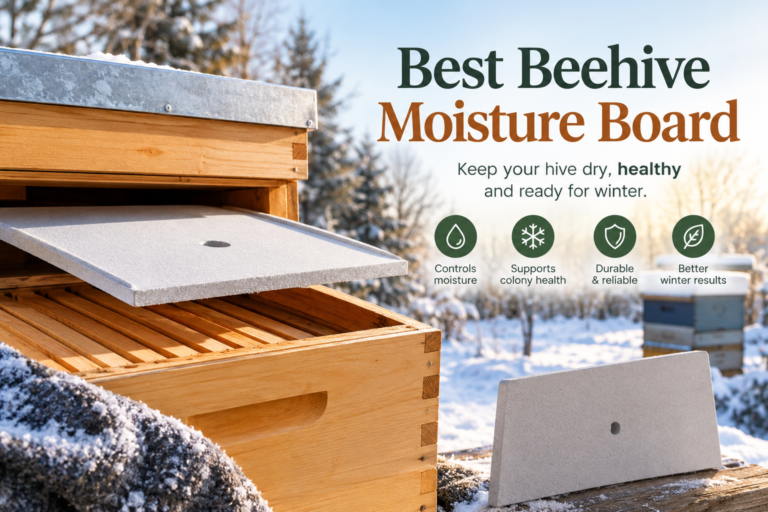
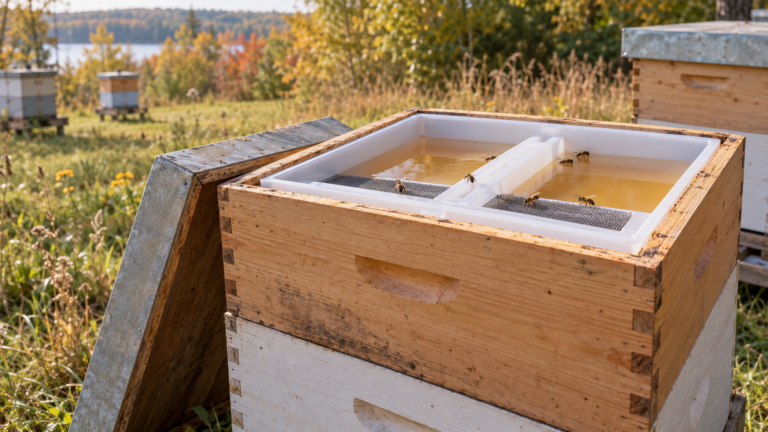
Top insulation options include a quilt box filled with coarse wood shavings (provides insulation, moisture absorption, and ventilation in one unit), an insulated inner cover board placed above the cluster, or a moisture board placed above the inner cover. The Bee Cozy includes a top inner cover pad that addresses this partially. For the coldest zones or most exposed locations, a dedicated quilt box or insulated top board alongside the lateral wrap gives more complete protection than lateral wrapping alone.
Common Winter Wrap Mistakes
✗ Mistakes That Reduce or Eliminate Wrap Effectiveness
- Choosing the wrong hive size — 8 and 10 frame wraps are not interchangeable; neither are single and double storey versions
- Covering the upper entrance, quilt box vents, or inner cover notch with wrap material
- Leaving large gaps at the bottom edge where cold air channels underneath
- Wrapping before the colony’s fall preparation is complete — Varroa treatment, feeding, and mouse guards must come first
- Using tar paper alone in Zone 3 exposed individual hives without supplemental foam insulation
- Not securing the outer cover against wind — any wind event can displace an unsecured cover
- Assuming a wrap compensates for inadequate stores, high Varroa, or a weak colony
- Assuming every climate needs the same insulation level — Zone 5 with a natural windbreak needs different protection than Zone 3 open prairie
- Removing the wrap too early in spring — late-season cold snaps when brood rearing has begun are particularly damaging
Which Winter Wrap Is Best for You?
🏆 Choose Bee Cozy If…
- You winter standard Langstroth hives outdoors in Zone 3–4
- You want a purpose-built reusable wrap with the highest available insulation rating
- You want top and lateral insulation in one product
- You have standard 8 or 10 frame equipment in 1 or 2 storey configuration
💰 Choose an Insulated Vinyl Wrap If…
- You winter in Zone 4–5 or in a sheltered Zone 3 location
- You want a lower-cost commercial alternative with confirmed insulation value
- You prefer Velcro closure for easier mid-winter adjustment
- You will add top insulation separately
📜 Choose Tar Paper If…
- You are wrapping a large number of hives and cost per hive is a primary factor
- You combine it with rigid foam panels for actual insulation value
- Your hives are grouped in blocks that share body warmth
- Your apiary has strong natural wind protection
🛠️ Choose DIY Foam If…
- You have non-standard hive dimensions
- You are insulating groups of hives sharing a block
- You want configurable insulation thickness for your specific climate
- You are comfortable measuring, cutting, and securing materials each season
Final Buying Guidance
If you keep bees in a cold climate, choose a wrap based on your hive configuration, winter temperatures, wind exposure, ventilation setup, and budget — not simply on the thickest insulation available. A well-fitted R5 wrap on a sheltered Zone 4 hive often performs comparably to an R8 wrap on an exposed position. Context matters more than R-value alone.
Not sure which wrap fits your hive? 🐝
Describe your hive configuration, location, and climate zone — our AI assistant will help you choose the right wrap type for your winter setup.
🐝 Ask Bee Now — It’s Free🐝 WiseBee Disclosure
Affiliate Disclosure: This article contains Amazon affiliate links. If you purchase through our links, we earn a small commission at no extra cost to you. Learn more →
Disclaimer: This article is for educational purposes only and does not constitute professional apicultural or veterinary advice. Always consult a qualified beekeeper for guidance specific to your situation. Full disclaimer →