Best Beehive Top Feeders:
Safe, High-Capacity Picks for Fall Feeding
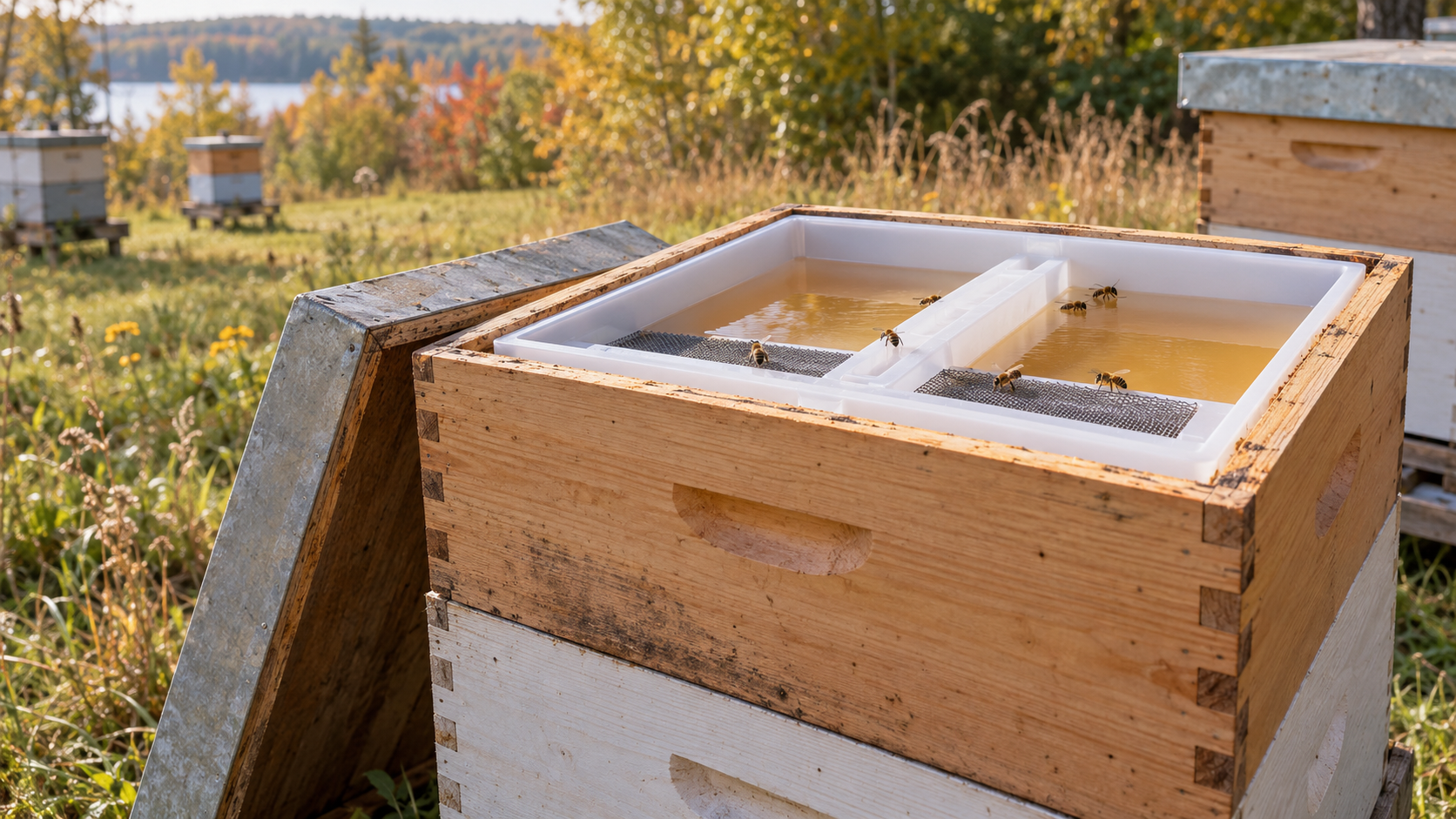
For heavy fall feeding with 2:1 syrup, a full-width screened reservoir top feeder is the most practical choice — it holds enough syrup to reduce refill frequency, keeps feeding activity above the brood nest, and can be refilled without opening the colony. The Mann Lake Honey Bee Top Feeder is the most consistently reviewed option available in Canada, with a galvanized steel safety screen and single-piece plastic reservoir. For beekeepers managing one or two hives with more modest syrup requirements, a round rapid feeder mounted over the inner cover hole is easier to handle and clean. The correct choice depends on how many hives you manage and how large your colonies’ stores deficit is going into fall.
Yes — bees can drown in a top feeder if the access design fails. Most top feeders reduce this risk through galvanized steel safety screens, ribbed access channels, sponge rings, or floating platforms that prevent bees from falling into the syrup reservoir. However, even with these features, drowning can still occur if the screen is not secured correctly, if bees access the reservoir from a gap, or if the syrup level drops and bees try to reach it from below the screen. Mann Lake specifically warns that bees can get under the screen when syrup levels drop and recommends checking the screen seal at the base. No top feeder completely eliminates drowning risk — correct installation and regular inspection reduce it significantly.
A properly installed top feeder significantly reduces robbing risk compared to an entrance feeder — syrup is above the colony and largely inaccessible to foragers from neighbouring hives. However, a top feeder does not eliminate robbing risk entirely. If the feeder leaks, if syrup is spilled during refilling, or if the outer cover does not seal tightly, the syrup smell can attract robbers. During September dearth, reduce the hive entrance simultaneously with installing a top feeder, fill feeders in the early evening rather than midday, and clean up any spills immediately. A weak colony with an improperly sealed feeder in a large apiary is still at robbing risk.
Yes — 2:1 syrup (2 parts sugar by weight to 1 part water) is suitable for all three types of top feeder reviewed here, provided the feeder is clean and the syrup is allowed to cool before filling. 2:1 syrup is denser and more viscous than 1:1 — it flows more slowly through access screens and channels, which can be an advantage in reducing overflow but may slow uptake slightly in cold weather. In very cool September conditions, bees may access 2:1 syrup less actively than in warm August weather — this is normal and reflects reduced colony processing activity as temperatures drop, not a problem with the feeder itself.
Yes — honey supers intended for harvest should be removed before fall feeding begins, including before installing a top feeder. Feeding sugar syrup with supers on risks contaminating extractable honey with sugar syrup, which is not acceptable for sale or consumption as honey and may violate Canadian honey regulations. Remove all harvest supers before the first day of fall feeding. Any honey remaining in supers at that point is typically not worth extracting and can be left as supplemental stores or removed and extracted separately with a clear “feeding syrup only” label.
📋 In This Article
Entrance feeders expose syrup at the hive entrance and favour robbing during fall dearth. Frame feeders require opening the brood nest and occupy the space of a frame. A well-designed hive-top feeder holds more syrup, keeps feeding activity above the colony, and can usually be refilled without disturbing the brood nest. It is not a perfect system — a leaking feeder or an incorrectly seated screen creates its own problems — but for fall feeding with 2:1 syrup in a Canadian apiary, it is the most practical option for most beekeepers.
Best Beehive Top Feeders at a Glance
| Pick | Type | Capacity | Hive Fit | Drowning Protection | Best For | Price |
|---|---|---|---|---|---|---|
| Mann Lake Top Feeder 🏆 Best Overall |
Full-width reservoir | Verify listing | 10 frame standard | Galvanized steel screen | Heavy fall feeding, multiple hives | Amazon.ca → |
| Round Rapid Top Feeder ✅ Best for 1-3 Hives |
Round rapid feeder | Verify listing | 8 & 10 frame via inner cover | Dome cover + ribbed channels | Small apiaries, easy cleaning | Amazon.ca → |
| Top-Mounted Pail Feeder 💰 Best Budget |
Inverted pail / bucket | Varies by pail | Most Langstroth hives | Perforated lid — verify seal | Low cost, flexible capacity | Amazon.ca → |
Verify Capacity and Dimensions Before Ordering
Top feeder listings on Amazon.ca vary significantly in actual capacity and dimensions even within the same search results. Before ordering, confirm the exact litre or gallon capacity declared for the specific listing, the exterior dimensions against your hive body width, and whether a super or rim is included or must be purchased separately. Do not rely on category or search-page descriptions — read the individual product page specifications.
How We Chose These Hive-Top Feeders
Our selections are based on feeder design, manufacturer specifications, compatibility with standard Langstroth equipment, ease of cleaning, and patterns in verified customer feedback on Amazon.ca. We do not describe products as field-tested unless we have personally used them. Products were selected for consistent availability on Amazon.ca, meaningful drowning-reduction design, and suitability for 2:1 fall syrup feeding in a Canadian autumn context.
Criteria evaluated: declared capacity, 8 or 10 frame compatibility, drowning-reduction mechanism, refill access without opening the brood nest, single-piece or low-joint construction, cleaning access, delivery availability in Canada, and recurring issues noted in verified reviews.
Why Choose a Hive-Top Feeder?
Higher Capacity for Fall Feeding
Fall feeding often requires delivering 10-20 litres of 2:1 syrup per colony over a compressed 3-4 week window before temperatures drop too low for effective bee processing. A high-capacity top feeder reduces the number of refill visits required — useful for beekeepers managing multiple hives or visiting remote apiaries. The actual refill frequency depends on the feeder’s capacity, the colony’s uptake rate, and ambient temperature — a colony can consume syrup much faster in warm early September than in cool late September.
Refill Without Opening the Brood Nest
The outer cover is removed and the feeder refilled from above — the brood nest does not need to be opened. Bees access the syrup from below through a screened or channelled opening. In practice, bees will often be clustered near the feeder access when you refill — keep protective equipment on. The brood nest remains undisturbed, which matters in September when maintaining cluster warmth becomes increasingly important.
Better Robbing Control Than an Entrance Feeder
Syrup above the colony and enclosed under an outer cover is less accessible to foragers from neighbouring colonies than syrup at the hive entrance. A top feeder can reduce — not eliminate — robbing risk, provided the feeder does not leak, the outer cover closes properly, and no syrup is spilled during refilling. The entrance should still be reduced to a small opening during the fall dearth period regardless of feeder type.
The Trade-Offs — What Top Feeders Do Not Solve
- — Higher cost than entrance or frame feeders
- — Heavy when full — a 15L feeder filled with 2:1 syrup weighs approximately 20 kg
- — Leaks if the screen is not correctly seated or the feeder body is cracked
- — Some models require an empty super as a housing rim — not always included
- — Bees may access the reservoir from below the screen when syrup levels drop
Detailed Reviews of the Best Beehive Top Feeders
Mann Lake is one of the most recognized names in North American beekeeping supply, and their top feeder reflects deliberate design choices for fall feeding: a galvanized steel safety screen separates the bee access channels from the main syrup reservoir, and the single-piece plastic construction minimizes leak points compared to multi-part assemblies. The feeder inserts into an empty super body placed above the inner cover — the outer cover then sits on top.
The galvanized screen is the key feature for fall use: it creates a physical barrier that substantially reduces the risk of bees entering the main syrup reservoir. Mann Lake themselves note in their product documentation that bees can get under the screen when the syrup level drops — a reminder that no drowning-prevention system is passive. Check the screen seat regularly, especially as you refill partially empty feeders.
Confirm the exact declared capacity on the current Amazon.ca listing before purchasing — full-width 10-frame models vary between approximately 1 gallon and 4 gallons depending on the specific product version.
✓ Advantages
- Established brand with documented specifications
- Galvanized steel screen — more durable than plastic mesh
- Single-piece reservoir reduces leak risk
- Refill without opening brood nest
- Suitable for 2:1 fall syrup
— Limitations
- Requires an empty super body as housing rim
- Heavy when filled to capacity
- Bees can access reservoir under screen when level drops
- Higher price than generic alternatives
Round rapid feeders mount over the round hole in a standard Langstroth inner cover — the dome sits above the inner cover, bees access syrup from below through the centre of the feeder, and an empty super placed around it protects the dome from the outer cover. Several versions are available on Amazon.ca from brands including Duseu, Proloso, and Baderke — all follow the same basic design principle. Confirm the dome diameter matches your inner cover hole before ordering.
The dome design keeps syrup enclosed while allowing bees to reach it through a central channel — this reduces (but does not eliminate) exposure to outside foragers. Many models include ribbed or grooved access channels that give bees grip while ascending to the syrup surface. For one to three hives with moderate syrup requirements, the round rapid feeder is easier to handle, easier to clean, and less expensive than a full-width reservoir feeder.
Verify the capacity of the specific listing you select — round rapid feeders on Amazon.ca range from under 1L to approximately 2-3L depending on model. Smaller-capacity models require more frequent refilling during peak fall feeding.
✓ Advantages
- Compatible with 8 and 10 frame hives
- Compact — easier to handle and store
- Simple to clean between uses
- Lower cost than full-width feeders
- No empty super required in some designs
— Limitations
- Smaller capacity — more frequent refills
- Inner cover hole diameter must match dome
- Drowning risk if ribbing is insufficient
- May need an empty super for outer cover clearance
A pail feeder is an inverted food-grade bucket with a perforated or screened lid — placed over the inner cover hole, surrounded by an empty super, and covered by the outer cover. Bees access syrup through the perforations from below. The principle is the same as a manufactured top feeder at a fraction of the cost, and the capacity can be adjusted by choosing a larger or smaller pail depending on how much syrup the colony needs.
The main variable — and the main risk — is the lid seal. A food-grade pail with a properly perforated lid holds syrup by vacuum as long as the seal is complete. A cracked lid, an improperly seated lid, or perforations that are too large will result in a rapid syrup leak inside the hive — making a mess, raising hive humidity, and potentially triggering robbing. Always test the inverted pail with water over a sink before placing it on any hive.
Pre-made pail feeders designed specifically for beekeeping are also available on Amazon.ca and eliminate the DIY element while keeping costs lower than branded top feeders. Verify the perforation size — holes sized for water may release 2:1 syrup too slowly or too quickly depending on viscosity.
✓ Advantages
- Lowest cost option
- Flexible capacity — choose pail size
- Simple to replace if damaged
- Syrup stays enclosed if lid is sealed
— Limitations
- Lid seal failure causes significant leaks
- Must be tested with water before use on hives
- Requires empty super as housing rim
- Perforation size must be verified for 2:1 syrup
Top Feeder Comparison by Use Case
| Situation | Better Choice |
|---|---|
| Large stores deficit — 10+ litres needed per colony | Full-width reservoir (Mann Lake) |
| More than three colonies in the apiary | Full-width reservoir |
| One to three hives, moderate deficit | Round rapid feeder |
| Limited budget, careful beekeeper | Top-mounted pail feeder (leak-tested) |
| Transparent syrup level visible without removing cover | Round transparent rapid feeder |
| Infrequent apiary visits — 5+ days between refills | Highest-capacity reservoir available |
| Temperatures consistently below 10°C at night | Top feeder may not be effective — consider fondant instead |
Buyer’s Guide — What to Look for in a Hive-Top Feeder
Correct 8 or 10 Frame Fit
Verify the exterior dimensions against your hive body width before ordering. Confirm whether the super housing rim is included or must be purchased separately. Check that the outer cover closes correctly with the feeder installed.
Drowning-Reduction Design
Look for a galvanized steel screen, ribbed channels, anti-drowning sponge rings, or a dome design. No design completely eliminates drowning — check the screen seat regularly and inspect after each refill as syrup levels drop.
Capacity vs Filled Weight
A 15L feeder filled with 2:1 syrup weighs approximately 20 kg. Consider whether you can safely lift and fill it at hive height, whether the hive stand is stable enough, and whether you actually need to fill it completely each time.
Leak Resistance
Single-piece reservoirs have fewer joint points than assembled feeders. Fewer seams means fewer potential leak paths. Verify that gaskets or o-rings are included and replaced when worn. Test with water before first use on a hive.
Cleaning and Mold Prevention
Corners and crevices that trap syrup between uses develop mold. Look for smooth interior surfaces, detachable components, and designs that allow complete drying before winter storage. A feeder you can fully rinse and inspect is worth more than one you cannot.
Weather and UV Resistance
Food-grade plastic feeders should resist deformation in hot August sun. The outer cover provides some UV protection, but avoid feeders with thin plastic walls that crack after one or two seasons of freeze-thaw cycling in Canadian conditions.
How to Use a Top Feeder Safely
Test for Leaks Before Placing on Any Hive
Fill the feeder with water over a sink or on bare ground — away from the apiary. Invert it (for pail feeders) or place it in its operating position and observe for leaks for five minutes. A slow drip becomes a significant leak over 24 hours on a hive. Do not skip this step with a new feeder or a feeder returned from winter storage.
Install Screens and Covers Correctly
When a Top Feeder Is Not the Best Choice
Consider an Alternative When:
- The colony needs only a small top-up — a frame feeder or pail causes less disruption for small quantities
- Night temperatures are consistently near or below 10°C — bees cannot process liquid syrup efficiently; switch to fondant placed directly above the cluster
- The hive stand is unstable or tilted — a heavy full reservoir increases tip risk
- The feeder dimensions do not match your specific hive body exactly — gaps between feeder and super allow robbing access
- The colony is too weak to defend itself — robbing risk remains even with an internal feeder if the colony cannot guard the entrance
- You cannot check for leaks within 24 hours of first installation — a leaking feeder discovered a week later has already done significant damage
- You need emergency winter nutrition — fondant or candy boards placed directly above the cluster are the correct tool, not syrup feeders
Final Verdict
Not sure which feeder fits your setup? 🐝
Describe your hive configuration, number of colonies, and stores deficit to our AI assistant — we’ll recommend the right feeder type and volume for your fall feeding plan.
🐝 Ask Bee Now — It’s Free🐝 WiseBee Disclosure
Affiliate Disclosure: This article contains Amazon affiliate links. If you purchase through our links, we earn a small commission at no extra cost to you. Learn more →
Disclaimer: This article is for educational purposes only and does not constitute professional apicultural or veterinary advice. Always consult a qualified beekeeper for guidance specific to your situation. Full disclaimer →