Best Beehive Moisture Boards
& Quilt Inserts for Winter
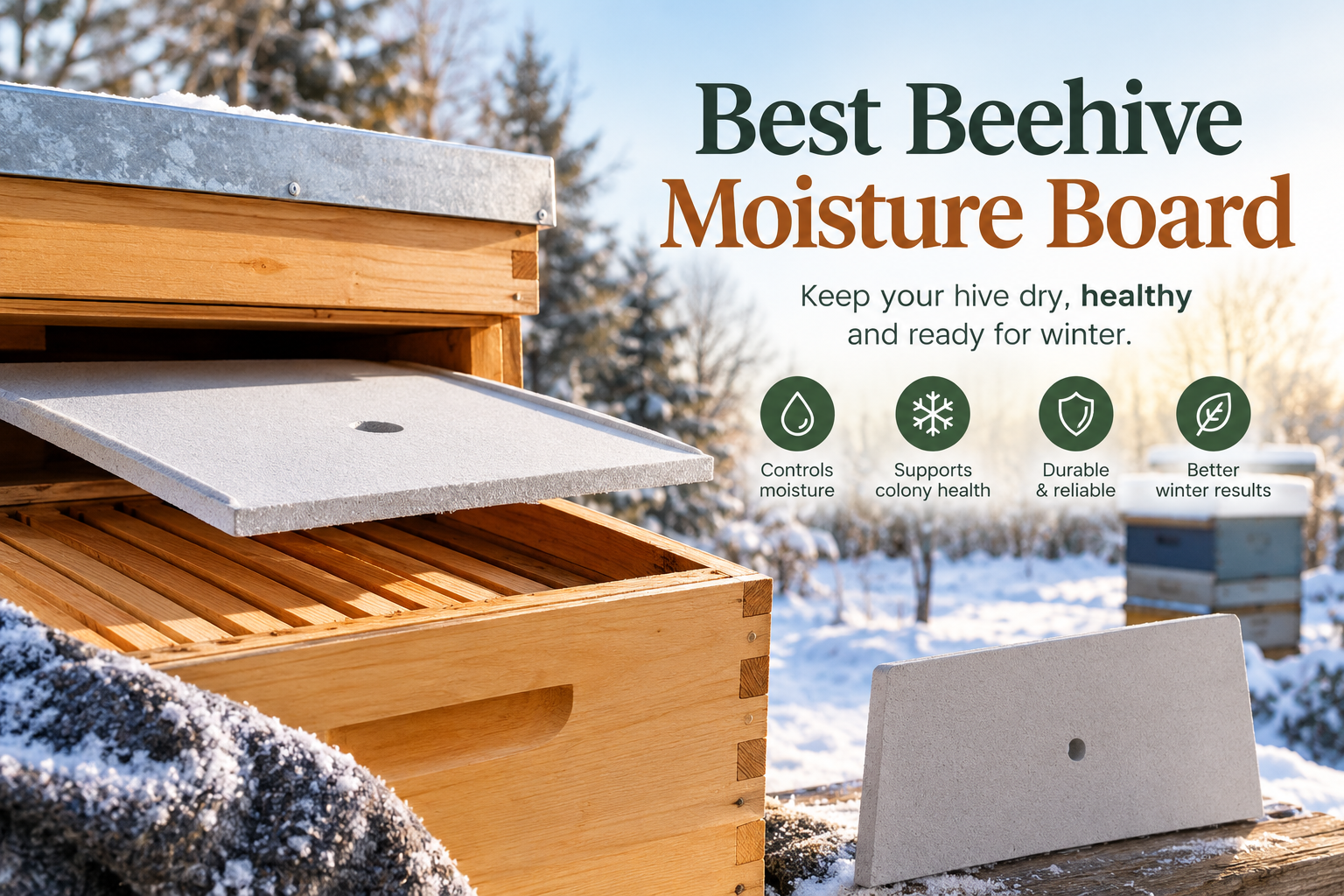
A beehive moisture board is an absorbent or insulating panel placed above the winter cluster — typically on the top bars or above the inner cover — to reduce condensation on cold overhead surfaces. It absorbs some of the moisture vapour rising from the cluster before it reaches the cold inner cover or outer cover surface where it could condense and drip back down. Whether it “works” depends on what you expect from it: a moisture board can reduce visible condensation on the inner cover surface, but it is one component of a broader system that also includes adequate ventilation, top insulation, and colony strength. It cannot compensate for inadequate stores, high Varroa loads, or a weak colony — which Ontario winter loss surveys consistently identify as the main contributing factors to colony failure.
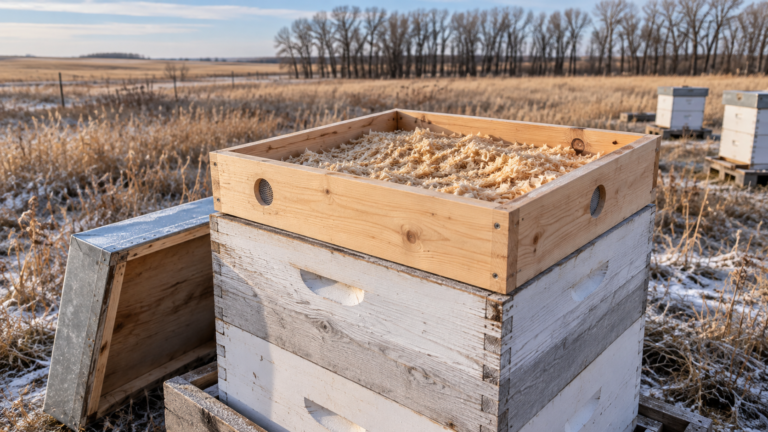
A moisture board is a flat panel — typically made of absorbent or insulating material — placed directly above the cluster. It has no dedicated housing and sits on the top bars or above the inner cover. A quilt box is a purpose-built wooden rim with a screened bottom and lateral vent holes, filled with coarse absorbent material (usually wood shavings). The quilt box creates a dedicated moisture-buffering chamber above the colony with ventilation to allow the absorbed moisture to escape. A moisture board is a simpler, lower-profile product; a quilt box is a more complete system that combines insulation, absorption, and ventilation in one structure. Both address the same problem — condensation above the winter cluster — through different approaches.
Using both simultaneously is usually redundant rather than beneficial. A quilt box already contains absorbent material that serves the same function as a moisture board — adding a moisture board below the quilt box shavings layer does not meaningfully improve performance and can create a physical barrier that reduces airflow between the cluster and the quilt material. Choose one coherent system: either a moisture board above the inner cover as a simple standalone addition, or a full quilt box system that handles moisture management, insulation, and ventilation together. If you have already built or purchased a quilt box, you do not need a moisture board as well.
The most commonly used DIY materials for a beehive moisture board are untreated burlap (hessian fabric), natural wool felt, or a shallow layer of coarse wood shavings held in a screened frame. All of these absorb moisture vapour, allow some airflow through the material, and are safe for use near bees. Do not use synthetic foam or fibrefill that could block airflow entirely, and do not use materials treated with flame retardants, pesticides, or other chemicals. The material must be able to dry out — either by being replaced periodically or by having adequate ventilation through or around it. A moisture board that stays permanently saturated stops absorbing and can become a mould source.
No — a moisture board does not replace upper ventilation, and should not be treated as a reason to seal a hive completely. A moisture board absorbs some of the moisture vapour before it reaches cold surfaces, but the absorbed moisture must eventually escape through ventilation openings or by periodic replacement of the board material. An inner cover notch, a small upper entrance, or quilt box vents provide the escape route for this moisture. A hive that is perfectly sealed with a moisture board inside will eventually saturate the board and begin accumulating moisture again. The Government of Ontario’s Best Management Practices explicitly state that hive entrances should be reduced but never completely closed, and that adequate ventilation must be maintained through winter.
📋 In This Article
- Why Winter Moisture Matters in Ontario Hives
- What Is a Beehive Moisture Board — and What Isn’t One
- Moisture Board vs. Quilt Insert vs. Quilt Box
- Products at a Glance
- Reviewed: Best Options for Ontario Winter Hives
- Buyer’s Guide — What to Check Before Buying
- What a Moisture Board Cannot Solve
- How to Install a Moisture Board Correctly
Moisture management above the winter cluster is one component of an Ontario winter hive system — not the most important one, and not a substitute for the preparation that actually drives colony survival. This guide explains what moisture boards and quilt inserts do, how to tell them apart from related products, and what to check before buying one for an Ontario Langstroth hive.
Why Winter Moisture Matters in Ontario Hives
Winter preparation isn’t only about keeping a colony warm. Moisture management matters too — specifically the moisture that forms when warm, humid air rising from the winter cluster meets colder surfaces inside the hive. A winter colony metabolizes honey stores to generate heat, producing water vapour as a byproduct. This vapour rises toward the top of the hive. When it contacts a cold overhead surface, it can condense.
Condensation on the inner walls of the hive is not automatically a problem. The specific concern is water accumulating above the cluster and dripping cold water directly onto the bees below — a combination of cold and wet that increases metabolic stress and store consumption. Ontario winters create conditions where this is worth managing: long confinement periods, significant temperature swings, and cold outer surfaces that create the temperature differential where condensation forms.
Moisture Is Not the Leading Cause of Ontario Winter Losses
Ontario winter loss surveys — including OBA member data from the 2024-25 season — consistently identify Varroa and associated viruses, weather and climate conditions, and weak colonies as the primary contributing factors to colony losses. A moisture board on a colony entering winter with high Varroa, inadequate stores, or poor population will not change the outcome. Address those fundamentals first; moisture management is a meaningful but secondary layer of winter preparation.
What Is a Beehive Moisture Board — and What Isn’t One
The terminology used in online listings is inconsistent — the same search returns moisture boards, quilt inserts, absorbent inner covers, and quilt box components, often with overlapping descriptions. Before buying, identify which of the following four product types a listing actually represents:
Moisture Board
A flat absorbent or insulating panel placed directly above the cluster — on the top bars or above the inner cover. No dedicated housing. Low profile. Absorbs vapour before it reaches the cold cover surface. Must be replaced or dried periodically.
Quilt Insert
An absorbent material — typically wool, burlap, or natural fibre — designed to sit inside a quilt-style setup or between covers. Similar function to a moisture board but used within a layered system rather than as a standalone product.
Quilt Box
A purpose-built wooden rim with a screened bottom and lateral vent holes, filled with coarse absorbent material. A complete system: provides insulation, absorption, and ventilation together. More involved to build or source than a simple board.
Moisture Absorber
Products designed specifically for moisture absorption — sometimes hygroscopic granules or treated fabric panels. Less common in beekeeping; more often used in sealed container contexts. Confirm bee-safety before use near a colony.
How to Identify the Product Type Before Buying
Check the listing for: a physical housing or rim (indicates quilt box, not just a board); what the absorbent material is and whether it is replaceable; whether vent holes are included or required; and what goes above the product — outer cover directly, or another component. A product that installs in under two minutes with no additional components is likely a moisture board or insert. A product with assembly instructions and vent requirements is likely a quilt box.
Moisture Board vs. Quilt Insert vs. Quilt Box
| Type | Main Purpose | Insulation | Ventilation | Best Suited For | What to Consider |
|---|---|---|---|---|---|
| Moisture board | Absorption | Some | Not built-in | Standard Langstroth, simple setup | Thickness, fit, absorbency, replaceability |
| Quilt insert | Moisture absorption | Some | Depends on setup | Quilt-style or layered systems | Material and how often it needs replacement |
| Quilt box | Insulation + moisture buffering + ventilation | Yes | Built-in vents | Outdoor Prairie and Ontario cold winters | Correct vent placement, shavings type, integration with wrap |
| Insulated inner cover | Insulation | High | Not built-in | Preventing cold overhead surface | Does not absorb moisture — pair with ventilation |
Already Have a Quilt Box? You Don’t Need a Moisture Board Too
A quilt box already contains absorbent shavings that serve the same function as a moisture board. Adding a moisture board below a quilt box is redundant and can reduce airflow between the cluster and the shavings. If you are using a quilt box, skip the moisture board. If your setup does not include a quilt box, a moisture board or quilt insert is a practical lower-profile alternative.
Products at a Glance
| Product | Type | Fits | Material | Best For | Buy |
|---|---|---|---|---|---|
| Bee Cozy Winter Hive Wrap 🏆 Ontario Made |
Lateral wrap + top insert | 8 & 10 frame | Polypropylene + aerofoil | Combined wind, insulation, moisture | Amazon.ca → |
| Burlap / Hessian Moisture Insert 💰 DIY-Friendly |
Quilt insert / moisture board | Any Langstroth | Natural jute / burlap | Simple moisture absorption layer | Amazon.ca → |
| Insulated Moisture Board Panel 🔲 Structured Option |
Moisture board with insulating layer | 8 & 10 frame | Foam + absorbent layer | Insulation + absorption combined | Amazon.ca → |
| Quilt Box — Build or Buy | Quilt box system | 8 & 10 frame | Wood rim + shavings | Complete moisture + insulation system | Amazon.ca → |
Reviewed: Best Options for Ontario Winter Hives
NOD Apiary Products is an Ontario-based beekeeping supplier, and the Bee Cozy is their purpose-designed winter hive wrap for Canadian conditions. It is a combined product: a heavy black polypropylene outer sleeve with an interior aerofoil insulating layer that wraps the hive body laterally, plus a top component that sits above the colony to provide insulation and some moisture buffering above the cluster.
The Bee Cozy addresses both lateral heat loss and above-cluster insulation in one product — which means it is relevant to this guide despite being primarily marketed as a winter wrap. For beekeepers who want a single product that handles wind protection, lateral insulation, and top moisture management together, it is the most coherent Ontario-specific option available. It is reusable for multiple seasons and sized for standard Langstroth 8 and 10 frame equipment. Confirm the specific dimensions of the listing against your hive body before ordering.
✓ Advantages
- Ontario manufacturer — designed for Canadian winter conditions
- Combined lateral and top component in one product
- Aerofoil inner layer provides meaningful insulation
- Reusable multiple seasons
- Available for 8 and 10 frame Langstroth
— Limitations
- More expensive than simple burlap insert alone
- Top component alone may not substitute a full quilt box in very cold regions
- Verify dimensions against your specific hive body brand
A piece of natural untreated burlap (hessian) fabric cut to fit the top bars or placed above the inner cover is the simplest, lowest-cost moisture management layer available to an Ontario beekeeper. Burlap absorbs moisture vapour readily, does not block airflow as tightly as synthetic materials, and is completely safe near bees when untreated. It is the same material used as quilt inserts in many commercial and DIY quilt box designs.
The practical limitation is straightforward: burlap alone does not insulate. It reduces condensation by absorbing vapour before it reaches the cold overhead surface, but a cold inner cover over burlap is still a cold surface — the temperature differential that drives condensation formation is not significantly reduced. For Ontario winters, burlap is more effective when used in combination with an insulated outer cover or quilt box than as a standalone product. Replace or dry the burlap on any mild winter day when it feels saturated — a permanently wet piece of burlap adds humidity rather than removing it.
✓ Advantages
- Very low cost — a metre of burlap costs a few dollars
- Natural, untreated, bee-safe material
- Cuts to any inner cover dimension
- Easy to replace mid-winter if saturated
- Same material used in commercial quilt inserts
— Limitations
- Does not insulate — does not reduce cold overhead surface temperature
- Must be dried or replaced when saturated
- Less effective without additional top insulation in place
A quilt box is the most complete above-cluster moisture management option for Ontario outdoor wintering. The combination of a screened bottom (allowing vapour to rise from the cluster into the shavings), coarse absorbent fill material, and lateral vent holes that allow the fill to dry provides insulation, absorption, and ventilation as a coherent integrated system. Unlike a flat moisture board, a quilt box creates a dedicated warm air buffer zone above the cluster that moderates the temperature differential where condensation forms.
The quilt box’s higher score reflects this systemic advantage — it is doing more work than a flat board. The trade-off is complexity: it requires building or sourcing correctly, installing with the right fill material, and integrating with the hive’s outer cover and winter wrap without blocking vents. A poorly built quilt box — with blocked vents, incorrect fill, or gaps at the edges — performs worse than a simple burlap board. Done correctly, it is the best single above-cluster moisture management system available for an Ontario Langstroth winter hive.
✓ Advantages
- Combined insulation, absorption and ventilation
- Creates warm buffer zone above cluster
- Reusable with periodic shavings replacement
- Can be DIY built with low-cost materials
— Limitations
- More complex to build or source than a flat board
- Vents must be protected and unblocked by wrap
- Incorrect fill material defeats the purpose
- Adds height to the hive stack
Buyer’s Guide — What to Check Before Buying
📐 Hive Footprint Match
A moisture board or insert must fit the inner opening of your hive body exactly. Gaps at the edges allow warm air to bypass the product entirely — the vapour takes the path of least resistance. Measure your inner cover opening before ordering. 8-frame and 10-frame openings are not interchangeable.
🌾 Absorbent but Breathable
The material must absorb vapour but not block all airflow. Dense foam that seals the top bars completely traps moisture below rather than managing it. Natural fibres — burlap, wool felt, coarse shavings — absorb and allow some vapour movement simultaneously.
🔄 Replaceability
A moisture board that cannot be replaced or dried when saturated becomes a liability rather than an asset. Confirm before buying whether the absorbent component is replaceable and how easily it can be checked and swapped on a mild winter day without a full hive inspection.
🌡️ Works With Your Top Insulation
A moisture board alone does not prevent condensation from forming — it only intercepts some vapour before it reaches the cold surface. It works best when the surface above it is also insulated. Confirm that your outer cover or top insulation arrangement works alongside the moisture board, not against it.
🌬️ Ventilation Still Required
Any moisture board or insert must be paired with adequate upper ventilation — an inner cover notch, small upper entrance, or quilt box vents — so absorbed moisture can eventually escape. A completely sealed hive with a saturated moisture board accumulates moisture faster than one without any management.
🇨🇦 Available on Amazon.ca
Confirm the product is actually in stock on Amazon.ca and ships to Ontario before purchasing. Check delivery timing against your planned installation date — October wrapping windows are short, and a product that arrives in November is not useful for that season.
What a Moisture Board Cannot Solve
A moisture board is a useful addition to a well-prepared Ontario winter hive. It is not a correction for underlying colony problems. Ontario winter loss survey data — including the OBA 2024-25 member survey — consistently points to Varroa and associated viruses, weak colony population, and weather conditions as the primary drivers of winter loss, not condensation alone.
- ✗ A moisture board cannot compensate for inadequate winter stores — a colony that runs out of food in February will not survive regardless of overhead moisture levels
- ✗ A moisture board cannot reduce Varroa mite loads or repair fat body damage already done to winter bees
- ✗ A moisture board cannot compensate for a colony too small to generate adequate cluster warmth
- ✗ A moisture board cannot replace upper ventilation — a saturated board in a sealed hive increases humidity rather than reducing it
How to Install a Moisture Board in an Ontario Winter Hive
Placement Options
On the top bars (no inner cover): The moisture board sits directly on the top bars of the uppermost brood box. Warm air from the cluster passes through or around the board before reaching the outer cover. This position maximizes contact with rising vapour but requires an outer cover that closes firmly over the board without compressing it.
Above the inner cover: The moisture board sits between the inner cover and the outer cover. This is less effective at intercepting vapour — warm air must pass through the inner cover opening first — but easier to install and remove. Confirm the inner cover has an open notch or hole that allows vapour to reach the board.
Key Installation Checks
- ✓ The board fits the opening without significant gaps at the edges
- ✓ The outer cover closes completely without compressing the board
- ✓ Upper ventilation (inner cover notch or small upper entrance) remains open
- ✓ The board is dry at installation — never install a damp or wet moisture board
- ✓ You have a plan to check and replace it on a mild winter day if needed
Final Thoughts
A well-chosen moisture board or quilt insert is a worthwhile addition to an Ontario winter hive that is already properly prepared — adequate stores confirmed, Varroa below 1%, sufficient population, and a coherent wrap and ventilation system in place. It is not a substitute for any of those fundamentals, and Ontario winter loss data is clear that those fundamentals matter more than what goes above the cluster.
Choose a product that fits your hive exactly, works with your existing top insulation and ventilation configuration, and can be checked or replaced mid-winter if needed. A burlap insert paired with a good insulated outer cover is a practical and low-cost approach for most Ontario beekeepers. A full quilt box is the more complete system for colder or more exposed locations. Either way — address the colony first, then the moisture. 🐝💧❄️
Not sure which system fits your hive? 🐝
Describe your hive configuration, location in Ontario, and current winter setup to our AI assistant — we’ll help you choose the right moisture management approach.
🐝 Ask Bee Now — It’s Free🐝 WiseBee Disclosure
Affiliate Disclosure: This article contains Amazon affiliate links. If you purchase through our links, we earn a small commission at no extra cost to you. Learn more →
Disclaimer: This article is for educational purposes only and does not constitute professional apicultural or veterinary advice. Always consult a qualified beekeeper for guidance specific to your situation. Full disclaimer →