Small Hive Beetle Control Ontario:
Identification, Traps & Treatment Guide (2026)
📋 In This Article
- What Is the Small Hive Beetle?
- Small Hive Beetle in Ontario — Legal Requirements
- How to Correctly Identify Small Hive Beetle & Larvae
- Recognizing a Small Hive Beetle Infestation
- Integrated Pest Management — Prevention First
- Small Hive Beetle Traps — What Actually Works
- Treatments That Work — Diatomaceous Earth, Nematodes
- About Slime Out — Important Note
- Small Hive Beetle Traps for Sale on Amazon Canada
The small hive beetle (Aethina tumida) is an increasingly serious pest for Ontario beekeepers — and one that many hobbyists underestimate until they open a hive to find it overwhelmed. Unlike Varroa, which attacks bees directly, the small hive beetle destroys the hive from the inside — fermenting honey, consuming brood, and triggering colony abandonment. This guide covers everything Ontario beekeepers need to know about identification, legal obligations, and effective control.
What Is the Small Hive Beetle?
The small hive beetle (SHB) — Aethina tumida — is a parasitic beetle native to sub-Saharan Africa that has spread to beekeeping operations worldwide, including Canada. It was first detected in North America in 1998 in Florida and has since spread northward. In Canada, SHB populations are now established in Ontario — particularly in the southern part of the province where warmer summers allow the beetle to complete its life cycle in outdoor soil.
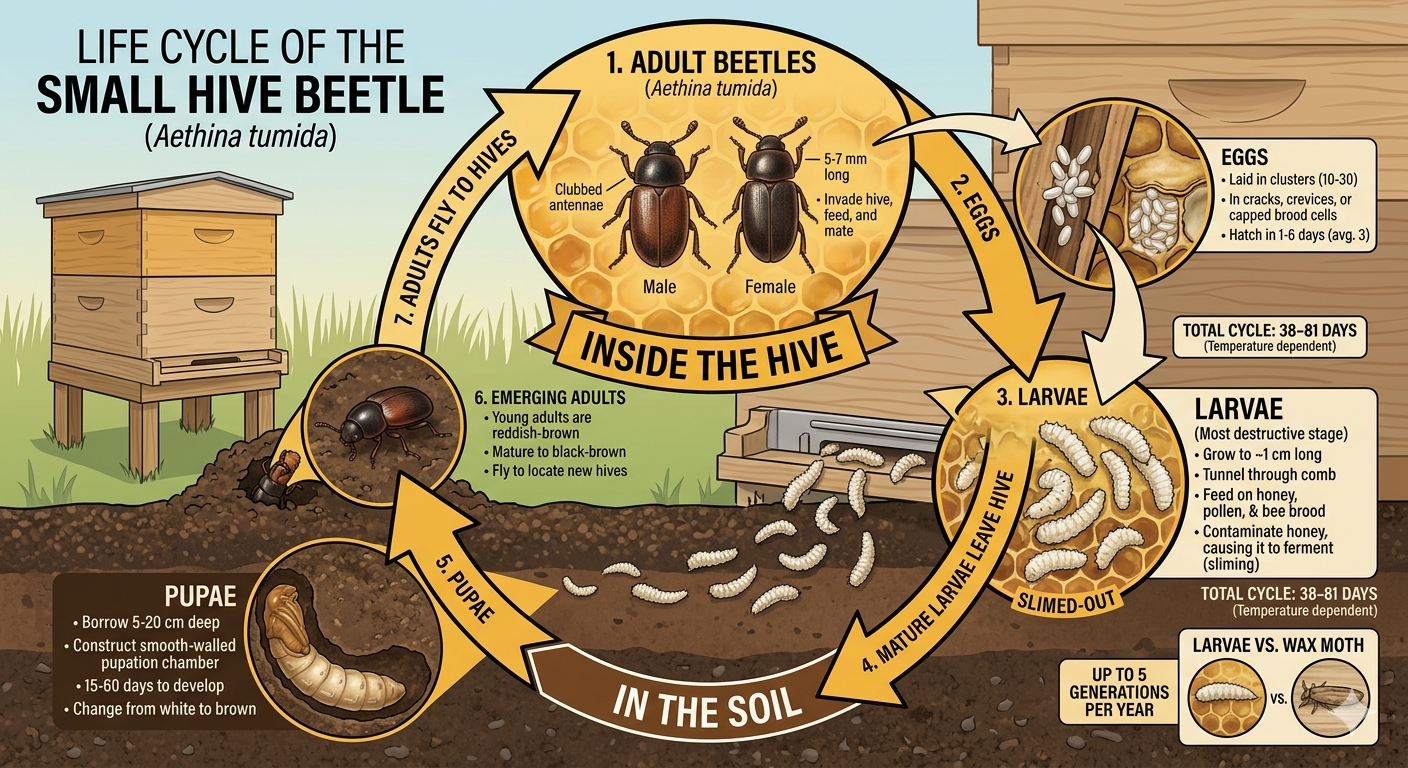
Small Hive Beetle Life Cycle
Understanding the life cycle is critical for effective control. The adult beetle lives inside the hive, reproduces rapidly in warm conditions, and its larvae do the actual damage. Crucially, the pupal stage occurs in the soil outside the hive — making treatment of the ground around your apiary a valuable part of the control strategy.
Small Hive Beetle in Ontario — Legal Requirements
The small hive beetle is a regulated pest in Ontario under the Bees Act. While SHB is not a reportable disease requiring mandatory notification in the same way as American Foulbrood, Ontario beekeepers have legal obligations regarding pest management and record keeping that apply to SHB infestations.
Ontario Legal Obligations — Small Hive Beetle
Under the Ontario Bees Act, registered beekeepers are required to maintain hives in a condition that minimizes pest and disease spread to other apiaries. This includes implementing appropriate SHB management where infestations are present. Ontario’s Provincial Apiarist can provide guidance on SHB management requirements and may inspect apiaries for pest management compliance. Contact OMAFRA if you discover a significant SHB infestation — particularly if you are selling or moving equipment between apiaries.
Do NOT Move Infested Equipment
Moving frames, boxes, or equipment from an SHB-infested apiary to another location spreads the beetle to new apiaries. Under Ontario’s Bees Act, spreading a regulated pest through negligent equipment movement can result in significant penalties. If your apiary has an active SHB infestation, treat it before moving any equipment and inform your provincial apiarist.
How to Correctly Identify Small Hive Beetle and Small Hive Beetle Larvae
Correct identification of the small hive beetle and small hive beetle larvae is the first step toward effective management. SHB is frequently confused with other hive beetles and even with wax moth larvae — an important distinction because management strategies differ significantly.
- Size: 5–7mm long — roughly 1/3 the size of a bee
- Colour: Dark brown to black, shiny
- Shape: Oval, flattened — fits into small crevices
- Antennae: Club-shaped — distinctive feature
- Behaviour: Runs rapidly when exposed to light
- Location: Corners of hive, under frames, in propolis cracks
- Size: Up to 11mm when mature
- Colour: Creamy white with brown head
- Shape: Elongated, 3 pairs of legs near head
- Spines: Two rows of small spines along back
- Behaviour: Tunnels through comb actively
- Smell: Infested comb smells of fermentation
Small Hive Beetle vs Wax Moth Larvae — How to Tell the Difference
Small hive beetle larvae are frequently confused with wax moth larvae — a critical mistake because they require different management approaches. Wax moth larvae are larger (up to 28mm), have a distinct grey/cream colour, create silken tunnels through comb, and lack the distinctive spines on their back. SHB larvae are smaller, cream-coloured, have three pairs of legs visible near the head, and have two rows of small spines along their back. If you are uncertain, contact your provincial apiarist for confirmation.
Recognizing a Small Hive Beetle Infestation
A small hive beetle infestation ranges from minor (a few adult beetles managed by a strong colony) to catastrophic (colony abandonment due to larval destruction of all comb). Knowing the signs of each level helps you respond proportionately.
Early Signs of Small Hive Beetle Infestation
Finding 1-5 adult beetles running away from light when you open the hive is normal in Ontario during summer — a strong, healthy colony can police this level of infestation with minimal damage. At this stage, improve colony strength, ensure adequate ventilation, and consider installing a trap as a precautionary measure.
Active Small Hive Beetle Infestation Signs
An active SHB infestation is identifiable by finding small hive beetle larvae tunnelling through comb, honey with a slimy or fermented appearance, a sour or fruity fermentation smell when opening the hive, and bees clustering away from affected areas of comb. Honey frames with an unusual yellowish discolouration and runny consistency have been fermented by SHB larvae and are unsalvageable.
Severe Small Hive Beetle Infestation — Colony Absconding
A severe small hive beetle infestation can trigger colony absconding — the entire bee population abandons the hive rather than continuing to fight the beetle population. If you open a hive to find large numbers of larvae, fermented honey throughout the brood area, and dramatically reduced bee population, the colony may be on the verge of absconding. Immediate intervention is required: remove and freeze all infested frames, treat the hive interior with diatomaceous earth, and assess whether the colony can be saved or should be combined with another.
Integrated Pest Management — Prevention First
Integrated Pest Management (IPM) for small hive beetle in Ontario prioritizes prevention over reactive treatment. A strong colony in a well-managed apiary is your most powerful weapon against SHB — beetles that enter a strong hive are typically captured, immobilized with propolis, and die before they can reproduce. IPM layers multiple strategies to create conditions where SHB cannot thrive.
Colony Strength — Your Primary Defence
A strong colony of 40,000+ bees can effectively police adult SHB — chasing beetles into corners where they become trapped or immobilized with propolis. Weak colonies cannot defend their hive perimeter and are rapidly overwhelmed. The most effective SHB prevention strategy in Ontario is simply keeping colonies strong through good spring management, timely feeding, and Varroa control that protects the bee population. A colony weakened by Varroa is exponentially more vulnerable to SHB damage.
Apiary Sun Exposure — Hive Placement Matters
Small hive beetles strongly prefer shade — adult beetles avoid bright, direct sunlight and are more active and reproductive in dark, humid conditions. Positioning your Ontario apiary in a location with maximum direct sunlight reduces SHB activity significantly. South or southeast facing hives in full sun are less attractive to SHB than shaded hives. Remove overhanging vegetation that creates shade over your hives during the warm season.
Extraction Room Hygiene — Preventing Spread
The honey extraction room is one of the most common sites for SHB population explosions in Ontario. Adult beetles enter supers being held for extraction and can lay hundreds of eggs in uncapped honey within hours. Always extract honey promptly — never leave uncapped supers or freshly extracted frames sitting in a warm extraction room overnight. Keep extraction rooms clean, cold, and sealed. Any frames not being extracted immediately should be stored in a freezer or cold room below 10°C to prevent beetle activity.
Limit Available Space — Tight Hive Configuration
SHB hides in dark corners and empty spaces within the hive that bees cannot easily patrol. Reduce beetle hiding places by keeping the hive configuration tight — remove empty supers not being used, reduce entrance size to what the colony can defend, and use a screened bottom board which allows beetles to fall through rather than hide on the bottom board. Do not leave stored empty supers stacked near active hives during summer.
Regular Inspection and Early Detection
Check the bottom board and corners of frames for adult beetles during every hive inspection from June through September in Ontario. The earlier an infestation is detected, the easier it is to manage. Keep an inspection log recording beetle counts — a sudden increase in beetle numbers is an early warning sign that warrants immediate trap installation and colony strength assessment.
Small Hive Beetle Traps — What Actually Works
Small hive beetle traps for sale in Canada range from highly effective to essentially useless. The most effective traps exploit one of two behavioural tendencies: the beetle’s preference for dark, confined hiding places, or the beetle’s attraction to fermenting food odours. Here is an honest assessment of what works for Ontario beekeepers.
Metal oil traps that sit on or replace the bottom board are the most consistently effective small hive beetle traps for Ontario beekeepers. The trap contains a shallow tray of food-grade oil (vegetable oil works well) that beetles fall into when they are chased off frames by bees. Beetles cannot escape from the oil and drown. These traps can capture hundreds of beetles per week in infested hives during peak summer.
How to use: Fill the oil tray to the indicated level with vegetable or mineral oil. Place the trap on the bottom board or use a trap-integrated bottom board replacement. Empty and refill with fresh oil every 2-4 weeks or when the trap is full of dead beetles. Clean with soap and water between refills to prevent fermentation of dead beetles attracting other pests.
The Freeman Beetle Trap combines a screened bottom board with an integrated oil tray. Beetles that fall through the screen or are chased off frames fall into the oil below. The screened bottom also improves hive ventilation — a bonus for Ontario’s humid summer conditions. A widely used and well-proven design among Ontario commercial beekeepers.
How to use: Replace your existing bottom board with the Freeman trap. Fill the oil tray and check every 2-3 weeks. The screened floor also allows Varroa mites to fall through — making it compatible with sticky board monitoring.
Between-frame traps sit in the frame space and are filled with vegetable oil. Beetles that seek refuge in the trap’s slots drown in the oil. These traps are placed on top of or between frames in the brood area. While useful as a supplemental trap, they are generally less effective than bottom board oil traps because they capture fewer beetles per deployment.
How to use: Fill slots with vegetable oil only — never use apple cider vinegar or sweet liquids which attract bees and can cause bee drowning. Place between the top bars of brood frames where beetles are most likely to hide.
WiseBee Tip: Use Multiple Trap Types Together
In Ontario apiaries with active SHB pressure, combining a Freeman bottom board trap with one or two between-frame traps significantly improves capture rates compared to using a single trap type. The bottom board trap catches beetles falling through the hive; the between-frame traps catch beetles hiding in the brood area. Together they cover both beetle habitats simultaneously.
Treatments That Work — Diatomaceous Earth and Nematodes
Diatomaceous Earth for Small Hive Beetle
Food-grade diatomaceous earth (DE) is one of the most effective and least disruptive treatments available to Ontario beekeepers for small hive beetle control. DE is a powdery substance made from fossilized microscopic algae — its microscopic sharp edges pierce the exoskeleton of beetles and larvae, causing them to dehydrate and die. It is non-toxic to bees, humans, and mammals when used correctly.
How to use DE for SHB in Ontario: Apply a thin line of food-grade DE along the outside perimeter of the hive — particularly around the entrance and at the base where larvae exit to pupate in the soil. Sprinkle lightly on the bottom board. Do NOT apply DE inside the hive on frames — it can harm bees and contaminate honey. Reapply after rain.
Use Food-Grade Diatomaceous Earth Only
Only food-grade diatomaceous earth is safe for use around beehives. Pool-grade or industrial DE has been chemically treated and is toxic to bees. Always wear a dust mask when applying DE — inhaling the fine particles is hazardous to your lungs regardless of grade. Apply on calm days when wind won’t blow DE into the hive entrance.
Nematodes for Small Hive Beetle Pupae in Soil
Beneficial nematodes — specifically Steinernema carpocapsae or Heterorhabditis bacteriophora — are microscopic parasitic worms that attack and kill SHB pupae in the soil around your apiary. This soil treatment targets the stage of the SHB life cycle that occurs outside the hive, reducing the population that re-enters hives as new adult beetles.
How to apply nematodes for SHB in Ontario: Mix nematodes with water according to package directions and apply to the soil within a 2-metre radius of your hives using a watering can. Apply in the evening or on overcast days — nematodes are killed by UV light. Keep soil moist after application for 2 weeks to support nematode activity. Repeat applications every 4-6 weeks during SHB season (June-September in Ontario).
Nematodes + Traps = Complete Life Cycle Control
Combining in-hive oil traps (targeting adult beetles) with soil nematode applications (targeting pupae) addresses two life cycle stages simultaneously. This dual approach is one of the most effective Ontario SHB management strategies because it breaks the reproduction cycle at two critical points — adult beetles inside the hive and pupating beetles in the soil outside.
About Slime Out — Important Note for Ontario Beekeepers
“Slime out” is the term used when a small hive beetle infestation reaches catastrophic levels — the larvae have spread through the entire hive, fermenting and liquefying honey throughout all frames. The honey takes on a slimy, discoloured appearance and a strong fermentation odour, and the entire comb structure may be compromised. At this stage, the colony has typically already absconded or is about to.
If you open a hive to find a slime-out situation in Ontario, the following steps are required: Do NOT move any frames or equipment to other hive locations — the larvae are still viable and will complete their pupation cycle wherever the frames are moved. Place all infested frames in sealed plastic bags immediately and freeze them for a minimum of 48 hours at -18°C or colder. This kills all life stages including eggs and larvae. Scrape and clean the hive boxes thoroughly before reuse — the fermented honey and larval residue must be completely removed. Apply food-grade DE to the soil around the hive location to kill any pupae already in the ground. Report significant infestations to your provincial apiarist — particularly if you are near other apiaries.
Important legal note: Slimed-out honey cannot be harvested or sold under any circumstances. It contains SHB larvae and fermentation products that make it unfit for human consumption and potentially harmful if used as bee feed.
Small Hive Beetle Traps for Sale on Amazon Canada
Final Thoughts on Small Hive Beetle Control in Ontario
Small hive beetle management in Ontario is best approached as a year-round integrated strategy rather than a reactive emergency response. Strong colonies, sun-exposed apiaries, prompt honey extraction, and well-placed oil traps handle the vast majority of SHB pressure that Ontario beekeepers face. Diatomaceous earth and nematodes add valuable additional layers for apiaries with persistent infestations.
The most important thing to remember: a strong colony is your best beetle trap. Every management decision that improves colony health — Varroa control, adequate feeding, swarm prevention — simultaneously improves your colony’s ability to police small hive beetle populations. Manage for colony strength first, and SHB management becomes dramatically simpler. 🐝🍯
Questions about beetle control in your hive? 🐝
Ask our AI beekeeping assistant — describe what you’re finding in your hive and get advice on the right management approach for your Ontario situation.
🐝 Ask Bee Now — It’s Free🐝 WiseBee Disclosure
Affiliate Disclosure: This article contains Amazon affiliate links. If you purchase through our links, we earn a small commission at no extra cost to you. Learn more →
Disclaimer: This article is for educational purposes only and does not constitute professional apicultural or veterinary advice. Always consult a qualified beekeeper for guidance specific to your situation. Full disclaimer →