Best Beehive Winter Wraps for Alberta:
Insulating Your Hive for Harsh Winters
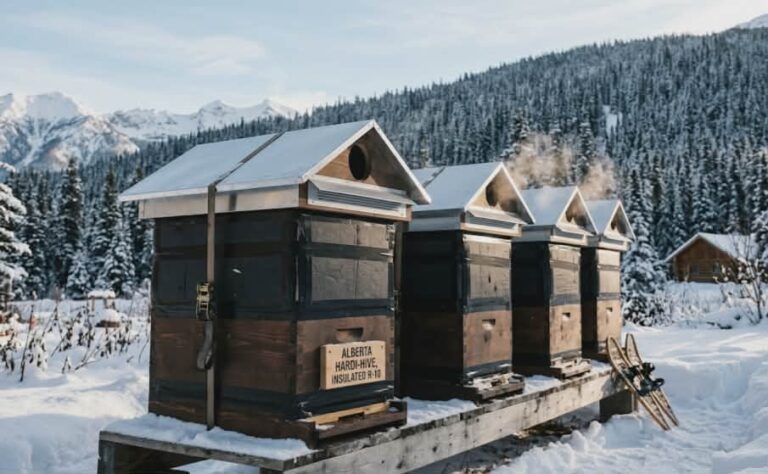
Yes — most Alberta beekeepers who overwinter colonies outdoors use some form of hive insulation or wrapping. Alberta’s Prairie winters regularly sustain temperatures of -20°C to -40°C with significant wind, and the extended cold period means colonies must maintain cluster warmth for five to six months with no foraging opportunity. A wrap reduces heat loss from the hive walls, moderates temperature swings during Chinook events, and protects the hive exterior from wind-driven moisture. The Alberta Beekeepers Commission recommends protective insulation for outdoor overwintering, and the practice is standard among both hobbyist and commercial beekeepers across the province. Hives wintered indoors in a managed cold room do not need external wrapping.
The Bee Cozy is a reusable winter hive wrap made by NOD Apiary Products, a Canadian manufacturer. It combines a UV-treated polypropylene outer shell with an R8 fibreglass inner insulating layer, and includes an inner cover pad. It is available in 1-storey (single deep) and 2-storey (double deep) versions, in both 8-frame and 10-frame sizes — the two sizes are not interchangeable, so you must select the version that matches your hive configuration. The Bee Cozy is widely used by Alberta beekeepers and is one of the most commonly referenced products for Prairie outdoor wintering. It reduces heat loss and acts as a windbreak, but like any wrap, it cannot compensate for inadequate stores, high Varroa, or a weak colony. Apply it once temperatures are consistently below 10°C and bees are no longer foraging.
Wrap Alberta beehives when daytime temperatures are consistently below 10°C and bees are no longer foraging actively — typically early to mid-October in central Alberta, earlier in northern regions and the Peace Country, somewhat later in southern Alberta in mild years. All fall preparation must be complete before wrapping: Varroa strips removed on schedule, liquid syrup feeding finished, mouse guards installed, and fondant or candy board placed above the cluster if stores are below target weight. The wrap should remain on the hive until spring temperatures are consistently above 10°C and any risk of snap freezes has passed — typically late April in most of Alberta.
Keep hives wrapped until temperatures are consistently above 10°C and the risk of spring snap freezes has passed. In Alberta this typically means late April to early May depending on region — southern Alberta may allow earlier unwrapping, northern Alberta and the Peace Region may need to keep wraps on into May. The Alberta Beekeepers Commission notes that wraps commonly stay on into late April under Prairie conditions. Do not unwrap based on calendar date alone — watch for consistent overnight temperatures above freezing and active bee flight activity before removing the wrap. Early unwrapping exposes colonies to cold snaps that can chill the cluster when the colony is most vulnerable and beginning to expand brood rearing.
No — a winter wrap must not block the hive’s ventilation. The Alberta Beekeepers Commission notes that the winter cluster produces heat, water vapour, and CO₂, and that without adequate ventilation, moisture can accumulate inside the hive. The wrap goes around the exterior and must leave both the lower entrance and any upper entrance or quilt box vents open and functional. The Bee Cozy’s installation instructions specifically note that both top and bottom entrances are required, and that the seam should face the front to create a tunnel where the entrances sit. A wrap that seals the hive is worse than no wrap — condensation accumulates and cannot escape.
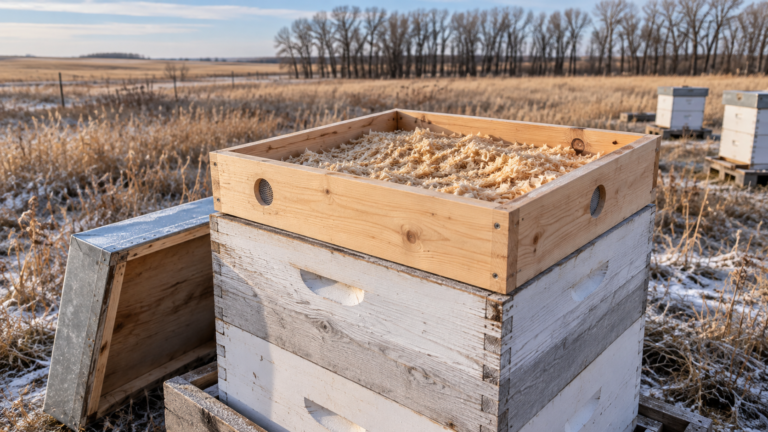
For Alberta outdoor wintering, top insulation above the cluster is a worthwhile addition alongside lateral wrapping. The Bee Cozy includes an inner cover pad that addresses top insulation to some degree. For additional top insulation, a quilt box or an insulated inner cover board placed above the cluster adds meaningful protection — warm air rising from the cluster meets a warmer overhead surface, which reduces condensation formation directly above the bees. The Alberta Beekeepers Commission notes that top insulation can be integrated into the lid or placed above the inner cover for individual hives. For grouped hives, a single large insulation piece placed over the group is also used. A lateral wrap plus top insulation gives more complete coverage than lateral wrapping alone for Alberta’s winter severity.
📋 In This Article
- Why Winter Wraps Matter in Alberta
- What Makes a Good Alberta Winter Wrap
- Types of Beehive Winter Wraps
- Best Beehive Winter Wraps for Alberta
- Bee Cozy Winter Wrap — Detailed Review
- Winter Wrap Comparison Table
- Commercial Wrap vs. DIY Insulation
- How to Install a Winter Wrap in Alberta
- Moisture and Ventilation — Don’t Seal the Hive
- Top Insulation — The Lateral Wrap’s Missing Half
- Common Winter Wrap Mistakes
- Which Wrap Should You Choose?
- Alberta Winter Prep Checklist
A winter wrap is the last thing that goes on an Alberta hive before winter — not the most important thing. Adequate stores, low Varroa, a strong queen, and a large enough cluster all matter more than what covers the outside. But for a colony that enters winter in good condition, the right wrap reduces heat loss, buffers temperature swings, and gives that colony a measurably more stable environment through six months of Prairie cold.
Why Winter Wraps Matter in Alberta
A standard wooden Langstroth hive body is not designed for sustained -30°C temperatures. The wood provides minimal insulation — not much more than a cold frame — and the large exterior surface area dissipates the cluster’s generated warmth rapidly. A winter wrap reduces the rate at which the hive loses this heat to the outside by adding an insulating and wind-resistant layer around the hive body.
This matters in two specific ways for an Alberta colony. First, less heat loss means fewer stores consumed maintaining cluster temperature — every calorie saved in January is a calorie available for spring buildup. Second, Alberta’s Chinook events can swing temperatures by 20°C or more within hours; a wrapped hive moderates this swing better than an unwrapped one, reducing the metabolic disruption these temperature changes cause.
A good Alberta winter wrap should: reduce heat loss through the hive walls; provide a wind barrier against Prairie winds; protect the outer hive surface from wind-driven moisture and ice; and fit precisely enough that no gaps allow cold air channelling underneath or around the sides. It should do all of this without blocking the entrances or ventilation the colony needs.
What Makes a Good Alberta Winter Wrap
🌡️ Insulation Value
Products that state an R-value (R4, R5, R8) give you a basis for comparison. A plain black polypropylene sleeve with no inner layer provides wind protection but minimal insulation. Confirm whether a listed product has an inner insulating layer or is an outer sleeve only.
💨 Wind Protection
Particularly important in exposed Alberta apiary locations. The wrap material should be dense enough to block wind-driven cold air, not simply a loose cover. Consider the closure system — Velcro and overlapping seams hold better in Chinook-speed winds than loose folds.
📐 Hive Fit
8-frame and 10-frame wraps are not interchangeable. Single-storey (one deep) and double-storey (two deeps) wraps are sized differently. Measure your exact hive body dimensions and match the wrap before ordering — a loose or oversized wrap creates gaps that negate its function.
🌬️ Entrance Access
The wrap must leave both the lower entrance and any upper entrance or quilt box vents completely clear. A wrap that blocks the entrance must be cut or repositioned — this is a step worth verifying against the product description before purchase.
💧 Moisture Resistance
The outer layer must withstand Alberta’s freeze-thaw and wet snow cycles without absorbing water into the insulating layer. Polypropylene exteriors handle this well. Natural fibre wraps become heavy and lose insulation value when wet.
♻️ Reusability and Cost per Season
A higher-cost commercial wrap that lasts 5+ seasons may cost less per season than tar paper replaced annually. Calculate cost per season per hive — not just purchase price — before making the comparison. Confirm whether the product can be cleaned and stored without degradation.
Types of Beehive Winter Wraps
UV-treated polypropylene exterior with an inner insulating layer (fibreglass, aerofoil, or foam). Pre-sized for standard Langstroth equipment. Reusable 3-5+ seasons. The Bee Cozy is the leading example.
Bubble-style or foil-faced layered insulation wraps. Can supplement a commercial wrap or serve as a standalone option in less severe locations. Not equivalent to polypropylene foam wraps in sustained extreme cold.
Rigid Styrofoam or fiberfill panels cut to hive dimensions and wrapped in polyethylene or tar paper, secured with bungee cord or staples. Documented in Alberta practice. Lower cost, higher effort.
Best Beehive Winter Wraps for Alberta
The Bee Cozy is manufactured by NOD Apiary Products in Canada and is the most widely used winter hive wrap among Alberta outdoor beekeepers. Its construction combines a UV-treated polypropylene outer shell with an R8 fibreglass inner insulating layer — this is not neoprene or simple plastic sheeting. The product has been used to winterize colonies for over 25 years and is specifically designed for Langstroth hive equipment in Canadian Prairie conditions.
It is available in four configurations: 1-storey and 2-storey versions in both 8-frame and 10-frame sizes. Each version is designed for its specific hive configuration — the 2-storey wrap covers a double deep or equivalent two-box winter setup, and the 8-frame and 10-frame versions are not interchangeable. The wrap also includes an inner cover pad that provides some top insulation above the colony. Installation follows the seam-to-front approach that NOD specifies: the seam creates an opening tunnel where both upper and lower entrances sit, so ventilation is maintained without cutting or modification.
✓ Advantages
- R8 fibreglass insulation confirmed by manufacturer and retailers
- Canadian-made, designed for Prairie winter conditions
- Includes inner cover pad for top insulation
- Quick installation — slides over hive, seam to front
- Reusable multiple seasons when stored properly
- Available in 4 configurations for different hive setups
— Limitations
- Higher upfront cost vs tar paper alternatives
- If mice chew a hole and moisture enters, insulation value is reduced
- Must select exact configuration — 8 and 10 frame not interchangeable
- The included inner cover pad may not fully replace a dedicated quilt box in severe cold
Several manufacturers produce insulated hive wraps with a Velcro closure system and a vinyl or polypropylene outer layer backed by an inner insulating layer rated at R4 or R5. These wraps typically fit two standard deep boxes for an 8-frame or 10-frame hive and are designed for quick installation without the slide-over approach of the Bee Cozy. The Velcro closure allows adjustment and re-use, though it must be checked periodically during the winter to ensure it has not come loose in wind.
The R4–R5 rating provides meaningful insulation for Alberta winters, though it is lower than the Bee Cozy’s R8. For most Alberta locations, R4-R5 is adequate when combined with good top insulation and wind protection from natural or installed windbreaks. Verify entrance opening position against your hive entrance location before ordering — not all wraps of this style have openings in compatible positions for every hive body brand.
✓ Advantages
- Velcro closure — easier to adjust and check mid-winter
- R4–R5 insulation — meaningful thermal value for Alberta
- Available in 8 and 10 frame versions
- Typically lower cost than Bee Cozy
- Reusable multiple seasons
— Limitations
- Lower R-value than Bee Cozy (R4–R5 vs R8)
- Velcro can loosen in Chinook wind events — check after each
- Entrance opening position varies between products — verify before ordering
- No included inner cover pad — top insulation requires separate solution
Tar paper (15 lb roofing felt) wrapping remains in use among Alberta beekeepers, particularly those managing larger numbers of hives where the cost difference becomes significant. The paper reduces direct wind exposure, provides some modest solar heat absorption on clear winter days through its black surface, and costs a fraction of commercial poly wraps. However, it provides minimal actual insulation — it is primarily a wind and moisture barrier for the hive exterior, not a thermal insulating layer.
For Alberta’s sustained extreme cold periods, tar paper alone is a weaker option than an insulated commercial wrap. Experienced Alberta commercial beekeepers who use tar paper typically also group hives in blocks of four with additional rigid foam insulation panels, which adds the R-value that the tar paper does not provide. For a single exposed hive in a northern Alberta location, tar paper alone is a significant step below an R8 poly wrap in terms of actual thermal protection.
✓ Advantages
- Very low cost — a roll covers many hives
- Available at every hardware store
- Black surface absorbs some solar warmth on sunny days
- Reduces wind exposure effectively
— Limitations
- Minimal insulation value — wind barrier, not thermal insulator
- Degrades in UV and freeze-thaw — replace annually or every two seasons
- Labour-intensive — stapling required each season
- Insufficient alone for single exposed hives in severe Alberta cold
Bee Cozy Winter Wrap — Detailed Review
What Is the Bee Cozy?
The Bee Cozy is a purpose-designed winter hive wrap produced by NOD Apiary Products (NOD Global), a Canadian beekeeping supplies manufacturer. It has been in production and use for over 25 years. The product is made from UV-treated polypropylene on the exterior with an inner R8 fibreglass insulating layer — not neoprene, not plain plastic, not foam alone. Many online descriptions mischaracterize the material; the manufacturer’s specification and verified retailer listings confirm UV polypropylene + R8 fibreglass.
Available Sizes
The Bee Cozy is sold in four distinct configurations that are not interchangeable:
- →1-Storey, 10-frame — fits a single deep 10-frame Langstroth; includes a 10-frame inner cover pad
- →1-Storey, 8-frame — fits a single deep 8-frame Langstroth; includes an 8-frame inner cover pad
- →2-Storey, 10-frame — fits two deep boxes (double deep), 10-frame; includes a 10-frame inner cover pad
- →2-Storey, 8-frame — fits two deep boxes (double deep), 8-frame; includes an 8-frame inner cover pad
Bee Cozy Installation — Key Notes from the Manufacturer
Install when temperatures are consistently below 10°C (50°F). Keep the wrap seam to the front of the hive — the seam creates a tunnel opening where top and bottom entrances are positioned. Roll excess air out of the wrap before sliding it over the colony. Allow 1 day for the wrap to fully re-expand after storage before assessing fit. Tip colonies slightly forward so moisture drains away from the entrance. Remove when temperatures are consistently above 10°C and snap freezes have passed.
Winter Wrap Comparison Table
| Feature | Bee Cozy | Insulated Vinyl Wrap | Tar Paper | DIY Foam + Poly |
|---|---|---|---|---|
| Insulation | R8 fibreglass | R4–R5 | Minimal | By thickness |
| Wind protection | Yes | Yes | Yes | Yes |
| Moisture resistance | UV poly exterior | Vinyl exterior | Some — degrades | Poly cover required |
| Reusable | 3–5+ seasons | Multiple seasons | 1–2 seasons | Yes |
| Installation | Slide over hive — 2 min | Wrap and Velcro — 3 min | Staple all edges | Cut and secure panels |
| 8-frame option | Yes | Yes | Yes — cut to fit | Yes — custom cut |
| 10-frame option | Yes | Yes | Yes — cut to fit | Yes — custom cut |
| Top insulation included | Inner cover pad | Not included | No | If top panel added |
| Best suited for | Standard Prairie outdoor wintering | Budget-conscious individual hives | Grouped hives + supplemental foam | Custom or non-standard setups |
Commercial Wrap vs. DIY Insulation
The Alberta Beekeepers Commission acknowledges that winter insulation can be homemade or commercially purchased, and experienced Alberta beekeepers use both approaches. The materials mentioned for DIY use in Alberta include Styrofoam, fiberfill, and fibreglass, typically protected by polyethylene or tar paper. Rigid foam panels held with bungee cord and wrapped in roofing paper is one commonly referenced Alberta DIY approach, and grouped hive blocks with R12 lateral and R20 top insulation represent the commercial-scale version of the same principle.
Advantages of Ready-Made Wraps
- Pre-sized to standard Langstroth dimensions
- Known and confirmed insulation value (R-value stated)
- Quick installation — under 5 minutes per hive
- Reusable for multiple seasons
- Designed with entrance access built in
- No cutting, fitting, or material sourcing required
When DIY Makes Sense
- Non-standard hive dimensions that commercial wraps don’t fit
- Grouped hive blocks where shared insulation is more efficient
- Potentially lower material cost per hive at large scale
- Configurable R-value by choosing foam thickness
- Requires measuring, cutting, and securing correctly each season
- Material durability varies — poly cover protects foam from degradation
How to Install a Winter Wrap in Alberta
Before Wrapping — Confirm These Are Done
The wrap is the last step. Complete all of the following before the wrap goes on: fall Varroa treatment removed at the correct day count; liquid syrup feeding finished and feeders removed; colony weight at or above target (fondant in place if below); mouse guard installed; quilt box or top insulation in place; outer cover secured against wind.
Timing
Wrap when daytime temperatures are consistently below 10°C and bees are no longer actively foraging — typically October in central Alberta, earlier in northern regions. Do not wrap while bees are still flying regularly in warm daytime temperatures; premature wrapping can overheat the hive on warm Chinook days. Do not delay until severe cold has already settled — wrapping after the cluster is fully formed disturbs the colony in vulnerable early-winter confinement.
During Installation
For a Bee Cozy: roll air out, slide over the hive with the seam at the front, tip the hive slightly forward for drainage. For a Velcro wrap: position so the entrance opening aligns, wrap snugly without gaps at the bottom, secure the closure firmly. For tar paper: wrap all four sides with 10-15 cm overlap, staple every 15-20 cm on all edges, fold and staple corners neatly. For any wrap type: confirm both entrances are clear, quilt box vents are unblocked, and the outer cover closes completely over the wrap.
Moisture and Ventilation — Do Not Seal the Hive
Insulation and ventilation work together. A winter wrap should not turn the hive into a sealed box. The Alberta Beekeepers Commission notes that the winter cluster produces heat, water vapour, and CO₂, and that without adequate ventilation, moisture accumulates inside the hive with potentially serious consequences.
A Wrap That Blocks the Entrance Is Worse Than No Wrap
A completely sealed hive accumulates carbon dioxide and moisture. Bees need a clear exit for cleansing flights on mild winter days, and the upper entrance or quilt box vents must remain open for moisture to escape. Verify that your chosen wrap has an entrance opening in the right position, and after installation, walk around the hive and confirm all ventilation openings are clear.
Top Insulation — The Lateral Wrap’s Missing Half
A lateral wrap covers the sides of the hive. It does not insulate the space directly above the winter cluster — where warm cluster air rises and condensation forms on cold overhead surfaces. For complete Alberta winter protection, top insulation should be addressed separately from or in addition to the lateral wrap.
The Bee Cozy includes an inner cover pad that addresses top insulation to a degree. For additional or more complete top insulation, a quilt box filled with coarse wood shavings or an insulated inner cover board placed above the cluster provides meaningful improvement, particularly in northern Alberta locations or for hives in very exposed positions. The Alberta Beekeepers Commission notes that top insulation can be integrated into the lid or placed above the inner cover for individual hives.
Common Winter Wrap Mistakes
✗ Avoid These Wrapping Mistakes
- Blocking the lower or upper entrance — bees must be able to exit; moisture must be able to escape
- Ordering the wrong hive size — 8-frame and 10-frame, and 1-storey and 2-storey, are not interchangeable
- Leaving gaps at the bottom where cold air channels under the wrap
- Wrapping while bees are still actively foraging in warm weather — creates overheating risk on Chinook days
- Relying on tar paper alone for a single exposed hive in northern Alberta’s severe cold
- Blocking quilt box ventilation holes with wrap material
- Not securing the outer cover against wind — Chinook events can remove an unsecured cover in hours
- Not installing a mouse guard before wrapping — mice establish themselves quickly once entrance patrolling decreases
- Assuming a good wrap solves every winter problem — colony strength, stores, and Varroa all matter more than what is on the outside
Which Winter Wrap Should You Choose for Alberta?
🏆 Exposed Single Hive, Standard Alberta Outdoor
- Bee Cozy 2-storey — confirm 8 or 10 frame version matches your hive
- Add quilt box or insulated inner cover pad for top insulation
- Secure outer cover against Chinook winds
💰 Budget-Conscious, Sheltered Location
- Insulated vinyl wrap with confirmed R-value and entrance opening
- Or tar paper supplemented with rigid foam panels above the cluster
- Natural windbreak adds significant wind protection at no cost
🔢 Multiple Hives — Grouped Configuration
- Individual Bee Cozy per hive, or
- Grouped blocks of 4 with shared rigid foam insulation on sides (R12) and top (R20)
- Group wrapping is the documented Alberta commercial approach
🛠️ Non-Standard Hive Dimensions
- DIY rigid foam panels cut to exact hive dimensions
- Protected with polyethylene outer layer or tar paper
- Confirm entrance openings are cut before installation
Alberta Winter Prep Checklist — Before and During Wrapping
☐ Confirm Before Installing the Wrap
- Colony strength assessed — at minimum 7-8 frames of bees
- Winter stores at target weight — fondant in place if stores are below minimum
- Post-treatment Varroa alcohol wash below 3% threshold
- Liquid feeding complete — feeders removed
- Varroa treatment strips removed at correct day count
- Quilt box or top insulation in place above the cluster
- Wrap size confirmed against actual hive dimensions (8 or 10 frame; 1 or 2 storey)
- Mouse guard installed before wrap goes on
- Outer cover secured with strap or weight against Chinook winds
- Both lower and upper entrances remain clear after wrap installation
- Quilt box vents or inner cover notch not blocked by wrap material
Final Thoughts on Winter Wraps for Alberta
An Alberta hive that enters winter with adequate stores, low Varroa, a healthy queen, and a strong cluster has the biological tools to survive the season. A well-fitted insulated wrap — Bee Cozy or equivalent — reduces the energy cost of maintaining that cluster through six months of Prairie cold. A quilt box above the cluster handles the moisture and top insulation side of the equation. Together, they give a prepared colony the best possible conditions for a full Prairie winter.
The wrap choice matters. But it matters last — after stores, Varroa, and colony strength. Get those right first. Then choose the wrap that fits your hive configuration correctly. 🐝❄️
Questions about wrapping your Alberta hives? 🐝
Tell our AI assistant your hive configuration, region in Alberta, and current setup — we’ll help you choose the right wrap type and confirm your complete winter configuration.
🐝 Ask Bee Now — It’s Free🐝 WiseBee Disclosure
Affiliate Disclosure: This article contains Amazon affiliate links. If you purchase through our links, we earn a small commission at no extra cost to you. Learn more →
Disclaimer: This article is for educational purposes only and does not constitute professional apicultural or veterinary advice. Always consult a qualified beekeeper for guidance specific to your situation. Full disclaimer →