How to Feed Bees Fondant
and Candy Boards in Cold Weather
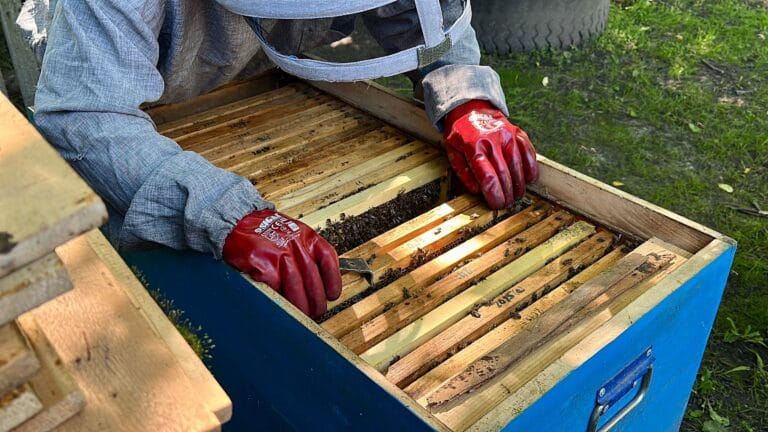
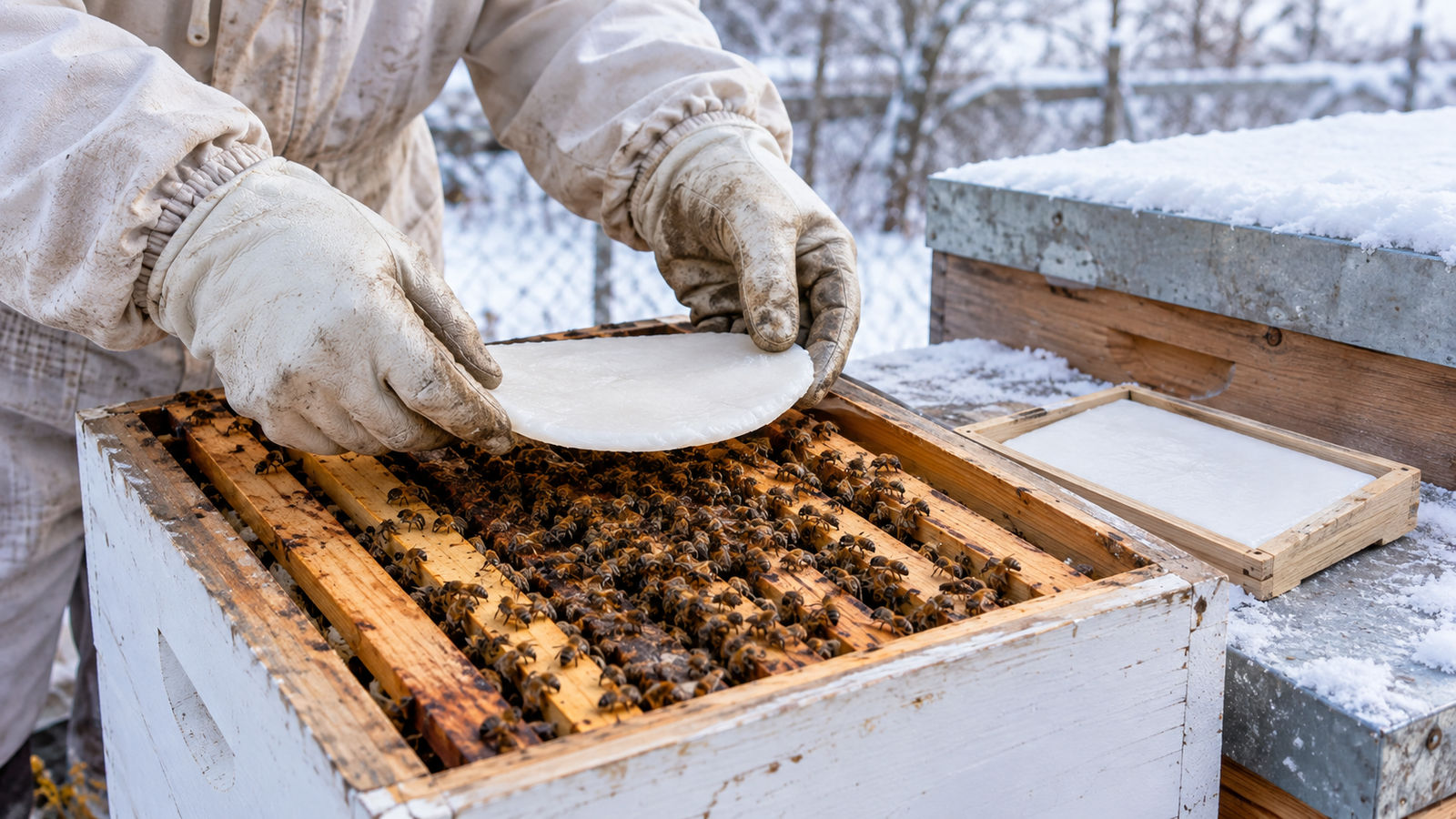
Place fondant directly above the winter cluster on the top bars, using a feeding shim or spacer rim to create enough clearance for bees to access it. The fondant must be positioned as close as possible to where the cluster is sitting — a block placed at the opposite end of the hive from the cluster may be inaccessible to bees that cannot break cluster in cold weather to reach it. Choose a calm, relatively mild day to open the hive briefly — minimize the time the hive is open. Close the hive promptly after placing the fondant. Do not disturb the cluster itself.
The relevant temperature is the temperature of the syrup itself, not the outside air. Research by Rusty Burlew (American Bee Journal) confirms that bees stop taking syrup when the syrup temperature drops to around 10°C (50°F). In a cold hive, syrup cools toward the ambient air temperature regardless of the air temperature inside. As a practical rule: when overnight temperatures are consistently falling below 10°C (50°F), switch to solid feed. At around 14-15°C (57-59°F), individual bees begin to struggle to maintain mobility without cluster warmth. The specific threshold varies with climate, hive configuration, and how well-insulated the feeder is — but consistently cold nights below 50°F (10°C) are the clearest signal to move to fondant or candy board.
Yes — fondant is one of the preferred cold-weather feeding options for honey bees precisely because bees can consume it without needing the material to be liquid. Bees moisten the fondant with saliva to dissolve the sugar, which means the feed is always at the bees’ own body temperature rather than the ambient air temperature. This makes fondant accessible to bees in cluster even when syrup would be too cold to drink. The fondant must be placed directly above or immediately accessible to where the cluster is sitting — bees in a tight winter cluster cannot travel far from the cluster to reach food on the opposite side of the hive.
Both fondant and dry granulated sugar (mountain camp method) are used as cold-weather emergency feeds, and both work. The practical differences are: fondant stays in place more reliably and can be pre-made in blocks; dry sugar requires a flat surface and can fall through frames if not placed carefully on newspaper or in a shallow form. Fondant provides a compact, consistent surface the bees can access directly. Dry sugar can be poured or spread quickly with minimal hive disturbance, which some beekeepers prefer in very cold conditions. Candy boards (solidified sugar in a board or frame) sit between the two — they are a pre-made solid that installs like fondant but uses a slightly different preparation. All three are preferable to syrup when temperatures are consistently below 10°C (50°F).
Yes — fondant as a cold-weather and emergency bee feed is used across Canada, the UK, Germany, Sweden, and cold-climate beekeeping regions throughout Northern and Central Europe. EU best management practices compiled across 11 European countries describe the use of solid feeds after cluster formation as a common approach in cold-climate regions. A 2026 scientific study on winter colony feeding documented the use of fondant placed above the cluster in colonies from the Toronto, Canada area during milder winter periods, confirming the approach is actively used and studied under Canadian conditions. The same principle applies across all cold-climate regions: liquid syrup becomes impractical once temperatures drop sufficiently; solid feed placed above the cluster is the practical alternative.
📋 In This Article
- When Is It Too Cold to Feed Bees Syrup?
- When to Use Fondant Instead of Syrup for Bees
- Fondant vs Candy Board vs Dry Sugar — What’s the Difference?
- How Much Winter Food Does a Colony Need?
- How to Make Bee Fondant — Step-by-Step Recipe
- How to Make a Candy Board for Bees
- How to Install Fondant Above the Winter Cluster
- How to Install a Candy Board in a Beehive
- Fondant and Moisture Management in Winter Hives
- Where This Cold-Weather Feeding Approach Applies
- How to Know If a Colony Needs Emergency Feed
- Common Fondant and Candy Board Mistakes
- Fondant vs Syrup — Quick Decision Guide
- Emergency Feeding Checklist
Solid emergency feed for bees — fondant, candy boards, or dry sugar — solves one specific problem: a colony that is short of food when temperatures are too cold for liquid syrup to be practical. It is not a substitute for autumn preparation, and it does not improve on a colony that was properly fed in fall. But when a colony is short of stores mid-winter and temperatures make syrup feeding impossible, getting solid feed above the cluster quickly can be the difference between a colony that survives to April and one that does not.
When Is It Too Cold to Feed Bees Syrup? — The Temperature Threshold Explained
The relevant temperature for winter syrup feeding is not the outdoor air temperature — it is the temperature of the syrup itself. A container of syrup placed in a cold hive will cool to approximately the ambient air temperature within a few hours. Research confirms that bees stop drinking syrup when the syrup temperature drops to around 10°C (50°F). Below this point, bees will not take the feed even if they are hungry.
There are two additional problems beyond accessibility. First, even if bees do take cool syrup, cold air holds very little moisture — bees cannot evaporate the excess water from the syrup to cap it safely as stores. Syrup taken down at low temperatures may sit uncapped in cells and ferment or contribute to hive humidity. Second, individual bees begin to lose mobility at around 14-15°C (57-59°F) without the collective warmth of the cluster — a lone bee away from the cluster in cold weather may not be able to return to it.
Entomologist Rusty Burlew, writing in the American Bee Journal, confirmed through repeated observation that bees cease taking syrup when the syrup itself — not the outside air — reaches approximately 50°F (10°C). A colony may be active at 15°C air temperature while its feeder sits at 8°C and goes untouched. This is why the practical guideline — “stop syrup when overnight temperatures consistently fall below 10°C” — works as a rule of thumb even though the mechanism is about syrup temperature, not air temperature.
No Universal Cut-Off Temperature — Use Judgment
The 10°C (50°F) guideline is a practical threshold, not an absolute rule. Hive type, feeder placement, insulation level, and local microclimate all affect the actual syrup temperature inside a given hive. In a well-insulated hive with an internal top feeder, syrup stays warmer longer than in an uninsulated hive with an external entrance feeder. Use consistent overnight temperature patterns and observed bee behaviour as your signal — not a fixed calendar date or a single temperature reading.
When to Use Fondant Instead of Syrup for Bees in Winter
Autumn syrup feeding while temperatures allow is always the preferred approach to building winter stores. Fondant is not a substitute for that preparation — it is emergency supplemental feed for colonies that arrive at winter with a stores deficit, or for colonies whose stores prove insufficient partway through winter. Use fondant when:
- →Temperatures are consistently below 10°C overnight — syrup is no longer practical as a primary feed method
- →The winter cluster has fully formed and bees cannot reliably reach a liquid feeder
- →Late winter stores are running low — fondant placed in late January or February can prevent starvation when the colony is beginning spring buildup but cannot yet forage
- →The hive feels light and stores appear exhausted — intervening early with solid feed is better than waiting until the colony is already starving
Fondant Is Emergency Insurance — Not an Autumn Preparation Substitute
A colony that entered winter well below target weight because it was underfed in autumn faces other problems beyond food quantity — bee population, Varroa damage to winter bees, and cluster size all matter. Fondant can address a food shortfall; it cannot correct damage already done to the winter bee generation from high Varroa loads or insufficient population. Address those in August and September — fondant addresses what it can in January and February.
Fondant vs Candy Board vs Dry Sugar — What Is the Difference?
| Feed Type | What It Is | Typical Use | Preparation | Accessibility to Cluster |
|---|---|---|---|---|
| Bee Fondant | Cooked solid sugar paste — smooth, dense texture | Cold-weather emergency feed, late winter supplement | Cooked to exact temperature; sets firm | High — bees moisten with saliva |
| Candy Board | Solidified sugar in a wooden frame or form | Winter supplemental feed, pre-installed before winter | Poured into frame form; air-dried or baked | High — same mechanism as fondant |
| Dry Sugar (Mountain Camp) | Plain granulated white sugar poured directly | Emergency quick-install feed | None — pour directly on newspaper over frames | Good if placed correctly above cluster |
| 2:1 Syrup | Sugar dissolved in water | Autumn stores building while temperatures allow | Dissolve sugar in warm water | Fails below ~10°C syrup temperature |
Dry Sugar Is Not the Same as Fondant — But It Works
Fondant and dry sugar address the same problem through different methods. Fondant is a cooked product with a specific sugar crystal structure that stays cohesive — bees work the surface with their mouthparts. Dry granulated sugar poured in the “mountain camp” method relies on condensation moisture inside the hive to gradually moisten the sugar’s surface. Both work. Fondant is generally more reliable in very cold, dry conditions where condensation may be minimal. Dry sugar is faster to install and requires no preparation.
How Much Winter Food Does a Colony Actually Need?
There is no universal answer — the right amount depends on hive type, colony size, climate severity, winter duration, and how much stored honey the colony already has. What fondant provides is supplemental emergency food on top of existing stores, not a full replacement for them.
As a general orientation for cold-climate beekeeping: official Ontario minimums (ontario.ca) are 32 kg / 70 lbs total hive weight for a single brood box and 45 kg / 100 lbs for a double — well-prepared colonies at these weights typically do not need fondant through a normal winter. A colony significantly below these weights heading into winter has a real risk of starvation before spring, and fondant installed in October or November may be the difference.
For late-winter top-up feeding (January–March), even colonies that entered winter adequately stocked can run short in a long or cold season, particularly as brood rearing begins and store consumption increases. Place fondant as soon as you determine stores are running low — do not wait for warm weather to feed syrup if the colony is at risk now.
Homemade or Ready-Made Bee Fondant: Which Should You Choose?
Before preparing fondant at home, it is worth knowing that ready-made bee fondant is commercially available in many beekeeping markets — including Canada, the UK, and continental Europe. Products such as Fondabee and HiveAlive Fondant Patties are sold in beekeeping supply shops and come pre-portioned and ready to place in the hive, with no cooking or mixing required.
Commercial Bee Fondant: A Convenient Alternative
Ready-made bee fondant eliminates the need to cook sugar, monitor temperatures, or mix the mixture yourself. Many products come in sealed packaging designed for direct placement inside the hive, above the cluster, following the manufacturer’s instructions. They are easy to store and practical for beekeepers managing multiple colonies or with limited preparation time.
When choosing a commercial product, look for fondant specifically formulated for honey bees. Check the ingredients and intended use — not every sugar paste sold commercially is suitable for winter feeding. Some products are formulated for spring stimulation rather than cold-weather emergency feeding, so read the label before purchasing.
Homemade fondant remains a practical option for beekeepers who prefer to prepare their own feed or want to reduce costs, particularly when feeding several colonies. The right choice depends on your available time, budget, and beekeeping setup — both homemade and commercial fondant can work well when properly prepared and correctly placed.
How to Make Bee Fondant at Home — Step-by-Step Recipe
Bee fondant is cooked to a precise temperature — this determines whether it sets correctly. A fondant cooked too cool stays sticky and soft; one cooked too hot becomes too hard for bees to work easily. Use a candy thermometer for reliable results. The recipe below is a tested formulation; results depend on following the temperature and method carefully.
Ingredients for ~2 kg of Bee Fondant
- 2 kg (4.4 lbs) plain white granulated sugar — no flavourings, colourings, or additives
- 600 ml (2.5 cups) water
- Optional: a small amount of white vinegar. Because acidity can affect sugar crystallization and texture, follow the tested recipe rather than adding vinegar by default — a plain sugar-and-water recipe is also suitable.
How to Make a Candy Board for Bees
A candy board is a distinct preparation from fondant — the two methods are not interchangeable. Fondant is cooked to a specific temperature and beaten to create a smooth, fine-crystal texture. A candy board uses a simpler no-boil method: damp sugar is packed into a frame and allowed to harden. Mixing the instructions for the two methods will produce a result that is either too soft or too hard to be useful.
Candy boards are designed to sit in a wooden frame directly on the top bars. They are often pre-installed before winter rather than added as emergency feed, but can also be made quickly as a cold-weather supplement.
What You Need for a 10-Frame Candy Board
- 2-3 kg (4.5–6.5 lbs) plain white granulated sugar
- 60–80 ml (¼ cup) water — just enough to dampen the sugar
- Shallow wooden frame or form matching your hive body footprint (8 or 10 frame)
- Parchment paper or wax paper to line the form
How to Install Fondant Above the Winter Cluster — Step by Step
Placement is the most important variable in cold-weather fondant feeding. Fondant placed at the wrong position in the hive may be completely inaccessible to a clustered colony in cold weather. A 2026 study on winter colony feeding — including data from colonies in the Toronto, Canada area — documented effective fondant feeding with product placed directly above the cluster during milder winter periods, confirming that proximity to the cluster is critical.
Fondant Placed Away From the Cluster May Not Be Reached
This is the most common reason fondant feeding fails in winter. A block placed on the left side of the hive while the cluster is on the right may be 30 cm away from the nearest bees — in cold weather, the cluster cannot break formation to travel that distance. If you find fondant untouched at a spring inspection while the colony starved, misplaced feed is often the cause. Always position solid feed directly above the cluster’s location.
How to Install a Candy Board in a Beehive
A candy board is designed to sit directly on the top bars as a frame-sized unit, requiring less precise positioning than a loose block of fondant. Install it with the sugar side facing down so bees can access it from below. Some candy boards include a small upper entrance notch cut into the frame — this serves as both an additional ventilation point and a bee exit, and it must remain open and not covered by the outer cover.
Check the candy board periodically on mild days by lifting the outer cover briefly — you can see how much has been consumed without disturbing the cluster. Replace or top up when stores appear significantly depleted, or when the board shows signs of heavy moisture absorption (soft, wet texture). Keep a spare board made and ready so replacement takes minimal time. How often to check depends on colony size, winter conditions, and how much food was available when the board was installed — there is no single interval that applies to all colonies.
Fondant and Moisture Management in Winter Hives
Solid feed solves a food-access problem. It does not solve a moisture problem. A colony with adequate fondant but poor top ventilation can still develop condensation issues above the cluster. These are separate concerns that require separate solutions — do not assume that installing fondant removes the need for proper above-cluster insulation and ventilation management.
There is a specific interaction worth noting: fondant installed without a feeding shim, placed directly against the hardware cloth bottom of a quilt box, can wick moisture into the quilt shavings and contaminate them. Always use a feeding shim to keep fondant separated from the quilt box material above it.
Where This Cold-Weather Bee Feeding Approach Applies
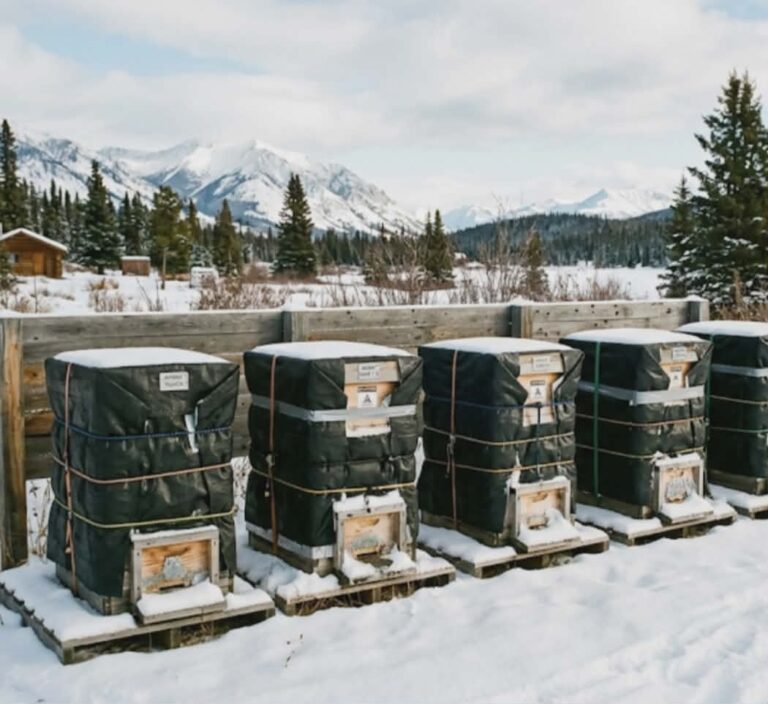
The principle — switch from syrup to solid feed when temperatures make syrup impractical — applies wherever bees are kept in conditions cold enough to make liquid feeding unreliable. The specific timing, quantities, and hive configurations vary by region, but the underlying approach is consistent.
🇨🇦 Canada — Prairies and Northern Regions
Long cold periods in Alberta, Saskatchewan, Manitoba, and northern Ontario make solid emergency feed relevant once the main liquid feeding window closes in September–October. A 2026 scientific study documented fondant use in Toronto-area colonies during mild winter periods, confirming active use under Canadian conditions.
🇺🇸 Northern United States
Upper Midwest (Minnesota, Wisconsin, Michigan UP), Northern Plains, Northeast (Vermont, Maine, New Hampshire, New York), and northern mountain regions all experience winter conditions where liquid feeding becomes impractical. Same principle; timing varies by local conditions.
🇬🇧 United Kingdom
Fondant is a standard cold-weather and emergency bee feed in the UK — widely sold in beekeeping shops as ready-made blocks. UK winters are milder than Canadian Prairies but cold enough to make syrup impractical for extended periods. British Beekeepers Association guidance includes fondant as a recommended winter feed.
🇩🇪 🇸🇪 Northern and Central Europe
EU best management practices compiled across 11 European countries including Germany, Sweden, and others describe solid feeds after cluster formation as standard practice in cold-climate regions. Local recommendations vary by country and hive type — consult regional beekeeping associations for country-specific guidance.
How to Know If a Colony Needs Emergency Feed in Winter
Do not open a wintered hive simply to check whether it needs feeding. Unnecessary disturbance in cold weather loses heat that the cluster may take days to recover. Use these external indicators first:
- →Hive feels unusually light when hefted from the back — significantly lighter than it was in October
- →Bees visible near the entrance or upper entrance in cold weather — this can be a possible indicator to investigate further, but it is not a reliable sign of starvation on its own. Interpret it alongside hive weight and the colony’s known stores situation.
- →Winter was longer or colder than typical — colonies that entered winter at minimum stores may be running short before spring
- →Colony entered winter below target weight — if you knew stores were marginal in October, proactive February feeding is appropriate without waiting for distress signals
If the hive feels adequately heavy and no distress signals are visible, do not open it. A quiet hive in winter is not a hive in distress — it is a colony managing its cluster correctly. Unnecessary inspections are one of the more common causes of winter colony loss.
Common Fondant and Candy Board Mistakes to Avoid
✗ Mistakes That Reduce Feeding Effectiveness
- Placing fondant at the wrong end of the hive — bees in cluster cannot travel to reach food that is not directly above them
- Waiting until the colony is already starving — intervene early when stores seem low, not when dead bees confirm starvation
- Opening the hive too long or in cold, windy conditions — cluster heat lost during installation may take longer to recover than the fondant helps
- Using commercial fondant not formulated for honey bees — patisserie fondant and cake decoration pastes may contain flavourings, colourings, or other additives not suitable for bees. Choose a product specifically labelled for beekeeping use and check the ingredients before purchasing.
- Installing fondant without a feeding shim — bees cannot access fondant sitting flat on top bars without clearance to get underneath it
- Assuming fondant solves a moisture problem — it addresses food, not condensation; ventilation must be managed separately
- Treating fondant as an autumn preparation substitute — a colony that was not properly fed in fall has other problems fondant cannot fix
- Blocking ventilation by piling fondant too high or against upper ventilation openings
Fondant vs Syrup — Quick Decision Guide for Feeding Bees in Cold Weather
Emergency Cold-Weather Feeding Checklist
☐ Before and During Every Cold-Weather Feeding
- Confirm the colony actually needs food — heft the hive, check for distress signals before opening
- Verify that temperatures are genuinely too cold for syrup — don’t switch to fondant unnecessarily if conditions still allow liquid feeding
- Use plain white sugar fondant only — no commercial fondant with flavourings, colourings, or additives
- Prepare fondant, feeding shim, and all tools before opening the hive
- Choose the calmest, mildest day available — minimize hive open time
- Locate the cluster position before placing feed — fondant must go directly above the cluster
- Use a feeding shim to create clearance between top bars and fondant
- Ensure fondant does not block or contact quilt box hardware cloth above
- Keep hive open for the minimum time — aim for under 2 minutes
- Check ventilation after installation — entrance and upper vents must remain clear
- Plan to check again in 2–3 weeks and replace fondant if needed
Questions about feeding your bees this winter? 🐝
Tell our AI assistant your hive weight, region, and current temperature conditions — we’ll help you decide whether fondant is needed and how to install it correctly.
🐝 Ask Bee Now — It’s Free🐝 WiseBee Disclosure
Affiliate Disclosure: This article contains Amazon affiliate links. If you purchase through our links, we earn a small commission at no extra cost to you. Learn more →
Disclaimer: This article is for educational purposes only and does not constitute professional apicultural or veterinary advice. Always consult a qualified beekeeper for guidance specific to your situation. Full disclaimer →