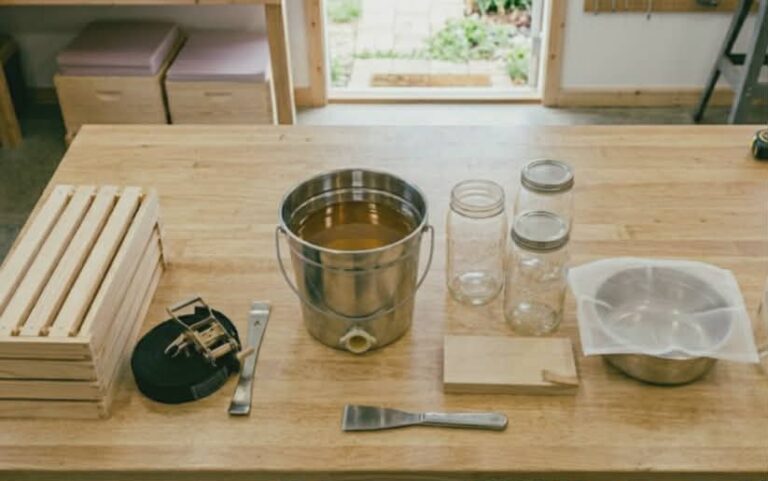

Extracting Canola Honey in Alberta:
How to Prevent Hardened Combs and Honey Loss
Alberta canola honey can begin showing micro-crystallization in uncapped comb cells within 7-10 days of the flow ending, and can reach Stage 3 visible granulation in 10-14 days. At Stage 3, uncapped cells appear milky-white and honey feels thick and pasty — standard radial extraction becomes very difficult without pre-warming frames. At Stage 4-5 (14-21 days post-petal drop), capped cells have set solid and normal extraction is impossible without first holding frames in a hot room at 35°C for 24-48 hours. The speed is driven by canola honey’s unusually high glucose-to-fructose ratio (~1.2:1) — glucose precipitates as crystals far more readily than fructose. Alberta’s low humidity accelerates this process compared to provinces with higher ambient moisture.
Large commercial Alberta beekeeping operations use bee blowers for honey super clearing because their scale makes overnight escape board logistics impractical. A commercial operation with 500+ hives across multiple apiary locations cannot pre-install escape boards at every site the evening before each extraction run — the labour and travel involved makes it unworkable. A bee blower clears a full super of thousands of bees in 60-90 seconds per super at the hive, allowing same-day harvest decisions without pre-planning. For hobby and sideliner beekeepers with 1-30 hives, bee escape boards remain the preferred method — they require zero disturbance of the bees during clearing and produce completely bee-free supers without the physical effort and potential robbing risk of frame-by-frame blowing in the open apiary.
A hot room is a climate-controlled space maintained at 32-38°C that Alberta beekeepers use to keep canola honey supers warm before and during extraction — preventing crystallization in frames and maintaining honey fluidity throughout the extraction process. Commercial Alberta operations use purpose-built heated storage rooms holding hundreds of supers simultaneously. For hobby beekeepers, any insulated space with a reliable heat source — a heated garage, a sealed shed with a propane heater, or even a well-insulated cargo trailer with a heating unit — can serve the purpose. A hot room is not optional for Alberta operations that cannot extract the same day supers are pulled — if there is any delay between pulling and extracting, frames need temperature support to prevent stage 3-4 crystallization during the wait.
Yes — if crystallization is at Stage 2-3 (milky appearance, thick but not solid), you can recover the honey by warming frames in a hot room at 35-38°C for 12-24 hours before extraction. The heat dissolves early crystals back into solution, restoring honey to a spinnable viscosity. Do not exceed 40°C — above this temperature enzymes are destroyed and HMF levels increase, affecting honey quality and Canadian grade standards. For Stage 4 (solid but relatively recent crystallization), extend warming to 24-48 hours at 35°C. For Stage 5 cement-stage crystallization (frames rigid, 3+ weeks post-petal drop), warming alone may not restore full spinability — crush-and-strain is the recommended recovery method for Stage 5 Alberta canola frames.
📋 In This Article
- Alberta vs Ontario — Why Canola Extraction Requires a Different Pace
- The Alberta Crystallization Clock — Stages and Rescue Windows
- Clearing Bees from Supers — Escape Boards vs Bee Blowers
- The Hot Room — Alberta’s Most Important Extraction Tool
- Uncapping Dense Alberta Canola Cappings
- Extracting, Filtering and Settling Canola Honey
- Rescuing Crystallized Canola Frames
- Complete Equipment Guide for Alberta Canola Extraction
Extracting canola honey in Alberta is not a leisurely summer afternoon project — it is a race against chemistry. The same glucose-rich composition that makes Alberta canola honey distinctive and beloved also means it begins hardening in the comb within days of the flow ending. Where an Ontario beekeeper has weeks to plan the extraction of their summer clover crop, an Alberta beekeeper has days. This guide covers everything you need to extract Alberta canola honey successfully, from clearing bees at commercial speed to operating a hot room that keeps frames spinnable when delay is unavoidable.
Alberta vs Ontario — Why Canola Extraction Requires a Different Pace
The extraction urgency difference between Alberta canola honey and Ontario clover honey is not a matter of preference or style — it is a direct consequence of the chemistry of two completely different honey varieties. Understanding this difference helps Alberta beekeepers calibrate their response when the harvest window opens.
The Alberta Crystallization Clock — Stages and Rescue Windows
Every Alberta beekeeper needs a mental model of exactly what is happening in the comb after canola petal drop — and how much time each stage allows for action. The five-stage crystallization timeline below maps the decisions available at each point.
Clearing Bees from Alberta Supers — Escape Boards vs Bee Blowers
- Clears a full super in 60-90 seconds
- No overnight pre-planning required
- Essential for 50+ hive operations
- Works frame-by-frame at the hive
- Requires sealed transport boxes immediately after
- More disruptive to bees than escape boards
- Higher robbing risk if not managed carefully
- 99% bee-free supers by morning
- Zero disturbance — no blowing required
- Install at dusk, pull supers at dawn
- No robbing risk during installation
- One board clears entire super stack
- Requires next-day extraction planning
- Best for 1-30 hive operations
The Hybrid Approach — Escape Boards Plus Morning Blower Pass
Many Alberta sideliner operations with 15-40 hives use a hybrid approach that combines both methods: install escape boards the evening before to clear the bulk of bees overnight, then use a leaf blower or bee blower the following morning for a quick pass over the remaining stragglers before loading supers into sealed transport boxes. This eliminates 90%+ of the bees with the passive escape board overnight, reducing the blowing time dramatically while still achieving the speed needed for same-morning extraction.
WiseBee Tip — Pull Supers at Dawn in Alberta August
Remove Alberta honey supers as early as possible in the morning — ideally at first light before 7am. Two reasons: foragers are not yet active at dawn, so bees being blown or brushed off frames cannot immediately fly back to the super during clearing. And Alberta’s August mornings are still cool enough to slow the crystallization rate slightly during transport — honey cooled to 15°C in the morning transport drive buys 1-2 additional hours before Stage 2 cloudiness accelerates. Afternoon super removal in Alberta August means extracting in late afternoon heat with bees flying everywhere. Morning removal means calm, cool, efficient extraction.
The Hot Room — Alberta’s Most Important Extraction Tool
A hot room is a climate-controlled space maintained at 32-38°C that Alberta beekeepers use to store honey supers before extraction — keeping honey liquid, preventing crystallization during any delay between pulling and processing, and warming partially crystallized frames back to spinnable condition. It is the single management tool that most separates consistent Alberta honey producers from those who lose significant crop to hardened combs every season.
Commercial Alberta operations have purpose-built hot rooms — insulated wooden structures or converted shipping containers holding hundreds of supers simultaneously at controlled temperature. For hobby and sideliner beekeepers, any insulated space with a reliable heat source works: a well-insulated garage with a propane or electric space heater, a sealed garden shed, or even a dedicated room in a barn with poly vapour barrier insulation. The key requirements are good insulation (the space must hold 35°C without excessive heating cost), reliable temperature control (a simple thermostat maintains the target temperature), and adequate airflow (a small fan prevents hot spots and distributes temperature evenly through stacked supers).
Building a Simple Alberta Hot Room on a Budget
For hobby beekeepers with 5-20 hives, a basic hot room can be constructed from an existing insulated garden shed or detached garage with minimal investment. Seal all gaps with spray foam insulation. Line walls with R-12 or higher rigid foam board if existing insulation is inadequate. Install a 1500W electric space heater with a built-in thermostat set to 35°C. Add a small circulation fan to distribute heat evenly. A 10×10 foot space at this spec can maintain 35°C in Alberta August ambient temperatures of 15-20°C for approximately $2-4 per day in electricity — easily justified by the honey saved from even a single super of avoided Stage 3 crystallization.
Never Use Open Flame Heaters Inside a Honey House
Propane or natural gas heaters with open flames must not be used inside a honey processing room where honey is being extracted. Honey vapour and fine wax particles suspended in warm extraction room air are combustible. Use electric heaters with enclosed elements and thermostatic control for honey house temperature management. Propane heaters are acceptable for warming an insulated storage space (hot room) separated from the active extraction area, but must have adequate ventilation and carbon monoxide monitoring in any enclosed space.
Uncapping Dense Alberta Canola Cappings
Canola honey cappings present a specific uncapping challenge not found with Ontario clover or wildflower honey: the wax cap sits close to the comb surface and the honey immediately behind it is dense and resistant. Even freshly harvested Stage 1 canola frames feel noticeably more resistant to a cold knife than clover frames. At Stage 2-3, a cold knife simply cannot perform adequately — it tears comb and produces jagged, incomplete cuts that reduce extraction efficiency.
Electric Hot Knife — Non-Negotiable for Alberta Canola
An electric hot uncapping knife at 65-70°C is the correct tool for Alberta canola honey at every crystallization stage. The heat melts the wax cap cleanly ahead of the blade without pressure — producing a smooth, flat uncapped surface that spins out completely in the extractor. For Stage 1-2 frames, a single smooth pass covers each frame face in 45-60 seconds. For Stage 3 frames pre-warmed in the hot room, run the knife slightly more slowly and at a lower angle to allow the heat more contact time with the denser honey surface.
Uncapping Fork or Roller — Essential Second Pass
After the electric knife main pass, run an uncapping fork or studded roller over any remaining closed cells — corners near the frame rail, sunken areas where the knife could not reach, and any cell that appears unbroken after the main cut. Alberta canola frames often have irregular comb surfaces from the intense brood-area building activity that precedes the flow — an uncapping fork handles surface variation that a flat knife blade cannot. Never load a canola frame into the extractor with visibly intact capped cells — those cells contribute zero to extraction yield and can jam or imbalance the extractor basket.
Extracting, Filtering and Settling Alberta Canola Honey
Extraction Temperature — Keep Everything Warm
Move uncapped canola frames from the uncapping station to the extractor immediately — do not allow them to sit and cool. A warm extraction room at 30-35°C is as important in the extraction step as in the pre-warming hot room. Canola honey that cools below 25°C during extraction becomes visibly more viscous and does not spin out completely — leaving residual honey on the comb that cannot be recovered without a second warming cycle.
Start the extractor at low speed for the first 2 minutes — dense canola honey requires more initial force to begin moving from cell to extractor wall than lighter honeys. Increasing to full speed before honey has begun to flow can create excessive centrifugal load on the comb, particularly new frames drawn during the same season. After 2 minutes at low speed, increase to full extraction speed for 4-5 minutes. Open the gate valve periodically to prevent honey depth on the extractor floor from rising high enough to impede the basket rotation.
The 48-Hour Bottling Deadline for Alberta Canola Honey
Extracted Alberta canola honey in a settling tank at room temperature begins showing first crystallization within 48-72 hours in August conditions. Skim the settling tank surface at 24 hours and again at 36 hours, then bottle immediately after the second skim. Do not allow canola honey to sit in an open settling tank for more than 48 hours at room temperature — partial crystallization at the base of the tank produces a two-layer product (liquid top, granulated bottom) that is very difficult to homogenize without reheating. Bottle promptly, store appropriately, and present to customers with a clear label noting natural crystallization is expected.
Rescuing Crystallized Canola Frames — What to Do at Each Stage
For supers showing Stage 2 cloudiness or Stage 3 early granulation, place the entire super (with frames in situ) in your hot room at 35°C for 12-24 hours. The heat dissolves early crystals back into solution, restoring honey to liquid or near-liquid viscosity. After warming, test a cell with a probe — if honey flows freely off the probe tip, it is ready for extraction. Proceed with electric hot knife uncapping and immediate extraction. Do not allow warmed frames to cool again before extraction — move directly from hot room to extractor without delay.
For Stage 4 frames with solidly crystallized honey throughout, extended hot room warming at 35-38°C for 36-48 hours can restore sufficient fluidity for low-speed extraction — but expect partial rather than complete yield recovery. The outer portions of cells closest to the comb wall liquefy first; the deep centre of larger crystallized masses may remain partially granulated. Extract at the lowest possible extractor speed and accept that some residual crystallized honey will remain in cells after extraction. Return these frames to a strong colony for bees to clean — they will dissolve and reconvert the residual honey efficiently.
For Stage 5 cement-stage frames where even extended warming does not restore adequate fluidity for extraction, crush and strain is the last-resort honey recovery method. Cut comb sections from the frame with a sharp knife, place in a large food-grade container, and mash thoroughly. Warm the mashed mass in a water bath at 35-38°C and strain through coarse then fine mesh. The resulting honey will be slightly darker with more wax content than spun honey but is fully edible and often marketable as raw crushed honey at a premium price point. The drawn comb is destroyed in this process — a significant production loss beyond the extraction delay that caused the Stage 5 crystallization in the first place. This loss is entirely avoidable with timely harvest.
Complete Equipment Guide for Alberta Canola Extraction
Final Thoughts on Extracting Canola Honey in Alberta
Extracting canola honey in Alberta is a test of preparation and response speed that has no equivalent in Canadian beekeeping. The beekeeper who has a hot room ready, escape boards installed the evening before petal drop, an electric knife set up and tested, and an extractor clean and assembled extracts the full value of Alberta’s extraordinary canola flow. The beekeeper who is not ready when petal drop arrives watches that value turn white and rigid in the comb while they scramble for equipment.
Stage 1 frames spin out in minutes. Stage 5 frames are concrete. Everything in between is a rescue operation that costs time, equipment, and ultimately honey. Know your stages. Watch your fields. Act the moment the signal comes — and let Alberta’s canola season reward the preparation you brought to it. 🐝🌻❄️🍯
Questions about your Alberta canola extraction? 🐝
Ask our AI beekeeping assistant — describe your frame condition, days since petal drop, and hot room setup and we’ll advise on the right extraction approach for your Alberta apiary.
🐝 Ask Bee Now — It’s Free🐝 WiseBee Disclosure
Affiliate Disclosure: This article contains Amazon affiliate links. If you purchase through our links, we earn a small commission at no extra cost to you. Learn more →
Disclaimer: This article is for educational purposes only and does not constitute professional apicultural or veterinary advice. Always consult a qualified beekeeper for guidance specific to your situation. Full disclaimer →