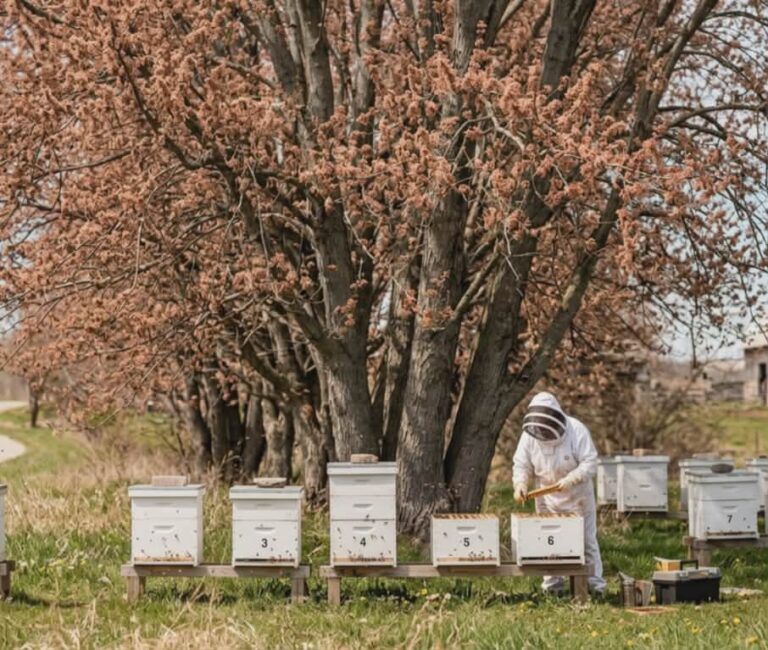

Essential May Beekeeping Tasks in Alberta:
Feeding and Hive Buildup Strategies
📋 In This Article
- May Beekeeping Tasks in Alberta — Why May Is Different
- Alberta Winter Bee Losses — Assessing What Survived
- Bee Hive Wrapping Removal Alberta — Timing Is Everything
- Feeding Bees Alberta May — The Complete Strategy
- Pollen Patties Alberta Beekeeping — Protein First
- Chilled Brood Prevention Alberta — The Cold Snap Danger
- Spring Hive Management Alberta — Building for Canola
- Canola Honey Prep Alberta — Getting Ready for the Big Flow
- May Beekeeping Checklist Alberta
May beekeeping tasks in Alberta are defined by one overriding goal: building colony populations fast enough to take full advantage of the short but extraordinarily productive Alberta honey season. With the canola flow arriving in late June or early July, Alberta beekeepers have approximately 6-8 weeks in May and early June to transform winter-weakened colonies into the powerhouses that fill supers. Every day of delay in May costs you honey in July.
May Beekeeping Tasks in Alberta — Why May Is Different
May beekeeping tasks in Alberta differ fundamentally from what Ontario beekeepers are doing at the same time. While Ontario beekeepers in May are focused primarily on swarm prevention for colonies already boiling with bees, Alberta beekeepers in May are racing against the clock to build colonies up from winter-depleted populations before the canola flow begins.
Alberta’s beekeeping season is brutally short but enormously productive when colonies are prepared correctly. The province’s canola, clover, and wildflower flows can fill supers faster than almost anywhere else in Canada — but only for colonies that have built up sufficient forager populations by the time the flow begins. May is your preparation month. Use it wisely.
Alberta Winter Bee Losses — Assessing What Survived
Alberta winter bee losses are among the highest in Canada — some years exceeding the national average significantly due to the province’s extreme cold and the difficulty of ensuring adequate winter stores through long, cold winters. May begins with an honest assessment of what survived and what condition surviving colonies are in.
Assessing Winter Survival in May
On your first warm May day above 13°C, open every hive for a full assessment. For each colony, evaluate: queen presence (look for eggs), brood pattern quality, population size, and food stores remaining. A colony covering fewer than 4 frames of bees in early May is at serious risk of not building up in time for the canola flow — consider combining it with a stronger colony rather than trying to nurse it through alone.
Alberta Winter Bee Losses — When to Combine vs. Rebuild
A colony covering 3 or fewer frames in early May Alberta has only a marginal chance of building up enough foragers for the canola flow. The colony strength needed for productive canola honey is substantial — supers should go on by mid-June at the latest, which means the colony needs to be filling 8-10 frames by early June. If a May colony is too small to reach that threshold, combining it with a strong colony gives you one productive unit instead of two underperformers.
Bee Hive Wrapping Removal Alberta — Timing Is Everything
Bee hive wrapping removal in Alberta is one of the most timing-sensitive tasks of May beekeeping. Remove wraps too early and you expose colonies to cold snaps that can kill brood. Remove them too late and the hive overheats on warm May days, stressing the colony and potentially triggering early swarming instinct.
When to Remove Bee Hive Wrapping in Alberta
The rule for bee hive wrapping removal in Alberta is: remove when nighttime temperatures are consistently above 0°C and daytime temperatures are reliably above 10°C. In southern Alberta (Calgary, Lethbridge), this typically means early to mid-May. In central Alberta (Edmonton, Red Deer), mid-May is the safer target. In northern Alberta, late May or even early June is appropriate.
The Gradual Approach to Hive Wrap Removal Alberta
Rather than removing the Bee Cozy wrap completely in one step, loosen or partially open it first on warm days while keeping it available for unexpected cold nights. Alberta’s May weather can swing from +18°C one afternoon to -3°C the following morning — a partially opened wrap gives ventilation on warm days while maintaining protection against cold snaps.
WiseBee Tip: Remove Wrap in Stages
Week 1 of May — loosen wrap and open ventilation holes. Week 2 — remove wrap on forecast warm days, replace at night if cold expected. Week 3 — remove permanently once night temps consistently above 0°C. This staged approach prevents both chilling and overheating during Alberta’s volatile May transition.
Feeding Bees Alberta May — The Complete Strategy
Feeding bees in Alberta in May is more complex than in any other Canadian province — because Alberta’s May weather requires different feed types at different temperatures, and because the goal of feeding in Alberta (maximizing buildup speed) requires a more aggressive approach than maintenance feeding.
What to Feed Bees in Alberta in May — By Temperature
| Temperature | Feed Type | Why | How |
|---|---|---|---|
| Below 5°C nights | Fondant / Candy board | Syrup too cold — ferments or bees won’t take it | Above frames, no full inspection needed |
| 5–10°C days | 1:1 syrup + pollen patties | Thin syrup mimics nectar — stimulates laying | Frame feeder inside hive — warmer than entrance feeder |
| Above 10°C reliable | 1:1 syrup — increase volume | Active foraging period — support heavy brood rearing | Hive top feeder — holds more volume |
| Natural pollen flowing | Syrup only — reduce patties | Natural pollen superior to substitute | Continue syrup until dandelions blooming in your area |
Why Feeding Bees in Alberta in May Requires More Syrup Than Ontario
Alberta colonies that survived a long winter typically emerge with lower populations than Ontario colonies — because Alberta winters are longer and colder, requiring more winter bee energy to maintain cluster temperature. These depleted colonies need more aggressive stimulative feeding in May to trigger rapid queen egg-laying and catch up to their potential. Feed generously and consistently — refill feeders before they run dry rather than waiting for bees to empty them completely.
Pollen Patties Alberta Beekeeping — Protein First
Pollen patties in Alberta beekeeping are not optional — they are the foundation of the entire May feeding strategy. Without adequate protein, nurse bees cannot produce royal jelly in sufficient quantity to raise healthy brood, regardless of how much syrup you provide. Protein must come before carbohydrates in the Alberta spring feeding priority list.
When to Start Pollen Patties in Alberta
Pollen patties in Alberta beekeeping should begin in late March — significantly earlier than most beekeepers think is necessary. Starting patties before natural pollen is available gives nurse bees the protein reserves needed to begin raising brood aggressively as soon as the queen starts laying in response to lengthening days. By the time willows and alders release their first pollen in mid-April, colonies with early pollen patties will already have a head start of 3-4 weeks of brood development over those that waited.
Pollen Patty Placement and Replacement
Place pollen patties directly on top of the frames above the cluster — as close to the brood nest as possible so nurse bees can access them without leaving the warm cluster. In early May when temperatures are still variable, a patty placed too far from the cluster may be ignored. Replace patties as soon as they are consumed — a strong May colony in Alberta can go through a 450g patty in 5-7 days.
Pollen Patties Alberta — The Canola Connection
Every frame of brood raised in May represents forager bees that will be flying during the Alberta canola flow in late June and July. A colony that raises 2 additional frames of brood in May due to early pollen patty feeding will have approximately 12,000 more forager bees available during the canola peak. At Alberta canola honey yields of 30-60kg per hive, the return on pollen patty investment is extraordinary.
Chilled Brood Prevention Alberta — The Cold Snap Danger
Chilled brood prevention in Alberta is one of the most critical and underappreciated aspects of May hive management. Unlike Ontario, where May temperatures rarely drop below 5°C, Alberta can experience significant cold snaps in May — including overnight frost events — that can kill developing brood if colonies are mismanaged or if beekeepers intervene at the wrong time.
What Is Chilled Brood and How Does It Happen in Alberta
Chilled brood occurs when developing larvae and pupae are exposed to temperatures below approximately 32°C for an extended period. In Alberta, chilled brood most commonly happens when beekeepers open hives during cool weather (below 13°C) and hold frames out of the hive for too long, or when colonies are too small to maintain adequate cluster coverage over their brood area during cold snaps.
Chilled Brood Prevention Alberta — Practical Rules
Never open hives in Alberta in May when temperatures are below 13°C. Keep full frame inspections brief — under 10 minutes in marginal temperatures. Do not pull brood frames completely outside the hive box during cool weather — partially slide them out for inspection while keeping them partially within the hive body. If a cold snap is forecast, do not inspect the day before — wait for confirmed warm conditions.
Alberta Cold Snap Warning — May Is Not Safe
Alberta recorded snow in May in multiple recent years. Never assume May means warm weather in Alberta. Before any hive inspection, check the hourly forecast for the next 12 hours — if temperatures are dropping or uncertain, postpone. A missed inspection is always better than chilled brood that sets back your colony’s buildup by 3 weeks.
Spring Hive Management Alberta — Building for Canola
Spring hive management in Alberta in May has one primary objective: building large, healthy forager populations that will be ready to work the canola flow. Every management decision in May should be evaluated against this objective — does this action help my colony grow faster, or does it set it back?
Spring Hive Management Alberta — Adding Space Correctly
Adding space too early in spring hive management in Alberta is a common mistake that causes chilled brood. Do not add a second brood box to a weak Alberta colony in early May just because calendar dates suggest it — wait until bees are actively covering 7-8 frames before adding space. A small colony spread across too large a space cannot maintain adequate cluster temperature during Alberta’s cool May nights.
Spring Hive Management Alberta — Combining Weak Colonies
Aggressive colony combining in May is a hallmark of efficient Alberta commercial beekeeping — and hobby beekeepers should adopt the same mindset. Combining two medium-strength colonies gives you one strong colony with excellent canola flow potential, rather than two struggling colonies that may not produce surplus honey at all. Use the newspaper method: place a single sheet of newspaper between the two colonies, cut a few slits in the paper, and stack one brood box on top of the other. Bees eat through the paper in 24-48 hours and merge peacefully.
Canola Honey Prep Alberta — Getting Ready for the Big Flow
Canola honey prep in Alberta is the endpoint of all May beekeeping work — everything done in May is preparation for the most productive honey flow in Canada. Alberta’s canola flow typically begins in southern Alberta around late June and in central Alberta in early July, with the peak lasting 3-4 weeks.
Canola Honey Prep Alberta — Super Timing
For successful canola honey prep in Alberta, honey supers must be on the hive before the flow starts — not after you notice bees are filling up. Colonies that enter the canola flow without adequate super space will fill the brood box with honey, cramping the queen and triggering swarming exactly when you want every bee working at maximum capacity.
Add your first honey super in mid-May when the colony covers 7-8 frames — even if the flow hasn’t started yet. Bees will draw the foundation and be ready to fill it the moment canola begins blooming in your area.
Canola Honey Alberta — A Special Challenge
Canola honey crystallizes unusually quickly — sometimes within days of being capped in the comb. Alberta beekeepers must harvest canola honey supers promptly — within 2-3 weeks of the flow ending — before crystallization makes extraction difficult or impossible. Many Alberta beekeepers extract canola honey while it is still slightly warm from the hive for this reason.
WiseBee Tip: Varroa Treatment Before Canola Supers
Complete your spring Varroa treatment before adding canola honey supers in May. Apivar strips must be out at least 2 weeks before supers go on. If you installed strips in early April, they should be ready to remove in mid-May — just in time for canola prep. Do not skip this step — a high Varroa load going into the canola flow will devastate your late-season colony health.
May Beekeeping Checklist Alberta — Complete
✅ Week 1 — Early May
- Assess all colonies — queen, brood, population, stores
- Identify weak colonies — combine rather than struggle with underperformers
- Continue pollen substitute patties — replace when consumed
- Begin 1:1 syrup feeding when daytime temps consistently above 10°C
- Loosen Bee Cozy wrap — open ventilation but keep for cold nights
- Check Apivar strip timing — 42 days minimum before removal
- Confirm Alberta Bee Act registration complete
✅ Week 2 — Mid May
- Remove bee hive wrapping Alberta when nights consistently above 0°C
- Remove Apivar strips if 42+ days and 2 weeks before supers planned
- Do alcohol wash Varroa count after strip removal
- Add first honey super when bees cover 7-8 frames
- Continue aggressive syrup feeding — refill before empty
- Watch weather forecast — postpone inspections if cold snap expected
- Inspect for swarm cells — less urgent than Ontario but still important
✅ Week 3-4 — Late May (Canola Prep)
- Assess colony strength for canola flow readiness — 8+ frames target
- Add second super if first is being drawn or filled
- Reduce or stop syrup feeding as natural forage begins
- Continue pollen patties until natural pollen abundant and consistent
- Plan splits only if colonies are genuinely strong — June splits risky in Alberta
- Order additional supers for canola flow if needed
- Record inspection findings — brood frames, population, queen status
Final Thoughts on May Beekeeping Tasks in Alberta
May beekeeping tasks in Alberta are fundamentally about speed and preparation. Every pollen patty placed, every litre of syrup consumed, every weak colony combined into a stronger unit represents progress toward the colony strength needed for the Alberta canola flow. The beekeepers who harvest 40-60kg per hive in July are the ones who fed aggressively in May, removed wraps at the right time, prevented chilled brood during cold snaps, and had their supers on before the first canola blossoms opened.
May in Alberta rewards patience with the weather and urgency with the management. Wait for warm days to open hives — but don’t wait a moment longer than necessary to feed, to equip, and to build. The canola flow waits for no one. 🐝🏔️🍯
Questions about your Alberta May colony? 🐝
Ask our AI beekeeping assistant — describe your colony’s current condition and we’ll help you build the best canola flow preparation strategy for your Alberta apiary.
🐝 Ask Bee Now — It’s Free🐝 WiseBee Disclosure
Affiliate Disclosure: This article contains Amazon affiliate links. If you purchase through our links, we earn a small commission at no extra cost to you. Learn more →
Disclaimer: This article is for educational purposes only and does not constitute professional apicultural or veterinary advice. Always consult a qualified beekeeper for guidance specific to your situation. Full disclaimer →