Ontario Beekeeping in July:
Honey Harvest, Heat Management & Colony Care
Ontario beekeeping in July involves five main tasks. First, monitor honey supers weekly and harvest when at least 80% of cells are capped and moisture reads below 18% on a refractometer. Second, manage hive ventilation during heat events — open upper entrances, ensure screened bottom boards are in place, and consider shade cloth over hives during heat waves above 35°C. Third, watch for and prevent robbing as the clover flow ends in late July by reducing hive entrances and avoiding syrup feeding during dearth. Fourth, monitor Varroa mite levels with an alcohol wash in mid-July and plan treatment immediately after honey supers are removed. Fifth, assess whether any colonies require emergency bee hive splits in July for Varroa management or queen rescue — but only under specific conditions.
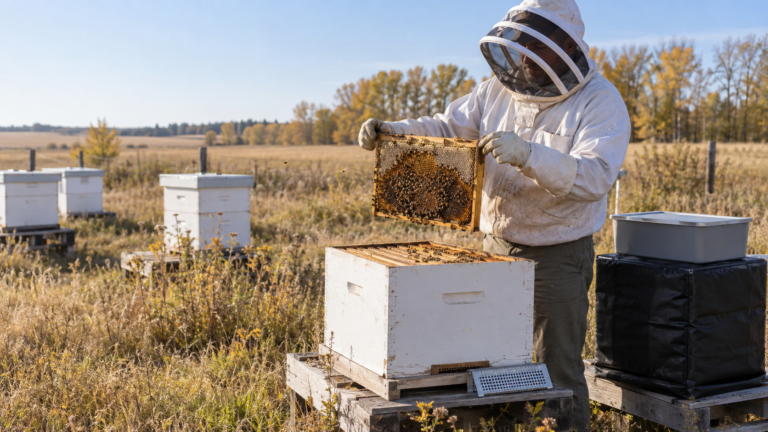
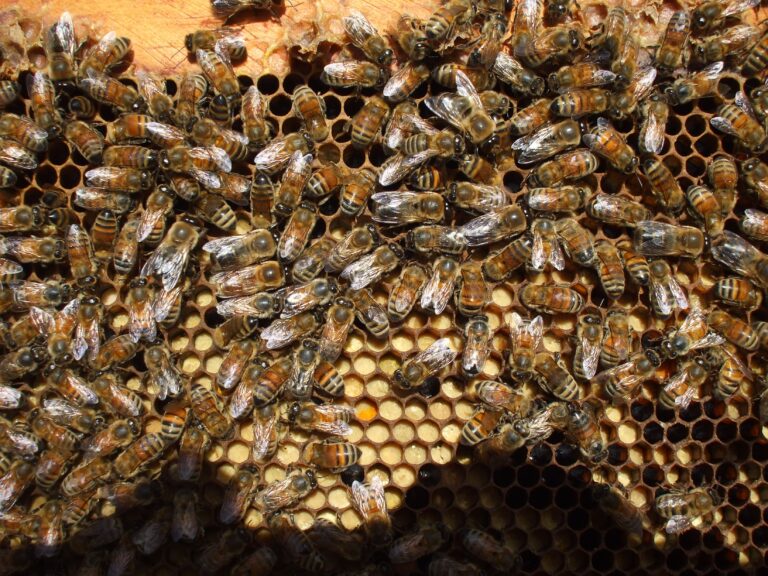
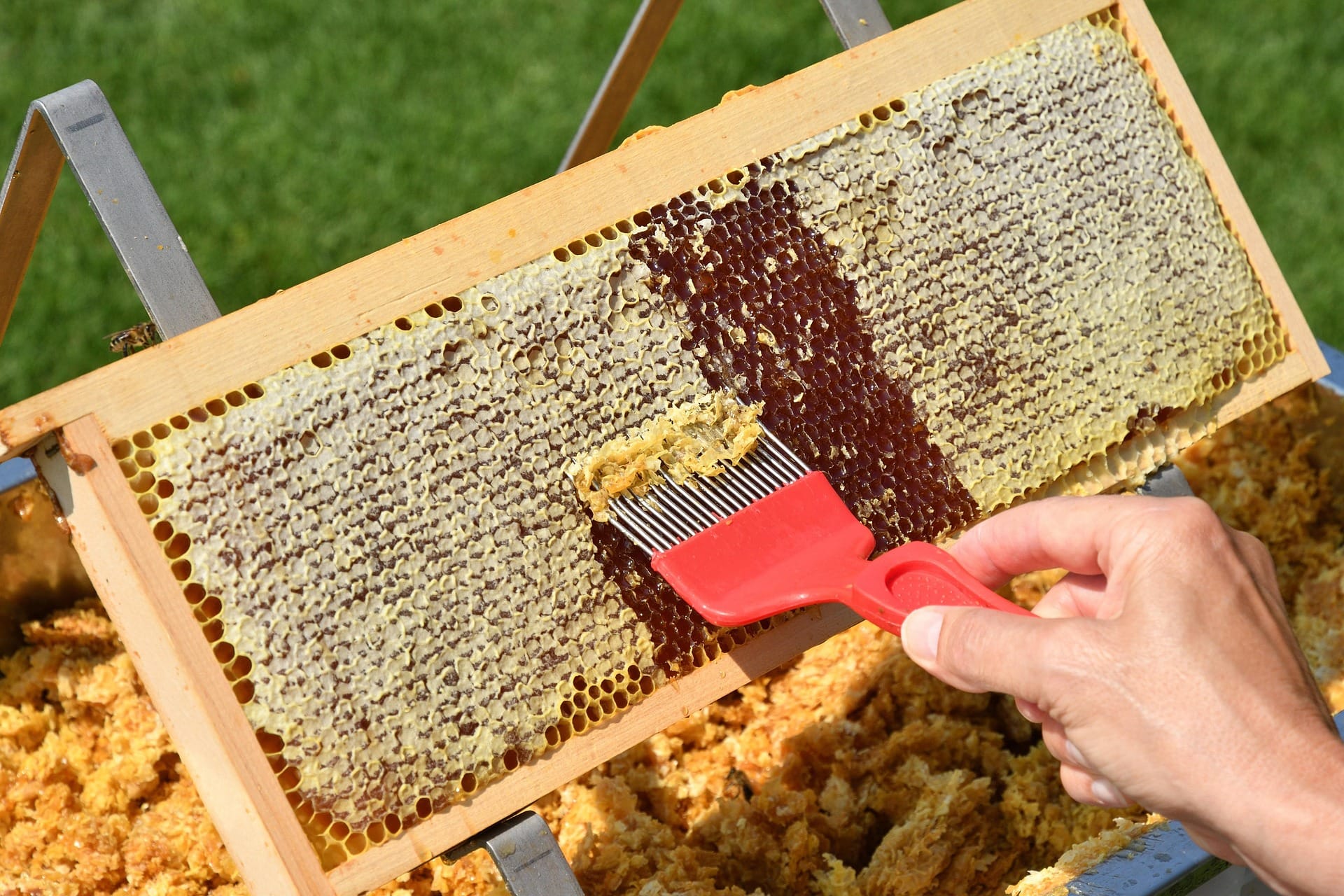
Harvest Ontario honey in July when at least 80% of cells in the super are capped with wax — this is the bees’ confirmation that moisture content is below the 18.6% fermentation threshold. Confirm with a refractometer before extracting any partially capped frames — target 17.5% or below for long-term storage. The Ontario clover flow typically ends in late July, so harvest your main crop between July 15th and August 1st before the flow dwindles. Do not wait for 100% capping — bees sometimes leave small areas uncapped regardless of moisture content. Use a bee escape board the evening before harvest to clear supers of bees overnight before extraction day.
To stop robbing bees in Ontario in July: reduce all hive entrances to 1-2 bee widths immediately when you notice robbing beginning — this allows the resident colony to defend effectively. Install a robber screen over the entrance if robbing is severe. Never leave honey supers uncovered outside the hive during extraction — the scent triggers robbing instantly. Do not spill syrup near hives during the dearth period. Robbing typically intensifies in late July as the clover flow ends and before the goldenrod flow begins — this 2-3 week dearth window in late July to mid-August is when robbing risk is highest in Ontario apiaries.
During Ontario July heat waves above 30-35°C: open the upper entrance (inner cover notch) fully to create a through-draft, ensure screened bottom boards are in place and not blocked by varroa sticky boards, and consider positioning a shade cloth over hives that receive full afternoon sun. Do not close any entrances during a heat event — adequate airflow is critical for bees to fan and maintain the 35°C brood temperature accurately. If bees are clustering heavily outside the hive (bearding) during a heat wave, this is normal cooling behaviour — do not mistake it for swarm preparation and do not open the hive during peak heat hours between 12pm and 4pm.
Treat for Varroa in Ontario in late July to early August — immediately after honey supers are removed and before the critical winter bee generation begins to be raised. The bees raised in August and September are the ones that will carry the colony through the Ontario winter to April. If these winter bees are parasitized by high Varroa loads they will be short-lived and the colony will collapse before spring. Do an alcohol wash in mid-July to assess mite levels: above 2% requires immediate treatment after supers come off. Apivar (amitraz strips) installed in late July-early August for 42 days is the standard Ontario post-harvest Varroa treatment protocol.
📋 In This Article
- The July Beekeeping Reality in Ontario — What to Expect
- Managing Honey Supers in July — Space Is Gold
- Beat the Heat — Bee Hive Ventilation in Ontario July Summers
- Monitoring the Dwindle and Preventing Bee Robbing in July
- Varroa Monitoring in July — Planning the Post-Harvest Treatment
- The July Bee Hive Split Dilemma — Is It Worth the Risk?
- July Beekeeping Checklist Ontario
- FAQ — Ontario Beekeeping in July
Ontario beekeeping in July is the month of harvest decisions, heat management, and transition planning. The clover and wildflower flows that filled your supers in June are winding down. The goldenrod flow is still weeks away. Varroa mites are building to their seasonal peak in the brood. And the question of whether any July bee hive splits are justified hangs over every apiary inspection. Get July right and your colonies enter the crucial August-September winter bee raising period in prime condition. Get it wrong and you spend autumn trying to rescue colonies that should have been thriving.
The July Beekeeping Reality in Ontario — What to Expect
July Ontario beekeeping operates in a narrow window between the end of the productive summer flow and the beginning of autumn preparation. Understanding what is happening biologically in the hive during July prevents management mistakes that are common even among experienced beekeepers.
• Supers nearly full
• Peak Varroa brood load
• Monitor moisture daily
• Heat management critical
• Flow dwindling
• Robbing risk rising
• Remove supers
• Install Apivar
• Reduce entrances
Managing Honey Supers in July — Space Is Gold
Honey supers management in July Ontario requires a shift in approach from June’s proactive addition strategy to July’s harvest-readiness assessment. The key decisions — when to stop adding supers, when to harvest, and how to handle partially filled frames — all happen in a 2-3 week window in mid-to-late July.
Stop adding new honey supers after August 1st in Ontario — any super added after this date is unlikely to be filled before harvest season ends. The clover flow peaks in late June to early July and declines rapidly through July. A new empty super added in late July will sit unfilled while bees focus energy on the dwindling flow and begin shifting into winter preparation mode.
If your existing supers are 70%+ full in early July — add one final super below the existing ones (bottom supering). If supers are less than 50% full in mid-July — no more supers. Focus energy on ensuring what is there gets fully capped before harvest.
Harvest when at least 80% of cells in the super are capped AND your refractometer confirms moisture below 17.5%. In Ontario’s humid July conditions, bees sometimes cap honey before it has fully evaporated to safe moisture levels — and sometimes leave it uncapped when it is already ready. The refractometer never lies. Never harvest a super without a moisture check during Ontario’s humid summer months.
Use a bee escape board the evening before harvest day. Place it under all supers you plan to remove — bees exit through the one-way escape overnight and cannot return. By morning, supers are nearly bee-free and extraction can begin without extensive bee-brushing or blower use.
WiseBee Tip — Harvest in the Morning, Extract Same Day
Harvest honey supers in the morning when temperatures are cooler and bees are less defensive. Begin extraction the same day supers are removed — Ontario’s summer humidity means uncapped cells absorb ambient moisture quickly. Honey left in open supers in a warm extraction room overnight can pick up 0.5-1% additional moisture. Extract, filter, and settle while the honey is still warm from the hive — it flows easily and filters cleanly at hive temperature.
Beat the Heat — Bee Hive Ventilation in Ontario July Summers
Bee hive ventilation in Ontario July summers is a genuine management priority — not just a comfort issue. When external temperatures exceed 35°C, which is common during July heat waves in southern Ontario, bees must dedicate significant colony resources to cooling the hive. This cooling effort diverts foragers from nectar collection and nurses from brood care — directly affecting honey production and colony health during a critical period.
Bearding Is Normal — Do Not Mistake It for Swarming
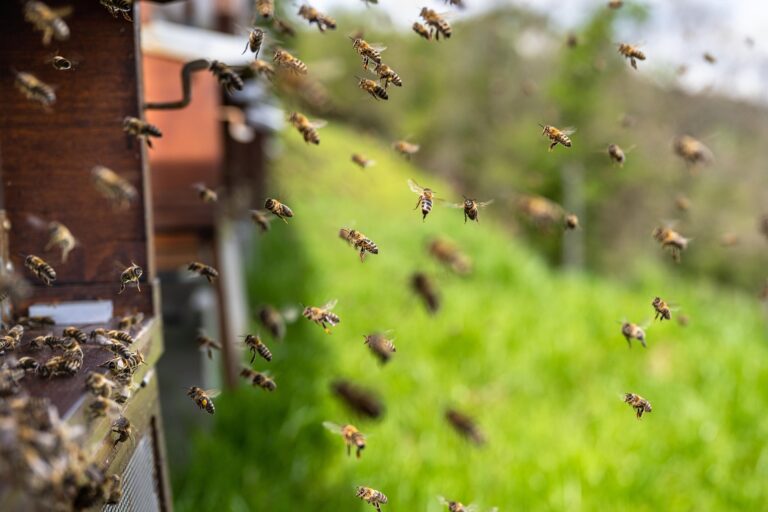
Bees clustering in large numbers on the outside of the hive (bearding) during July heat waves is a normal thermoregulation behaviour — not a sign of swarming. Bees move outside to reduce the thermal load inside the hive and help cool it by fanning from outside. Swarm season in Ontario is essentially over by July — if you see bearding during a heat wave, simply ensure adequate ventilation is in place and leave the bees to manage their own temperature. Opening the hive during peak afternoon heat does more harm than good.
Monitoring the Dwindle and Preventing Bee Robbing in July Ontario
The end of the Ontario clover flow in late July creates a period of nectar dearth that triggers one of the most damaging colony-management problems of the summer: robbing. As the flow dwindles, strong colonies begin targeting weak ones, recently harvested hives, and any exposed honey source in the apiary. July robbing in Ontario can destroy a weak colony in hours.
Recognizing the Flow Dwindle
The Ontario clover flow dwindles gradually through late July rather than stopping suddenly. Signs the flow is ending: bees becoming noticeably more defensive during inspections compared to June, entrance activity decreasing as fewer foragers bring in nectar, the hive weight stabilizing or declining on hive scales, and bees starting to fanaggressively at the entrance even during moderate temperatures. When you see these signs, reduce entrances on all colonies immediately — before robbing begins.
- Fighting bees tumbling at the entrance
- Dead bees accumulating rapidly outside
- Bees trying to enter through mesh/gaps
- Erratic, circling flight near the hive
- Stronger colony near weaker colony acting aggressively
- Wax and debris scattered at entrance
- Steady, purposeful entrance traffic
- Bees returning with pollen on legs
- Bearding during heat — no fighting
- Bees fanning at entrance — ventilation
- Foragers departing in straight lines
- Calm inspection even without smoker
Never Leave Honey Supers Open During July Dearth
During the late July dearth period, never leave uncovered honey supers sitting outside the hive — not even for the 10 minutes it takes to bring your extractor inside. The scent of open honey attracts robber bees from throughout the apiary within minutes, and a full robbing frenzy can begin before you return. Keep all supers covered or in a sealed room from the moment they are removed from the hive until extraction is complete.
Varroa Monitoring in July — Planning the Post-Harvest Ontario Treatment
Varroa mite populations in Ontario reach their seasonal peak in July and August — exactly when honey supers are on and standard treatments cannot be applied safely. Planning your post-harvest treatment now, in July, means you are ready to install Apivar strips the same day supers come off — minimizing the unprotected window during the critical winter bee raising period.
For the complete Ontario Varroa treatment guide including the full calendar, treatment options, and monitoring thresholds, see our dedicated Varroa Treatment Guide Ontario →
The July Bee Hive Split Dilemma — Is It Worth the Risk in Ontario?
The question of whether to make bee hive splits in July Ontario comes up in every apiary, every season. A colony showing late swarm pressure in July, a Varroa crisis requiring a brood break, or a high-value queen in a honey-bound hive — all create situations where a beekeeper looks at the calendar and wonders: is it too late?
July Beekeeping Checklist Ontario — Complete
✅ Early July (Week 1-2)
- Check honey super fill rate — add final super if existing ones are 70%+ full
- Stop adding new supers after July 10th
- Open upper entrance fully — July heat management begins now
- Do Varroa alcohol wash — count mites, plan post-harvest treatment
- Reduce hive entrances slightly — robbing season approaching
- Check refractometer — confirm honey moisture below 17.5% before harvesting
✅ Mid July (Week 2-3)
- Install bee escape boards evening before harvest day
- Harvest honey — extract and settle same day as removal
- Watch for bearding during heat waves — ensure screened bottom board is open
- Monitor for robbing signs — reduce entrances to minimum if dearth begins
- Never leave uncovered supers outside during dearth period
- Assess any emergency bee hive split situations — act only if justified
✅ Late July (Week 3-4)
- Remove all honey supers — flow is ending, protect stores from robbing
- Install Apivar strips same day supers come off — 2 strips per colony
- Close upper entrance partially — reduce to small gap to help colonies defend
- Begin planning autumn feeding schedule for September
- Check water source — hot July dries water stations rapidly
- Record hive weight and brood frames for late summer baseline
Final Thoughts on Ontario Beekeeping in July
July beekeeping in Ontario is the month where preparation meets reward — and where poor decisions from June become expensive problems. The clover honey you harvest in mid-July represents the result of months of colony building, swarm prevention, and super management. Treat that harvest with the care it deserves: check moisture before extracting, extract the same day, and protect your supers from robbing from the moment they leave the hive.
Then, the same week your supers come off, install Varroa treatment. The bees raised in August will carry your colony through 7 months of Ontario winter. Protecting them from Varroa in late July is the most important decision of the entire beekeeping year — more impactful than any split, any queen decision, or any feeding strategy. July honey harvest and July Varroa treatment are the twin priorities of Ontario beekeeping. Do both well and your colonies will reward you with another strong spring. 🐝☀️🍯🌻
Questions about your Ontario July apiary? 🐝
Ask our AI beekeeping assistant — describe your colony status, honey super fill rate, and Varroa levels and we’ll advise on the right July management for your Ontario hives.
🐝 Ask Bee Now — It’s Free🐝 WiseBee Disclosure
Affiliate Disclosure: This article contains Amazon affiliate links. If you purchase through our links, we earn a small commission at no extra cost to you. Learn more →
Disclaimer: This article is for educational purposes only and does not constitute professional apicultural or veterinary advice. Always consult a qualified beekeeper for guidance specific to your situation. Full disclaimer →