Alberta Beekeeping in July:
Managing the Massive Prairie Honey Flow
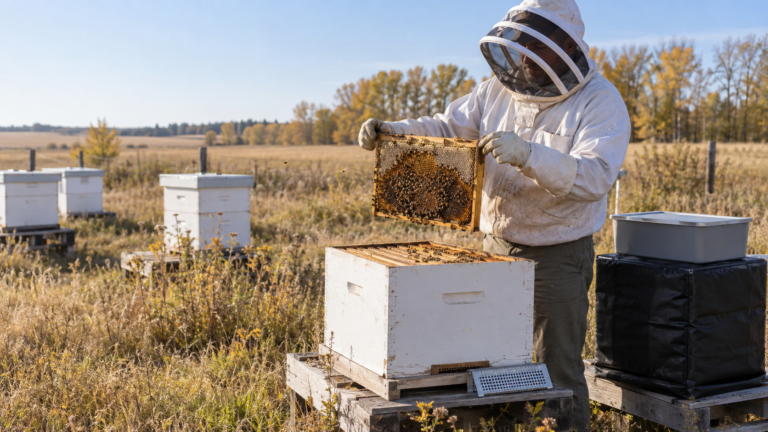
Alberta beekeeping in July centres on four main tasks. First, manage honey supers aggressively — stack multiple supers (3-4 at a time in commercial operations) and check fill rates weekly during the peak canola flow. Second, watch canola fields daily for petal drop — once canola flowers fall, begin harvest preparations immediately. Third, check honey moisture with a refractometer daily as the flow ends — canola honey crystallizes in the comb within 1-2 weeks of the flow ending, making timing critical. Fourth, do a Varroa alcohol wash in mid-July and plan oxalic acid or Apivar treatment immediately after supers come off. July bee hive splits in Alberta are extremely risky due to the compressed season — avoid unless it is a genuine emergency.
Canola honey crystallizes faster than almost any other honey because of its exceptionally high glucose-to-fructose ratio — approximately 1.2:1. Glucose is less water-soluble than fructose and readily precipitates as crystals at room temperature. In Alberta’s summer conditions, liquid canola honey in the comb can begin visibly crystallizing within 1-2 weeks of the flow ending. In extraction rooms at room temperature, extracted canola honey can show first crystallization within 2-4 weeks. This is why Alberta beekeepers must harvest canola honey promptly when the flow ends — leaving frames in the hive for even one extra week after petal drop significantly increases the risk of crystallized honey locked in the comb.
During peak canola flow, Alberta commercial beekeepers routinely stack 3-4 honey supers per hive simultaneously — sometimes more on exceptionally strong colonies. A large Alberta colony at peak canola can fill a medium honey super in 7-10 days during a strong flow. Running out of super space during peak canola flow is one of the most costly management errors in Alberta beekeeping — bees fill the brood nest with honey, crowding the queen, triggering swarms, and losing production during the flow’s most productive period. Have all supers assembled and ready before canola bloom begins and add them proactively, not reactively.
Harvest canola honey in Alberta when: at least 80% of cells are capped AND your refractometer reads 17.5% moisture or below AND canola flowers are beginning to drop in fields near your apiary. In most Alberta locations this is mid-July to late July for the first harvest. Do not wait for 100% capping — canola honey can begin crystallizing in uncapped cells within 1-2 weeks of the flow ending. The harvest window from petal drop to crystallization risk in the comb is often 7-14 days in Alberta’s warm summer conditions — one of the tightest harvest windows of any honey variety in Canada.
📋 In This Article
- The Unique Reality of Alberta Beekeeping in July
- Essential Tasks for Alberta Beekeeping in July
- Task 1 — Supering for the Canola Explosion
- Task 2 — Moisture and Ventilation Management During the Flow
- Task 3 — Planning the Late July Pull Before Crystallization
- Task 4 — Varroa Monitoring and Post-Harvest Treatment Planning
- The Risk of Mid-Summer Bee Hive Splits in Alberta
- July Alberta Beekeeping Checklist
- FAQ — Alberta Beekeeping July
- Coming Next — Three Deep Dive Articles
Alberta beekeeping in July is unlike July beekeeping anywhere else in Canada. The province’s long prairie days — often 17+ hours of daylight — combined with the extraordinary productivity of the canola honey flow create conditions that produce more honey per hive than any other Canadian province. But this abundance comes with a unique set of management challenges: canola honey crystallizes at an alarming rate, the harvest window is measured in days not weeks, and the compressed Alberta season means every management error in July has direct consequences for winter survival.
The Unique Reality of Alberta Beekeeping in July
To understand why Alberta beekeeping in July operates on a different level than any other Canadian province, you need to appreciate three intersecting factors: the length of prairie summer days, the extraordinary intensity of the canola nectar flow, and Alberta’s compressed season that ends abruptly rather than gradually.
The Prairie Day Length Advantage
Alberta’s position at 50-57° North latitude gives July an extraordinary daylight advantage over southern Canada. While Ontario beekeepers have approximately 15 hours of daylight in July, Alberta prairie beekeepers have 17+ hours — providing two additional hours of foraging time per day during the canola flow. Across the entire canola season this amounts to dozens of additional foraging hours, which directly translates into dramatically higher honey yields per colony.
The Canola Flow Intensity
The canola honey flow in Alberta is not merely a productive flow — it is an overwhelming biological event. A strong colony during peak canola can bring in 5-10kg of nectar per day, requiring the entire colony to shift into a dehydration and capping production mode that temporarily reduces foraging, brood care, and all other colony activities. The hive becomes a honey factory for 3-6 weeks, producing the distinctive white, fine-grained canola honey that Alberta is internationally known for.
WiseBee Tip — Watch the Canola Fields, Not the Calendar
The most important observation in Alberta July beekeeping is watching your local canola fields daily. When yellow petals begin dropping and green seed pods become visible — begin harvest preparations immediately. From petal drop to crystallization risk in uncapped comb cells is often less than 14 days in warm Alberta July conditions. No calendar date can tell you what your fields’ eyes can.
Essential Tasks for Alberta Beekeeping in July
• Stack 3-4 supers
• Maximum ventilation
• Check fill rate weekly
• Daily moisture check
• Prepare extractor
• Varroa alcohol wash
• Extract immediately
• Install Varroa treatment
• Begin autumn prep
Task 1 — Supering for the Canola Explosion
During the Alberta canola flow, adding honey supers reactively — waiting until one is full before adding the next — costs production. By the time a beekeeper notices a super is full and makes the trip to add another, the colony has already begun honey-bounding the brood nest, slowing the queen, and potentially entering pre-swarm mode. A colony without super space during peak canola flow begins filling brood cells with honey within 48 hours.
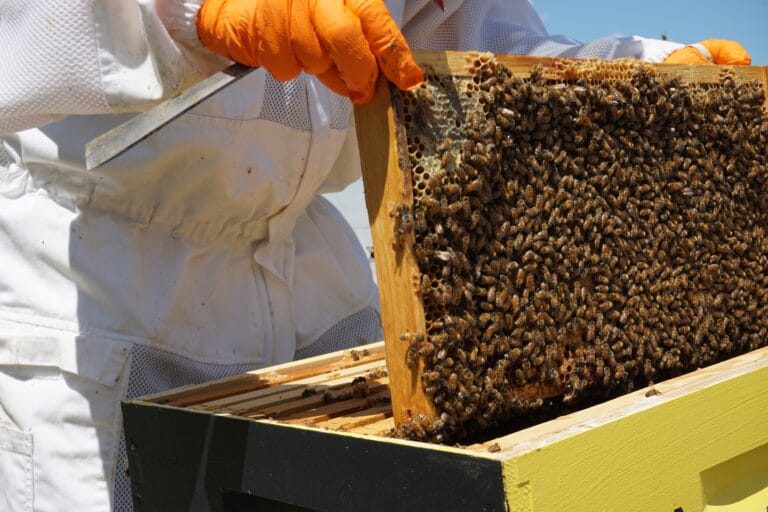
The correct Alberta approach is proactive stacking: add a new super when the existing one is 70% full, not 100%. During peak flow, this means adding supers every 7-10 days for strong colonies. Commercial Alberta beekeepers often stack 3-4 supers simultaneously — the extra empty space above acts as a buffer that gives bees room to move nectar upward as lower supers fill.
Use drawn comb in all July supers where possible. During the canola flow, bees must produce wax to draw foundation — energy diverted directly away from honey production. Pre-drawn comb eliminates this overhead and allows bees to fill the super with honey immediately upon installation.
Task 2 — Moisture and Ventilation Management During the Canola Flow
During peak canola flow, bees bring in nectar at 70-80% moisture content and must reduce it to below 18% before capping — a massive evaporative workload that requires enormous ventilation. Inadequate ventilation during the Alberta canola flow is one of the main causes of honey supers being capped at moisture levels above 18%, producing honey at risk of fermentation.
Ensure all hives have fully open upper entrances (inner cover notch fully open) and screened bottom boards clear of varroa sticky boards during July. The combination of upper and lower openings creates a chimney effect that pulls warm, moist air out of the hive continuously — exactly what bees need to process the canola nectar flood efficiently.
Alberta July afternoons regularly exceed 30°C. While this temperature aids nectar evaporation, it also creates thermal stress on the colony if ventilation is inadequate. Hives in full direct sun benefit from a shade cloth covering from 1pm-5pm during extreme heat events above 35°C — the shade reduces thermal load without eliminating the airflow the colony needs for nectar processing.
Task 3 — Planning the Late July Pull Before Crystallization
The late July honey pull in Alberta is the most time-critical agricultural harvest decision in the province. Unlike clover honey, which gives beekeepers weeks of flexibility, canola honey crystallizes in the comb within days to weeks of the flow ending. A beekeeper who delays harvest by one week too many may find frames locked solid with granulated honey that cannot be extracted — representing hundreds of dollars of lost production and potentially ruined frames.
Begin daily moisture monitoring with your refractometer when canola fields show the first signs of petal drop. Target 17.5% moisture or below for long-term storage. When moisture is at target AND 80%+ of cells are capped — pull the supers that same day. Do not wait for the next weekly inspection. Install bee escape boards the evening before and extract the morning after removal.
Have your extractor assembled, settled, filters clean, and bottling jars ready before the flow ends — not after. In Alberta, the harvest season waits for no one.
How fast does Alberta canola honey crystallize?
Task 4 — Varroa Monitoring and Post-Harvest Treatment Planning
Varroa mites reach seasonal peak loads in Alberta in late July and August — exactly when honey supers are on and standard treatments cannot be applied. The window between super removal and the start of winter bee raising (the critical brood cycle in August-September) is the most important Varroa treatment window of the year.
Alberta July Varroa Action Plan
Do an alcohol wash in mid-July — 300 bee sample from brood frame. Above 2% (6 mites) requires immediate treatment after supers come off. Remove supers as soon as harvest ready. Install Apivar strips the same day supers are removed — 2 strips per colony, 42-day treatment. Remove Apivar in early September before wrapping preparations begin. This timeline protects the August-raised winter bee generation that determines spring colony strength.
The Risk of Mid-Summer Bee Hive Splits in Alberta
Unlike Ontario, where July bee hive splits are risky but sometimes justified by the goldenrod fall flow, Alberta has no equivalent autumn buffer. When the canola flow ends in late July, Alberta’s beekeeping season moves directly toward winter preparation — there is no secondary major nectar flow to support a late split’s store-building requirements.
A bee hive split made in July Alberta has approximately 6-8 weeks before September 1st winter preparation must begin. This is not enough time for a split to raise winter bees, build adequate stores, and consolidate into a winter-ready cluster — even with aggressive supplemental feeding. The mathematical reality of Alberta’s compressed season makes routine July splits irresponsible regardless of how strong the parent colony is.
The only July situations where a bee hive split in Alberta might be justified are extreme emergencies: a Varroa crisis requiring a brood break for treatment, or saving a high-value mated queen from certain loss. Even in these cases, mated queens are non-negotiable and autumn feeding support must be fully committed to before the split is made. There is no Alberta equivalent of Ontario’s goldenrod lifeline.
July Alberta Beekeeping Checklist — Complete
✅ Early July (Week 1-2) — Peak Canola Flow
- Check super fill rate every 7 days — add new super when 70% full
- Stack 3-4 supers on strong colonies — never restrict space during peak flow
- Ensure all upper entrances are fully open — maximum ventilation for nectar dehydration
- Screen bottom boards clear — no varroa sticky boards blocking airflow
- Watch canola fields daily for signs of petal drop
- Begin daily refractometer moisture checks on partially capped frames
✅ Mid July (Week 2-3) — Harvest Preparation
- Do Varroa alcohol wash — 300 bees, count mites, plan post-harvest treatment
- Assemble and clean extractor — have it ready before flow ends
- Confirm moisture below 17.5% on 80%+ capped supers before pulling
✅ Late July (Week 3-4) — Post-Harvest
- Pull all remaining supers — crystallization risk is now critical
- Install Apivar strips same day as super removal
- Reduce hive entrances — dearth and robbing risk begin as flow ends
- Freeze empty drawn comb frames before storage — kills wax moth eggs
- Begin autumn feeding assessment — which colonies need supplemental stores?
- Prepare windbreaks and storm protection — August prairie storms intensify
Coming Next — Three Deep Dive Alberta July Articles
This guide covers the July Alberta beekeeping overview. Three dedicated articles are coming that go deeper into the most complex July challenges specific to Alberta prairie beekeeping:
Final Thoughts on Alberta Beekeeping in July
Alberta beekeeping in July is where the entire year’s work either pays off or falls short. The canola flow’s extraordinary generosity rewards beekeepers who prepared their colonies in May, made smart split decisions in June, and had supers in place before the bloom. It punishes those who run out of super space, delay the harvest, or misread the crystallization timeline.
The fundamental discipline of Alberta July beekeeping is urgency — not panic, but the calm, prepared urgency of a beekeeper who knows that the window between peak flow and crystallized frames is measured in days. Watch your fields. Check your moisture daily. Extract the moment conditions are right. Install Varroa treatment the same day your supers come off. And let the massive prairie honey flow reward the preparation you put into it. 🐝🌻🏔️🍯
Questions about your Alberta July apiary? 🐝
Ask our AI beekeeping assistant — describe your canola flow status, super fill rate, and moisture readings and we’ll advise on the right July harvest timing for your Alberta hives.
🐝 Ask Bee Now — It’s Free🐝 WiseBee Disclosure
Affiliate Disclosure: This article contains Amazon affiliate links. If you purchase through our links, we earn a small commission at no extra cost to you. Learn more →
Disclaimer: This article is for educational purposes only and does not constitute professional apicultural or veterinary advice. Always consult a qualified beekeeper for guidance specific to your situation. Full disclaimer →