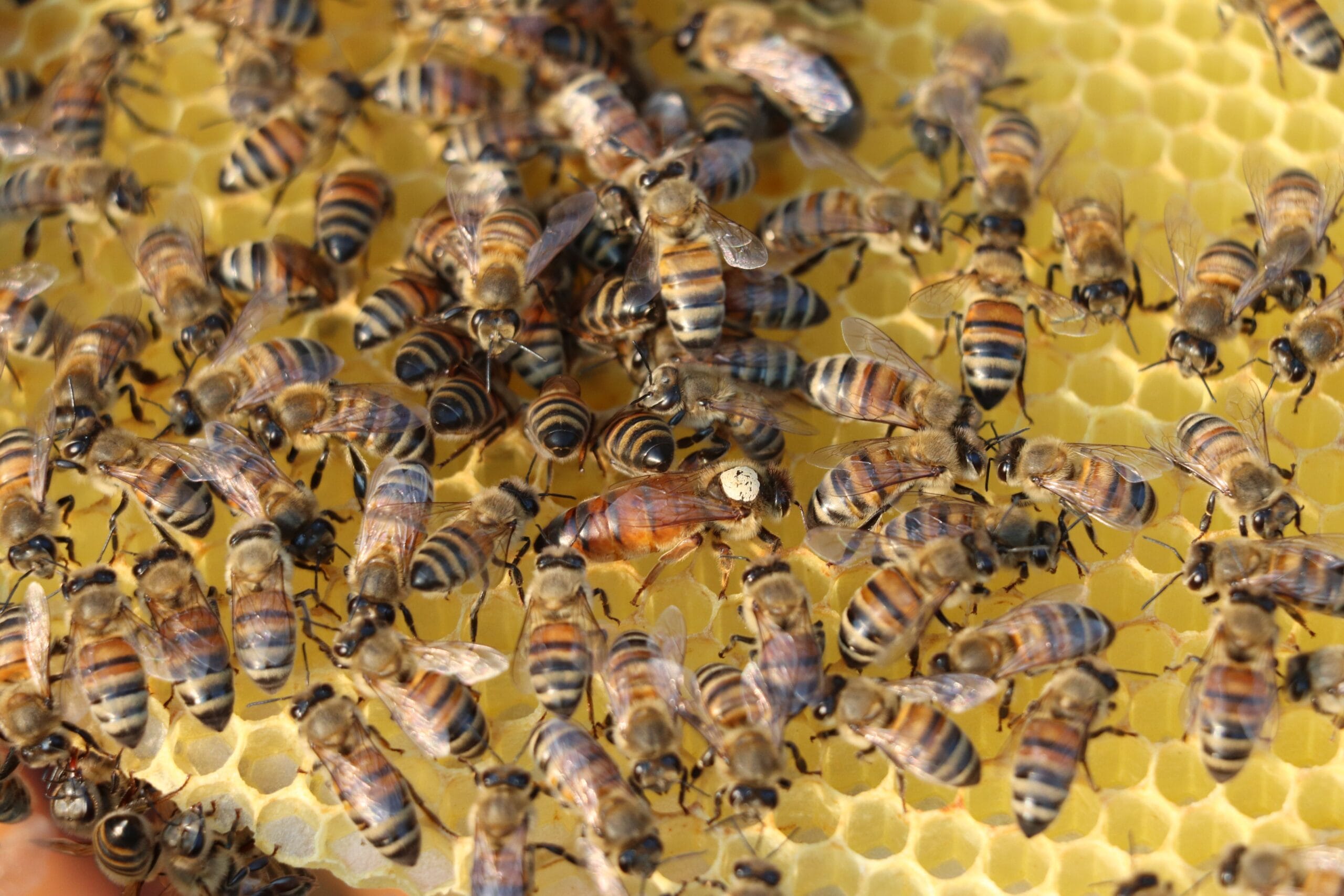
Late Summer Re-Queening in Ontario:
Why August Is the Best Month to Replace Your Queen
August requeening in Ontario produces two specific winter survival advantages over any other requeening time. First, a young queen introduced in early August begins laying immediately — her eggs hatch in 3 days, larvae develop for 6 days, and capped pupae emerge after 21 days total. Worker bees raised from August eggs begin emerging as adult bees in the last week of August and first weeks of September — exactly during the critical window when winter bees are supposed to be developing. These bees emerge in a low-Varroa-load environment (after August treatment) and accumulate the vitellogenin (fat body protein) they need for winter survival. Second, young queens maintain laying rates longer into autumn than old queens — often laying significantly through September while old queens dramatically slow or stop in late August. This extended autumn laying directly increases winter bee population numbers.
Bees reject introduced queens more readily in August than in spring for two biological and behavioural reasons. First, during active nectar flow in spring and early summer, worker bees are physiologically in a receptive, expansive colony mode — they accept new queen pheromones more readily when the colony is growing and the motivation to maintain continuity is high. During late summer nectar dearth, workers are in a defensive, contracting colony mode — they are more suspicious of any disturbance including a new queen’s unfamiliar pheromones. Second, August bees are older on average than spring bees — forager-age workers dominate the population as brood rearing slows, and older bees are consistently less accepting of new queens than younger nurse bees. The solution is to create colony conditions that mimic the receptive spring state: feeding 1:1 syrup during introduction mimics a nectar flow and shifts colony behaviour toward the expansive, accepting mode.
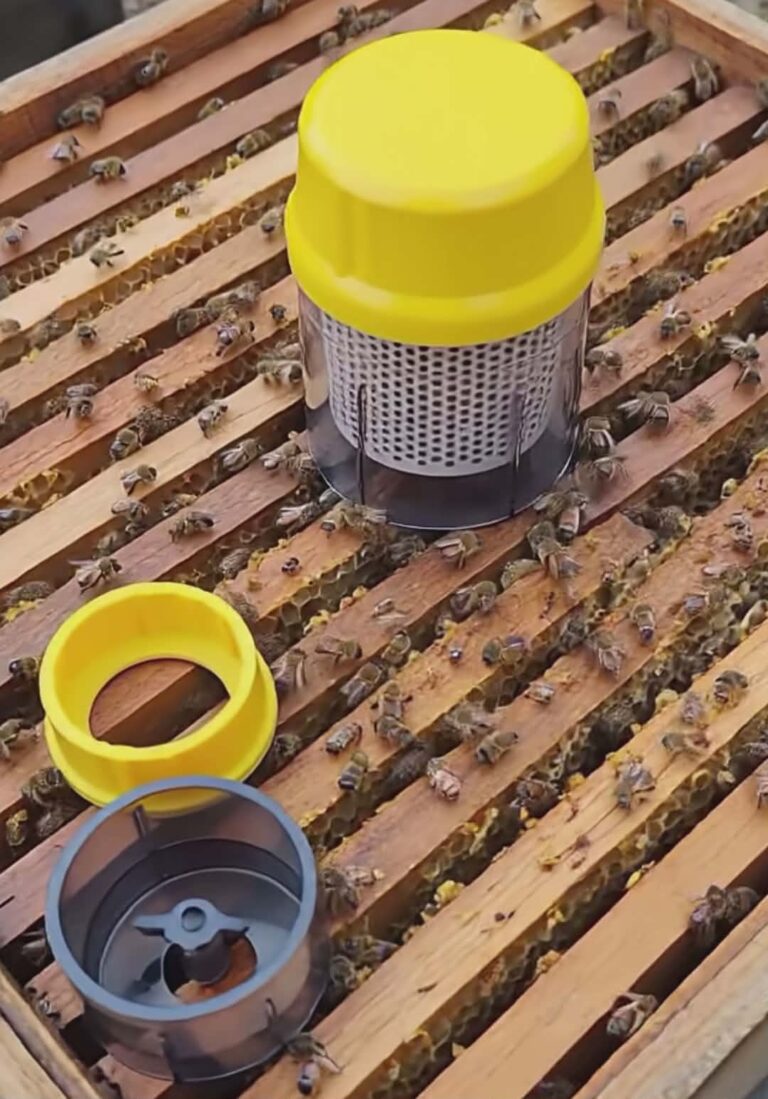
Leave the queen cage in place for a minimum of 5-7 days for August requeening — significantly longer than the 3-4 day standard spring introduction period. The extended cage time serves two purposes: it allows the colony more time to recognize and accept the new queen’s pheromones through the cage screen before direct contact occurs, and it gives the beekeeper two inspection opportunities (Day 3 and Day 7) to assess acceptance behaviour before the queen is released. Signs of acceptance: bees clustered peacefully on the cage, gentle movement, no aggressive biting at the screen. Signs of rejection: bees biting and chewing aggressively at the cage, loud high-pitched colony tone, bees pressing against the mesh from multiple directions. If rejection signs are present on Day 3, do not release the queen — extend the cage period by 2-3 more days and ensure 1:1 syrup feeding is active. Only proceed to removal when bees are calm and accepting at the cage screen.
The window for effective August requeening in Ontario is August 1-20. A queen introduced on August 1st begins laying by August 3rd — her first brood emerges as adult bees by August 24th, with subsequent brood cycles producing bees through mid-September. These are legitimate winter bees. A queen introduced on August 20th begins laying August 22nd — first brood emerges September 12th, and the generation of bees developed while she was being introduced (August 20th eggs onwards) emerges in September and early October. These bees have minimal time to accumulate fat body reserves before the October cluster forms. A queen introduced after September 1st in Ontario provides essentially no benefit to the current winter — her brood will emerge too late to develop proper winter bee physiology. Post-September requeening benefits the following spring season only, not the upcoming winter.
August queen availability in Ontario is significantly limited compared to May-June — most Ontario queen breeders sell out their primary production by July. To secure August queens: contact Ontario queen breeders in late June or early July and specifically request late-season queens. The Ontario Beekeepers’ Association (ontariobee.com) member directory lists registered Ontario queen breeders — many will take late-season orders if contacted early enough. Alternatively, BC suppliers (Kucheran Queens, Harnden Apiaries) ship mated queens to Ontario in August with reliable transit times. Italian or Carniolan queens from Ontario-local breeders are preferred over California-imported queens for better adaptation to Ontario autumn conditions — a locally-raised Ontario queen typically overwinters more successfully than an imported warm-climate queen.
📋 In This Article
- Why August Requeening Produces Better Winter Bees Than Any Other Timing
- Young Queen vs Old Queen — The Winter Survival Data
- The Ontario August Requeening Window — How Much Time You Have
- The August Acceptance Challenge — Why Colonies Are More Resistant
- The Safe Introduction Protocol — Step by Step for August
- Feeding During Introduction — The Acceptance Rate Booster
- Reading the Signs — Acceptance vs Rejection in August
- Where to Find Ontario Mated Queens in August
- August Requeening Checklist — Ontario
Requeening hives in August Ontario is one of the most underused professional beekeeping techniques in the province — and one of the most impactful for winter survival. Most hobbyist beekeepers think of requeening as a spring activity. Professional Ontario beekeepers know that an August queen introduction, done correctly, produces a winter colony with a younger, more productive queen, a stronger winter bee population, and a meaningfully higher spring survival rate. The challenge is not biology — it is acceptance. August bees are defensive, hungry, and suspicious. This guide tells you exactly how to introduce a new queen when the colony is working against you.
Why August Requeening Produces Better Winter Bees Than Any Other Timing
The case for August requeening in Ontario is built on a simple biological fact: the bees raised in August and September are the bees that must survive the Ontario winter. Whatever influences the quality and quantity of those bees directly determines whether your colony is alive in April. A young, high-performing queen introduced in early August maximizes both the quantity and quality of the winter bee generation in two distinct ways.
- Laying rate declines August 1-15 sharply
- Stops laying in many cells by August 20
- Fewer winter bees raised — smaller cluster
- Higher supersedure risk during autumn
- Unplanned supersedure = weak winter queen
- Spring population build-up delayed significantly
- Laying at peak rate immediately after introduction
- Continues laying through mid-September actively
- Maximum winter bee population produced
- No supersedure risk for 18+ months
- Heads first spring expansion colony efficiently
- Spring population surge 3-4 weeks earlier
Young Queen vs Old Queen — The Winter Survival Difference
A queen bee’s productivity is directly tied to her age and to the number of viable sperm remaining in her spermatheca from her mating flights. A new mated queen has a full spermatheca — typically 5-7 million sperm — and lays fertilized worker eggs at maximum efficiency. As she ages through her second and third year, sperm supply depletes and laying efficiency decreases, producing more unfertilized drone eggs, more skipped cells, and a progressively patchier brood pattern.
In Ontario August, the difference between a new queen and a two-year-old queen is not merely about laying rate — it is about the thermal biology of the winter cluster. A colony headed by a young queen enters October with more frames of winter bees, a denser cluster that generates heat more efficiently, and a queen who will begin robust spring laying earlier and more productively than an old queen who spent autumn in semi-retirement. Studies on Canadian colony winter survival consistently show queen age as one of the two most predictive factors (along with Varroa mite load) for April survival outcomes.
The Industry Standard — Many Ontario Commercial Beekeepers Requeen Every Year
Many large-scale Ontario commercial beekeeping operations requeen every colony every year — not because the old queens are failing, but because the productivity difference between a current-year queen and a one-year-old queen is measurable in honey yield and winter survival rates. For hobby and sideliner beekeepers who cannot afford to requeen annually, August is the highest-priority requeening window — colonies headed by queens that are two years old or older by August should be requeened before winter, not in spring when the old queen has already limited the winter bee population she could have produced.
The Ontario August Requeening Window — How Much Time You Have
The August 1-20 window for Ontario requeening is strict and not extendable. A queen introduced on August 1st has her first eggs hatching August 4th, first brood capped August 13th, first new bees emerging August 22nd — these new workers have 5-6 weeks to accumulate fat body reserves before cluster formation in early October. A queen introduced August 20th produces first new bees September 10th — these workers have only 3-4 weeks for fat body development, producing weaker winter bees. Every week of delay past August 1st reduces the benefit of August requeening to winter survival.
The August Acceptance Challenge — Why Ontario Colonies Resist New Queens
The data above illustrates the single most important insight for Ontario August requeening: feeding 1:1 syrup during the introduction period raises acceptance rates from ~45% without feeding to ~75-80% with feeding — a difference that makes August requeening reliably practical rather than a coin flip. The syrup feeding works because it biochemically and behaviourally shifts the colony from dearth-defensive mode toward flow-receptive mode. Bees receiving steady carbohydrate input behave as if a nectar flow is active — they become less aggressive, more tolerant of disruption, and significantly more accepting of unfamiliar pheromone profiles from a new queen.
The highest-risk moment in August queen introduction is the first 2 hours after the old queen is removed and the new caged queen is placed. During this window, worker bees are acutely aware of the queen pheromone disruption — the old queen’s mandibular gland pheromone (9-ODA) drops from the air rapidly after her removal, and workers enter a heightened awareness state in which any unfamiliar scent profile is treated as a threat rather than an opportunity.
To reduce this risk: never introduce the new caged queen immediately after removing the old one. Remove the old queen, close the hive, and wait a minimum of 1-2 hours before introducing the new cage. During this waiting period, start or top up the 1:1 syrup feeder. When you return, workers are calmer and beginning to register the absence of queen pheromone — making them more receptive to accepting the new cage. This 1-2 hour gap is one of the most effective single-step improvements to August queen acceptance rates.
The Safe Introduction Protocol — Step by Step for Ontario August
Feeding During Introduction — The Acceptance Rate Booster
The most important and most often skipped step in Ontario August requeening is continuous 1:1 syrup feeding from 48 hours before introduction through the entire 7-10 day cage period. This feeding protocol is not optional — it is the primary mechanism that raises August acceptance rates from 45% to 75-80%, transforming an unreliable late-summer requeening into a reliably successful one.
Why 1:1 (Not 2:1) During Queen Introduction
The goal of feeding during queen introduction is behavioural — mimicking a nectar flow to make workers receptive rather than defensive. 1:1 syrup most closely mimics incoming nectar in concentration and behaviour. 2:1 syrup is processed into stores rather than triggering the “flow is happening” colony behavioural state. Use 1:1 exclusively during the introduction cage period. Switch to 2:1 after the queen is confirmed laying and established — at that point the goal shifts from acceptance to stores building.
WiseBee Tip — Add Honey-B-Healthy or Lemongrass Oil to Introduction Syrup
Adding Honey-B-Healthy (a commercial blend including lemongrass oil and spearmint oil) to the 1:1 introduction syrup at the label rate provides an additional acceptance benefit — lemongrass oil partially mimics the Nasonov pheromone that bees use to signal a positive location or event. Colonies receiving lemongrass-supplemented syrup during queen introduction show measurably calmer behaviour and reduced cage-biting aggression. Use only the labelled amount — excessive essential oil concentrations can have the opposite effect. This is a low-cost addition (a few drops per litre of syrup) with a meaningful positive effect on acceptance behaviour.
Reading the Signs — Acceptance vs Rejection in August Ontario
Acceptance Signs — What You Want to See on Day 3
Bees clustered loosely on the cage surface — not pressed hard against the screen. Bees extending their tongues through the mesh to feed the queen and her attendants. Workers moving calmly around the cage and across adjacent frames without high defensive tone. The colony’s overall sound is normal — the steady hum of a calm hive rather than the high-pitched roar of an agitated colony. If you see bees apparently stroking the cage screen gently and not biting — acceptance is in progress and the 7-day timeline is appropriate.
Rejection Signs — When to Extend the Cage Period
Multiple bees biting aggressively at the cage mesh — you will see their mandibles working visibly. The colony tone is higher-pitched than normal. Bees forming a tight cluster that is clinging and pressing at the screen rather than loosely covering it. Worker bees attempting to pull on the attendant bees inside the cage through the mesh. If any of these signs are present on Day 3: do not release the queen. Extend the cage period 3-5 additional days, ensure syrup feeding is active, and check again. Never release a queen into a colony showing rejection behaviour — she will be killed within minutes of contact with workers.
Emergency Reversion — When August Requeening Fails
If a new queen is killed after release — which happens in roughly 20-25% of August introductions despite best practices — you have two options. First, if you kept the old queen alive in a separate cage: reintroduce her immediately using the same cage method. An old queen returned to her original colony is accepted at very high rates — the bees recognize her pheromone. Second, if the old queen was discarded: order a replacement mated queen immediately. The colony will begin building emergency queen cells from the youngest available larvae — if emergency queen cells are present, pinch all but the two best-positioned ones and allow one to emerge and mate. This walk-away approach takes 4-6 weeks and produces a locally-mated queen, but given the compressed August timeline, a purchased replacement is always preferable.
Where to Find Ontario Mated Queens in August
August Requeening Checklist — Ontario 2026
✅ Before Requeening Day
- Order mated queen — confirm August availability with breeder in late June or July
- Begin 1:1 syrup feeding 48 hours before planned requeening day
- Confirm internal frame feeder is in place and functioning — no entrance feeders
- Plan requeening inspection for morning (8-11am) — never afternoon
- Prepare queen cage inspection — verify candy plug is intact, screen undamaged
- Have a small separate cage or container ready to hold the old queen temporarily
✅ Requeening Day
- Morning inspection — find and remove old queen, cage separately
- Close hive — wait 1-2 hours minimum before introducing new queen cage
- Return — place new queen cage horizontally between central brood frames, candy up
- Light smoke at entrance only — not directly on cage
- Fill syrup feeder before closing hive
- Mark calendar: Day 3 check, Day 7 cage removal (if accepted)
✅ Day 3 Check
- Observe cage without removing — look for acceptance vs rejection behaviour
- Acceptance: gentle clustering, tongue-feeding through screen → proceed to Day 7
- Rejection: aggressive biting, high colony tone → extend cage period 3-5 more days
- Refill syrup feeder — syrup must remain available throughout introduction period
- Old queen should still be alive and separate — emergency reversion still possible
✅ Day 7-10 — Confirmation
- Inspect cage — candy should be cleared, queen released
- Check frames adjacent to cage position for fresh eggs (hand lens if needed)
- Eggs visible: accepted — remove empty cage, continue 1:1 syrup 7-10 more days
- No eggs, queen still caged: candy not cleared — gently assist by removing candy plug with pin
- No queen found: failed introduction — begin emergency response immediately
- Discard old queen once new queen confirmed laying — reversion window closed
Final Thoughts on Late Summer Requeening in Ontario
Requeening hives in August Ontario is the professional beekeeper’s secret weapon for winter survival — and the most underutilized management tool in the hobby beekeeping toolkit. The evidence is clear: young queens produce more winter bees, lay longer into autumn, overwinter at higher rates, and produce stronger spring colonies than old queens managed through another winter. The August window to capture these advantages is narrow — August 1-20 — and the acceptance challenge is real but solvable with syrup feeding and patience.
Find your old queens in August. Know which colonies are heading into winter with two-year-old or older queens. Order replacement queens in June or July so they are available when you need them. Feed 1:1 syrup before and during introduction. Leave the cage for 5-7 days. Read the acceptance signs honestly. The beekeeper who does this work in August — when it is inconvenient, when the dearth makes bees difficult, when attention has already shifted to extraction and Varroa treatment — is the beekeeper whose colonies open in April strong, populous, and ready to build into another productive Ontario season. 🐝👑🍂❄️
Questions about your Ontario August requeening? 🐝
Ask our AI beekeeping assistant — describe your queen’s age, colony strength, and current mite levels and we’ll advise on whether August requeening is the right decision for your specific hive situation.
🐝 Ask Bee Now — It’s Free🐝 WiseBee Disclosure
Affiliate Disclosure: This article contains Amazon affiliate links. If you purchase through our links, we earn a small commission at no extra cost to you. Learn more →
Disclaimer: This article is for educational purposes only and does not constitute professional apicultural or veterinary advice. Always consult a qualified beekeeper for guidance specific to your situation. Full disclaimer →