Fall Feeding Strategy for Alberta Bees:
When and How to Feed 2:1 Sugar Syrup
Start fall feeding Alberta bees the same day honey supers are removed — typically early to mid-August. Unlike Ontario where beekeepers feed 1:1 syrup in August for queen stimulation and switch to 2:1 in September for stores building, Alberta’s compressed season means 2:1 heavy syrup should begin immediately after harvest. Alberta has no fall nectar flow after canola ends — every gram of the 40-42 kg winter store requirement must come from supplemental feeding. Starting September 1st instead of August 1st costs approximately 4 weeks of feeding time in a season where temperatures prevent syrup uptake by early October. This delay is unrecoverable — a colony that enters October with 25 kg of stores instead of 40 kg will require emergency fondant feeding through winter and has a significantly higher spring mortality risk.
An Alberta colony on two brood boxes (standard Langstroth setup) needs 40-42 kg (85-90 lbs) of total winter stores — honey from the summer flow plus processed syrup combined. To determine your syrup requirement: weigh the colony after supers are removed, subtract the known empty weight of boxes and frames (typically 18-22 kg for two wooden boxes with frames), and the remaining weight represents current stores. Subtract current stores from the 42 kg target to get your deficit. To produce 1 kg of processed honey stores from 2:1 syrup, bees need approximately 1.2-1.3 kg of syrup (accounting for water evaporation during processing). Multiply your deficit by 1.25 to get your total syrup volume in kilograms. Convert kg to litres for 2:1 syrup: divide by approximately 1.35 (the density of 2:1 syrup). This is the volume your feeders must deliver before temperatures drop below 10°C.
Alberta beekeepers use 2:1 syrup from the start of fall feeding (not 1:1) for two specific reasons tied to the prairie climate. First, 2:1 syrup has a significantly higher sugar content — bees must evaporate less water from it to reach the 17-18% moisture level required for capping. In Ontario’s warm, long autumn, 1:1 syrup gives bees weeks to complete this evaporation. In Alberta’s rapidly cooling August-September, bees have far less time and lower ambient temperatures slow the evaporation process — 2:1 syrup dramatically reduces the evaporative workload and allows bees to store it faster. Second, 2:1 syrup takes longer to ferment in the feeder — at August ambient temperatures, 1:1 syrup can begin fermenting in as little as 48 hours, especially in warm weather. 2:1 syrup’s higher sugar concentration inhibits yeast activity and stays stable for 4-7 days in the feeder — essential when daily refilling is impractical for beekeepers managing multiple apiary locations across Alberta’s distances.
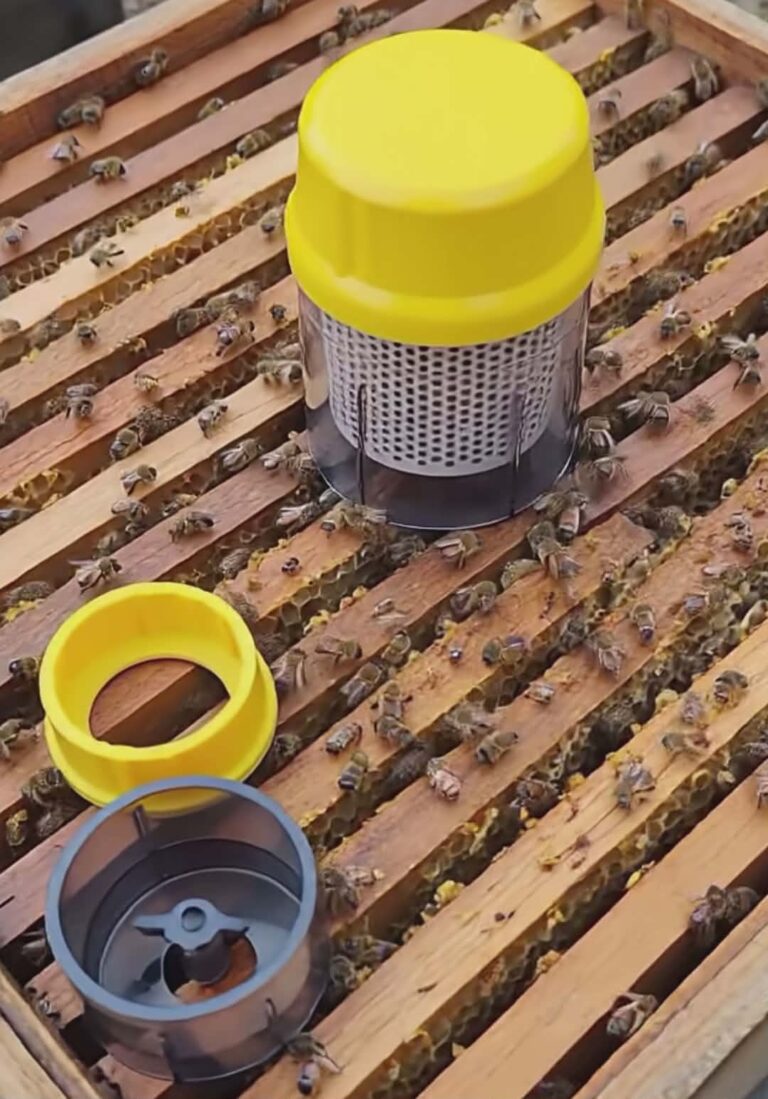
Top feeders (also called hive top feeders or Miller feeders) with 10-15 litre capacity are the best choice for Alberta fall feeding. They sit above the top brood box under the outer cover, allowing bees to access syrup from below through a screened access point without leaving the hive cluster — critical when Alberta August nights are already cold enough to discourage forager-style travel to entrance feeders. Large capacity (10-15L) means fewer refills across a season where refilling multiple colonies at remote apiary locations is logistically challenging. Internal frame feeders (also good) hold 2-3L and require more frequent refilling but maintain warmer syrup temperatures inside the hive. Never use entrance feeders during Alberta fall feeding — exposed syrup at the entrance attracts robbing from the highly aggressive post-canola dearth forager population in the open prairie environment.
Stop fall feeding Alberta bees when daytime temperatures consistently drop below 10°C — typically mid-September in central Alberta, earlier in northern regions. Below 10°C, bees cannot efficiently process and evaporate syrup moisture to safe storage levels, and syrup left in feeders overnight in near-zero temperatures risks partial freezing that makes it inaccessible to bees. After syrup feeding ends, switch to solid supplemental feeds: fondant blocks or candy boards placed directly above the winter cluster provide carbohydrate emergency nutrition at any temperature without the processing requirement. If colonies have not reached target winter weight when syrup feeding must stop, install a large fondant block (1-2 kg) immediately and plan to check and replenish it through winter inspections. A colony with a fondant board can survive a 5-8 kg stores deficit that would otherwise be fatal.
📋 In This Article
- Why Alberta Fall Feeding Is Fundamentally Different
- Why 2:1 Syrup — Not 1:1 — From Day One in Alberta
- The 2:1 Syrup Recipe — Preparation and Quantities
- Alberta Winter Weight Target — How Many Kilograms Your Colony Needs
- The Feeding Math — Calculating Your Colony’s Syrup Requirement
- The Alberta Fall Feeding Timeline — August Through October
- Best Feeder Types for Alberta Late Summer Conditions
- When Syrup Stops — Fondant and Candy Boards for Cold Alberta Winters
- Fall Feeding Checklist — Alberta
Fall feeding bees in Alberta is not a September task — it is an August emergency that begins the same day honey supers come off. Ontario beekeepers have the luxury of goldenrod forage through September, mild nights through October, and a gradual transition into winter stores building. Alberta beekeepers have none of these buffers. When the canola flow ends, so does nature’s contribution to the colony’s winter stores. Everything that follows — 5 to 6 months of prairie winter — depends on what the beekeeper puts into those hives in August.
Why Alberta Fall Feeding Is Fundamentally Different from Ontario
- No fall nectar flow after canola ends
- 2:1 syrup from Day 1 — no stimulation phase
- Feeding window: Aug 1 – Sept 15 maximum
- Nights below 10°C by mid-August
- 42 kg stores needed — 100% supplemental
- Wrapping begins October 1-15
- Goldenrod + aster flow Aug–Sept
- 1:1 August for queen stimulation
- Feeding window: Aug 1 – Oct 10
- Nights above 10°C through September
- 30-35 kg stores needed — partial natural
- Wrapping begins October 15-31
The consequence of treating Alberta fall feeding like Ontario fall feeding — starting 1:1 in August and transitioning later — is a colony that enters October with 10-15 kg of stores deficit that cannot be filled with syrup because temperatures have already dropped below the processing threshold. This deficit is filled with emergency fondant through winter, costs the beekeeper additional money and labour, and statistically results in a higher April mortality rate than colonies that reached target weight before wrapping.
Why 2:1 Syrup — Not 1:1 — From Day One in Alberta
- Mimics nectar flow — stimulates laying
- 50% sugar content — high water content
- Bees must evaporate 35%+ moisture
- Takes 5-7 warm days to process per batch
- Ferments in feeder within 48hrs at 25°C
- Correct for Ontario August stimulation
- Wrong for Alberta fall stores building
- High sugar concentration — stored faster
- 67% sugar content — minimal water to remove
- Bees must evaporate 50% less moisture
- Stored in 2-3 days vs 5-7 for 1:1
- Stable in feeder 4-7 days at any August temp
- Correct for Alberta from Day 1 post-harvest
- Essential when window is August-September only
WiseBee Tip — Why Dense Syrup Matters When Nights Are Cold
Bees evaporate water from syrup by fanning with their wings — a metabolic process that requires warm temperatures for efficient evaporation. As Alberta nights cool below 15°C in August, fanning activity decreases dramatically during the overnight hours. 2:1 syrup requires roughly 50% less evaporation time than 1:1 to reach safe storage moisture levels — meaning bees can process and cap 2:1 syrup even with shortened warm-weather fanning windows. A batch of 1:1 syrup added to a hive on a cool Alberta August afternoon may sit uncapped for days, absorbing ambient humidity and potentially exceeding fermentation moisture thresholds before bees can finish processing it.
The 2:1 Syrup Recipe — Preparation for Alberta Fall Feeding
- Heat water to 60-70°C — not boiling. Boiling water can caramelize sugar and create HMF compounds harmful to bees at high concentrations.
- Add sugar gradually to hot water while stirring continuously — not the other way around. Adding water to sugar creates lumps that are difficult to dissolve completely.
- Stir until sugar is fully dissolved — no visible granules. This may take 5-10 minutes for a large batch. Undissolved sugar crystallizes in feeders and clogs access screens.
- Allow to cool to below 40°C before filling feeders — hot syrup placed directly in feeders creates condensation inside the hive and can temporarily disorient bees near the feeder.
- Optional: add 1 teaspoon of citric acid per 10L batch to slightly acidify syrup — inhibits yeast growth and extends feeder stability by 1-2 days in warm August weather.
Never Use Brown Sugar, Icing Sugar, or Artificial Sweeteners
Alberta fall feeding must use only plain white granulated cane or beet sugar — sucrose. Brown sugar contains molasses residues that cause bee dysentery during winter confinement. Icing sugar contains cornstarch that bees cannot digest. Artificial sweeteners provide no nutritional value. Raw or minimally processed sugars contain minerals and organic compounds that increase bee gut bacterial load during the long winter confinement period. White granulated sugar is the only safe and effective base for bee syrup at any concentration.
Alberta Winter Weight Target — How Many Kilograms Your Colony Needs
(empty boxes + frames)
(bees + brood)
Why Alberta Needs More Stores Than Ontario
An Ontario colony can survive winter on 25-30 kg of stores because the Ontario winter cluster has shorter confinement, milder average temperatures reducing metabolic rate, and an earlier spring (March-April forage) reducing the starvation risk window. Alberta colonies face a 5-6 month confinement period at significantly colder temperatures (-20 to -35°C winter lows versus -10 to -20°C in southern Ontario), requiring larger caloric reserves to maintain cluster warmth through longer cold snaps. The 40-42 kg Alberta target provides a meaningful safety margin — a colony that consumes stores faster than expected during a prolonged cold snap still has reserves remaining rather than starving in February.
The Feeding Math — Calculating Your Alberta Colony’s Syrup Requirement
For beekeepers without hive scales, a practical alternative is to lift the back of each hive slightly at harvest time and again at wrapping time — the change in perceived weight gives a rough indication of stores accumulation progress. More reliable: remove the outer and inner covers before wrapping and count full frames of capped honey in both boxes. Each fully capped Langstroth deep frame holds approximately 3-4 kg of honey. A colony with 10-12 full frames of capped stores in two brood boxes is approaching target weight.
The Alberta Fall Feeding Timeline — August Through October
Best Feeder Types for Alberta Late Summer Feeding
- 10-15L capacity — fewer refills across Alberta distances
- Bees access from below — no cold exposure needed
- Stays inside outer cover — insulated from night cold
- Large surface area — high daily syrup uptake rate
- Screened access prevents bee drowning
- Requires removing outer cover to refill
- More expensive than other feeder types
- Inside brood box — warmest possible location
- Bees access syrup at cluster temperature
- No robbing risk — fully enclosed in hive
- Works well in cold August nights
- Small capacity — refill every 1-2 days in peak uptake
- Requires opening hive to refill
- Occupies one frame position in brood box
- Easy to refill without opening hive
- Inexpensive
- Exposed syrup triggers aggressive prairie robbing
- Syrup accessible to wasps and other insects
- Syrup freezes overnight in cold Alberta August nights
- Very small capacity — constant refilling required
- Large capacity buckets available cheaply
- DIY-friendly with punched lid
- Can be placed inside empty super above brood box
- Requires empty super rim to house — adds hive height
- Potential for leaking if lid not correctly modified
- Syrup cools quickly at Alberta August night temperatures
WiseBee Tip — Refill Top Feeders in the Warmest Part of the Day
Fill Alberta top feeders between 10am and 2pm when temperatures are at their daily maximum and bee activity inside the hive is highest. Syrup added to a feeder at 5pm on a cooling Alberta August afternoon sits cold and unattended through the 8-12°C overnight hours before bees engage with it next morning. Morning refills give bees maximum warm-day processing hours per batch. For operations with many hives across multiple apiary locations, plan your August feeding route so each location is visited during its local warmest hours — an eastern apiary visited at 9am and a western one at 2pm maximizes useful feeding time per day.
When Syrup Stops — Fondant and Candy Boards for Alberta Winters
When Alberta night temperatures consistently drop below 10°C — typically mid-September — syrup feeding must end. Bees cannot process cold liquid syrup efficiently, and syrup sitting in a feeder at near-freezing overnight temperatures risks partial freezing that makes it inaccessible and potentially damaging to the feeder equipment. The transition from syrup to solid supplemental feed must happen before this temperature threshold, not after.
A fondant block (commercial bee fondant or homemade candy board) placed directly on the top bars above the winter cluster provides carbohydrates that bees can access at any temperature — they simply eat the solid candy without needing to process or evaporate it. Fondant does not provide the concentrated energy efficiency of processed honey stores, but it prevents starvation when stores run short and temperatures prevent syrup feeding.
Place a 1-2 kg fondant block on the top bars during the final inspection before wrapping — even for colonies that appear to have adequate stores. Alberta winters produce unexpected extended cold snaps that increase cluster metabolic rate and store consumption beyond projections. A fondant insurance policy costs a few dollars and prevents a colony loss worth hundreds. Check and replenish fondant during any mild winter days above -5°C when the outer cover can be briefly lifted.
DIY Candy Board — Simple Alberta Recipe
Combine 4.5 kg white granulated sugar with 250ml warm water and 1 tablespoon apple cider vinegar in a large pot. Heat gently to 120°C (use a candy thermometer), stirring continuously. Pour immediately into a shallow form the width of your hive body, approximately 2-3 cm deep. Allow to cool completely — 2-4 hours. The result is a firm candy slab that bees chisel from the surface throughout winter. Store extras in sealed plastic bags — candy boards keep for an entire season if kept dry.
Fall Feeding Checklist — Alberta 2026
✅ August 1–15 — Start Immediately
- Install top feeders or internal frame feeders same day supers are removed
- Fill with 2:1 syrup — never 1:1 in Alberta fall feeding
- Record each colony’s estimated current stores (frame count or hive weight)
- Calculate syrup deficit and volume required for each colony
- Refill feeders every 3-4 days — uptake rate is highest this week
- Never leave entrance feeders — robbing risk is maximum during August dearth
✅ August 15–31 — Continue, Monitor Temps
- Continue 2:1 syrup feeding — adjust refill timing to warmest daily hours
- Check night temperature forecasts — refill only if nights above 8°C
- Assess stores progress — count capped frames on each visit
- Prioritize colonies furthest below target weight for next refill
- Begin sourcing fondant blocks for mid-September installation
- Note any colonies with very slow uptake — may indicate weak colony needing attention
✅ September 1–15 — Final Syrup and Transition
- Last aggressive syrup feeding window — maximize uptake while temperatures allow
- Final stores assessment — weigh or count frames for every colony
- Switch to fondant for any colony still below 35 kg total stores by Sept 10
- Install mouse guards on all hives
- Remove top feeders and replace with inner cover when syrup feeding ends
- Place 1-2 kg fondant block on top bars of every hive before inner cover goes on
✅ October 1–15 — Winter Configuration
- Final inspection — confirm fondant in place, upper entrance open 1-2cm
- Bottom entrance reduced to mouse guard width only
- Winter wrapping installed — poly insulation wrap or wooden insulation box
- Record final hive weight and frame count for each colony
- Mark any colonies needing priority spring check (below 40 kg going in)
- Season complete — monitor for unusual activity through winter on mild days
Final Thoughts on Fall Feeding Strategy for Alberta Bees
Fall feeding bees in Alberta is one of the most consequential beekeeping decisions of the year — and one of the most time-pressured. The beekeeper who installs feeders on August 1st, feeds aggressively through the warm weeks, transitions to fondant in mid-September, and wraps colonies at target weight in early October gives their Alberta hives the nutritional foundation for surviving 5-6 months of prairie winter. The beekeeper who delays feeding, uses light syrup, or assumes the colony will manage on whatever honey it collected naturally faces a February dead-out that could have been prevented with a bag of sugar in August.
The math is unambiguous: 42 kg of stores, zero natural fall forage, 6-8 weeks of usable feeding weather. Start on August 1st. Feed 2:1 from Day 1. Use large-capacity top feeders. Switch to fondant when syrup stops being processed. Wrap at target weight. These five rules, applied consistently, are the difference between colonies that emerge strong in April and empty boxes discovered in February. 🐝🍂❄️🍯
Questions about fall feeding your Alberta apiary? 🐝
Ask our AI beekeeping assistant — describe your colony weights, current stores, and apiary location and we’ll calculate your syrup requirement and feeding timeline for reaching Alberta winter weight before October.
🐝 Ask Bee Now — It’s Free🐝 WiseBee Disclosure
Affiliate Disclosure: This article contains Amazon affiliate links. If you purchase through our links, we earn a small commission at no extra cost to you. Learn more →
Disclaimer: This article is for educational purposes only and does not constitute professional apicultural or veterinary advice. Always consult a qualified beekeeper for guidance specific to your situation. Full disclaimer →