Best Beehive Winter Wraps for Ontario:
5 Things to Check Before Buying
Many Ontario beekeepers use winter wraps, particularly in exposed locations or colder northern and central regions of the province. A wrap primarily reduces wind exposure and can add insulation depending on the product. It is not a universal requirement — a colony in a sheltered location with strong population, adequate stores, and top insulation may overwinter well without a lateral wrap. What matters more than the wrap itself is: adequate winter stores, low Varroa going into winter, a healthy queen, and sufficient population to generate cluster warmth. A wrap on an underprepared colony will not change the outcome.
Black plastic alone is not insulation — it is a wind barrier and solar heat absorber. A heavy-duty black plastic wrap around a hive reduces cold wind penetration and, on sunny winter days, can absorb some solar warmth that benefits the outer surface of the hive. However, it does not provide meaningful thermal insulation against sustained -15°C to -25°C Ontario winter temperatures. Products described as “insulated wraps” have an additional layer of foam or aerofoil material on the inside — this is the distinction that matters. The Wellington County/OBA wraps, for example, combine a black outer sleeve with an inner aerofoil insulating layer. If you are buying a retail alternative, confirm whether it includes an inner insulating layer or is black plastic only.
Buy and prepare the wrap in September. Install it when daytime temperatures are consistently below 10°C and bees are no longer foraging — typically October in most of Ontario, later in southern regions and earlier in the north. All fall tasks must be complete before wrapping: Varroa treatment removed on schedule, liquid feeding finished, feeders removed, mouse guards installed, and fondant placed above the cluster if stores are below target. Wrapping too early while bees are actively foraging on warm days can increase hive temperature unnecessarily. Wrapping too late — after the cluster has fully formed and temperatures are already severe — risks disturbing early winter confinement.
Generally no — a 10-frame wrap on an 8-frame hive will be too wide and create gaps where cold air can enter. A wrap that bunches, folds, or leaves spaces on the sides provides significantly less protection than one fitted correctly. Most beehive winter wrap products are sized for either 8-frame or 10-frame Langstroth equipment — they are not interchangeable. Before ordering, confirm the hive body width and match it exactly to the wrap dimensions. A wrap that slips or billows in Ontario winter winds loses much of its protective function.
A winter wrap itself does not directly cause moisture problems — but it can contribute to them if it is combined with a poorly ventilated top configuration. If a wrap seals the sides of the hive tightly without adequate upper ventilation and moisture management, moisture from the winter cluster has fewer routes to escape. This is why a wrap is one component of a system — not a standalone solution. The upper ventilation (quilt box vents, inner cover notch, or upper entrance) must remain functional after the wrap is installed. A wrap that covers upper entrances or ventilation openings creates a sealed environment that can accumulate condensation above the cluster.
📋 In This Article
- The OBA Group Program vs Retail Alternatives
- Check 1 — Insulation or Only a Wind Barrier?
- Check 2 — Measure the Hive First
- Check 3 — Entrance and Ventilation Compatibility
- Check 4 — Top Protection Is Not Included
- Check 5 — Durability and Canadian Availability
- Quick Comparison of Ontario Winter Wrap Options
- Which Wrap Should You Choose?
- When to Install a Winter Wrap in Ontario
- Final Checklist Before You Buy
Choosing a beehive winter wrap by appearance or price alone can leave your hive under-protected — or fitted with a product that covers the entrance, blocks ventilation, or simply doesn’t fit your boxes. Before buying any wrap, check these five details against your actual hive configuration.
The OBA Wellington County Program vs. Retail Alternatives
🇨🇦 About the Wellington County Wrap Program
Since 2007, the Wellington County Beekeepers’ Association has organized an annual group wrap program for Ontario beekeepers, with proceeds supporting the OBA Tech-Transfer Research Program. The wraps are made-in-Ontario polypropylene products combining a heavy black outer sleeve with an inner insulating layer. For 2026, orders closed September 8th with pickup at Fergus or Cornwall only — no direct shipping. If you ordered through the program, your pickup is scheduled for mid-October. If you missed the deadline or cannot access a pickup location, the retail alternatives below are the practical path forward. The program remains a good option for those who can meet its ordering and pickup requirements.
| Option | Main Advantage | Limitation |
|---|---|---|
| OBA group program | Competitive price, Ontario-made, supports OBA research | Fixed deadline, pickup only (Fergus or Cornwall) |
| Retail insulated wrap | Available now, ships to most Ontario addresses | Higher cost, dimensions vary — verify before ordering |
| Simple black plastic wrap | Very low cost, wind protection | Minimal insulation — confirm inner layer exists |
| DIY rigid foam panels | Configurable thickness and R-value | Requires measuring, cutting, and securing correctly |
This is the most consequential detail to verify before buying. Some products marketed as beehive winter wraps are heavy-duty black plastic sleeves — they reduce wind penetration and absorb some solar warmth on clear winter days, but provide very little thermal insulation against sustained cold. An insulated wrap has an additional inner layer of foam, aerofoil, or similar material that slows heat transfer through the hive walls. These are fundamentally different products, often described with the same search terms.
How to tell the difference: look for the product description to mention a specific inner material (foam, aerofoil, closed-cell insulation) and — ideally — a thickness measurement. A product described only as “heavy duty black polypropylene” without mentioning an inner layer is likely a wind barrier only. The colour alone does not indicate insulation performance.
Simpler Wrap Adequate
- Apiary is naturally sheltered from prevailing wind
- Colony is strong with top insulation already in place
- Southern Ontario location with milder winters
- Hive body already has thick wooden walls
More Insulation Needed
- Exposed location with no natural windbreak
- Central or northern Ontario winter severity
- Single hive without benefit of group warmth
- Thin-walled or poly hive body
A wrap that is too wide creates gaps where wind enters underneath. A wrap that is too narrow stresses the material and may not close properly. “10-frame” on a product listing does not guarantee compatibility with your specific brand of hive body — exterior dimensions vary between manufacturers. Measure before ordering.
☐ Measure These Dimensions Before Ordering
A wrap that fits loosely can be pushed by Ontario winter winds, creating openings that negate its protective function. Confirm the wrap’s closure method — Velcro, snap, staple, or overlap — and whether it can be secured tightly against your specific hive body without bunching.
A winter wrap must have a pre-cut or easily created opening at the lower entrance that aligns with your hive entrance and mouse guard. Confirm that the opening in the wrap matches the entrance position on your hive — some wraps have the entrance opening in a fixed position that may not align correctly with your bottom board configuration.
Also verify: whether the wrap allows access to a planned upper entrance or ventilation opening; whether a quilt box vent or inner cover notch will remain clear after the wrap is installed; and whether the wrap can be partially opened for inspection without complete removal. Do not rely on the wrap to provide ventilation — its job is to reduce cold air penetration, not to create airflow. A coherent ventilation plan must exist independently of the wrap.
Ventilation: The Goal Is Balance, Not Maximum Airflow
A common misconception is that more ventilation is always better for winter hives. Excessive ventilation removes the cluster-generated warmth that bees work to maintain. The goal is a configuration where moisture can escape gradually through controlled openings — not cold drafts blowing through the hive. A wrap that seals the sides while keeping planned upper ventilation open achieves this balance.
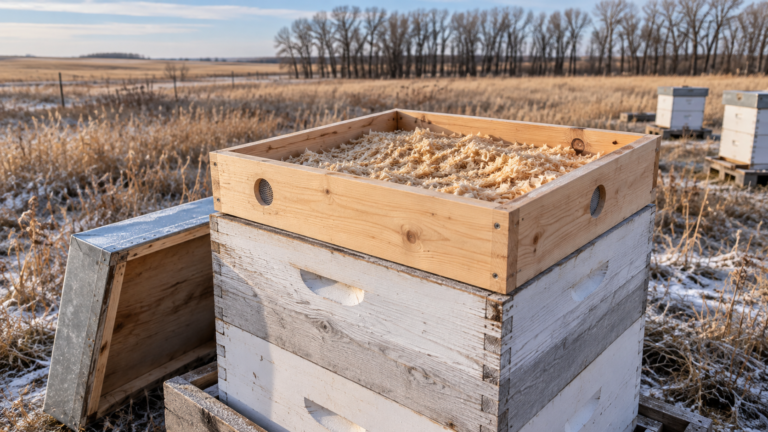
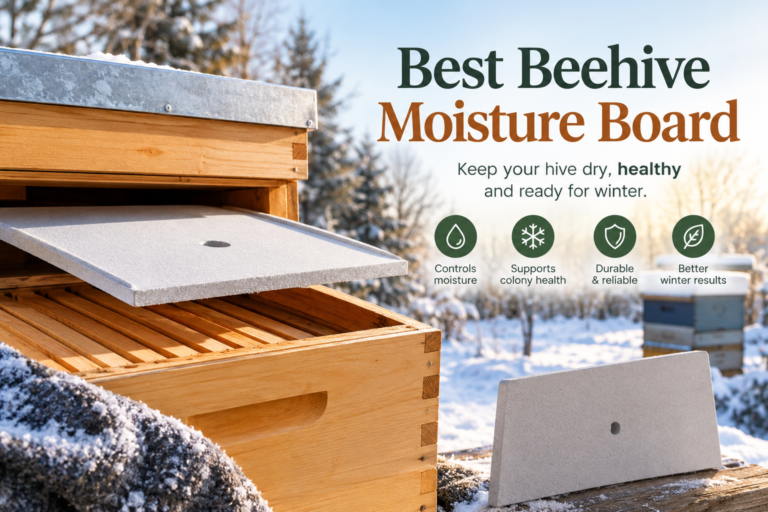
A lateral winter wrap protects the sides of the hive. It does not provide top insulation or moisture management above the winter cluster. These are separate functions requiring separate solutions — a quilt box, insulated inner cover, moisture board, or equivalent system placed above the colony before wrapping begins.
The distinction matters because a cold overhead surface is where condensation forms in a winter hive — not the sides. Water condensing on a very cold inner cover surface and dripping onto the winter cluster creates a cold-and-wet combination that increases colony stress and risk of loss. A well-insulated outer cover and an above-cluster moisture management layer address this; the lateral wrap does not.
Material and reusability: Check whether the outer material is water-resistant and UV-stable. Ontario winters include ice, freeze-thaw cycles, and Chinook-style wind events — a wrap that splits at the corners or loses its closure after one season is not good value. Confirm whether the product is designed for single-season or multi-season use and whether it can be cleaned and stored for the following year.
Installation: A good wrap installs without large gaps, stays fixed in wind without falling off, allows removal or adjustment without tearing, and does not require covering the entrance during installation. Closure systems — Velcro, snaps, overlap — vary in how well they hold against Ontario winter winds. Check reviews for reports of wraps shifting or opening during cold weather.
Canadian availability: Verify the product is actually in stock on Amazon.ca and ships to your Ontario address. Check that the listed dimensions match the description, confirm how many wraps are included per order, and review the return policy before purchasing. Do not assume a product described as available in Canada ships within a useful timeframe — check estimated delivery against your planned wrapping date.
Quick Comparison of Ontario Beehive Winter Wrap Options
| Product Type | Protection | Insulation | Entrance Opening | Reusable | Best For |
|---|---|---|---|---|---|
| Insulated polypropylene wrap (OBA style) | Wind + insulation | Yes — inner layer | Pre-cut | Yes | Standard Ontario outdoor wintering |
| Black plastic only (no inner layer) | Wind barrier | Minimal | Varies | Yes | Sheltered sites + top insulation in place |
| Multi-hive group wrap (2-4 hives) | Wind + shared warmth | Varies | Depends on config | Yes | Operations with grouped hives — verify fit |
| DIY rigid foam panels | Wind + insulation | Yes — by thickness | Beekeeper-cut | Yes | Custom hive sizes or non-standard setups |
Which Winter Wrap Should You Choose for Ontario?
🏆 Exposed Single Hive
An insulated wrap — inner layer confirmed — sized exactly for your hive body. Secured against wind. Upper insulation and ventilation handled separately.
💰 Budget Option
A weatherproof black wrap combined with a solid windbreak, strong top insulation, and a colony that entered winter in good condition.
🔲 Multiple Hives
A multi-hive group wrap if hive placement and outer cover dimensions are compatible — verify before ordering that the configuration works for your setup.
🛠️ DIY Builder
Rigid foam panels cut to your specific hive dimensions — the most customizable option, but requires careful installation to avoid blocking entrances or ventilation.
When Should You Install a Winter Wrap in Ontario?
Buy and prepare the wrap in September. Install it when consistent cold arrives — not on a fixed calendar date. In northern Ontario this may be October; in southern Ontario it can extend into late October or early November in mild years. The practical signals: bees are no longer foraging, daytime temperatures are consistently below 10°C, and all fall tasks are complete.
All of these must be done before the wrap is installed: Varroa treatment strips removed at the correct day count, liquid syrup feeding finished and feeders removed, fondant or candy board placed above the cluster if stores are below target, mouse guards fitted, and quilt box or insulated cover in place. The wrap is the last component installed — not a substitute for any of the preceding steps.
Final Checklist Before You Buy a Beehive Winter Wrap
☐ Verify Before Purchasing
- I know whether the product insulates or only stops wind — inner layer confirmed or not
- I have measured my hive configuration and matched it to the wrap dimensions
- The wrap is compatible with my entrance position and mouse guard
- Upper ventilation (quilt box vents, inner cover notch) will not be blocked by the wrap
- I have a separate plan for top insulation and moisture control above the cluster
- The product is actually in stock on Amazon.ca and ships to my address before my wrapping date
- I have checked what is included in the package and what the return policy is
- All fall preparation — Varroa retest, stores, mouse guard — will be complete before installation
Final Thoughts
Ontario’s group-order program remains a genuinely good option for beekeepers who can meet its ordering and pickup requirements — Ontario-made, purpose-designed, and with proceeds supporting beekeeping research. If you missed the 2026 deadline or cannot access Fergus or Cornwall, retail alternatives on Amazon.ca can serve the same function, provided you choose by insulation performance, exact hive dimensions, and entrance compatibility rather than by appearance or price alone.
A winter wrap is the final layer of a system that starts with colony health in August and finishes with proper top insulation and mouse guards in September. Get the sequencing right, and any well-fitted wrap will do its job through an Ontario winter. 🐝❄️🍂
Not sure which wrap fits your hive? 🐝
Tell our AI assistant your hive configuration, location in Ontario, and planned winter setup — we’ll help you identify the right wrap type and confirm your complete winter configuration.
🐝 Ask Bee Now — It’s Free🐝 WiseBee Disclosure
Affiliate Disclosure: This article contains Amazon affiliate links. If you purchase through our links, we earn a small commission at no extra cost to you. Learn more →
Disclaimer: This article is for educational purposes only and does not constitute professional apicultural or veterinary advice. Always consult a qualified beekeeper for guidance specific to your situation. Full disclaimer →