Varroa Mite Monitoring: How to Test Your Honey Bee Colonies
Alcohol wash, sticky board, and sugar roll explained — with calculation formulas and Canadian treatment threshold guidance
Why Monitoring Varroa Mites Matters
A colony can look healthy and active at the entrance while carrying a Varroa infestation high enough to compromise its survival. Bees continue to forage, cluster and raise brood even as mite populations rise — often until the damage to the developing worker generation becomes visible in late summer or fall, at which point recovery is much harder.
Visual inspection at the hive entrance or on frames will not give you a reliable estimate of how many mites are present. Mites spend a significant portion of their reproductive cycle inside capped brood cells, where they are entirely invisible. Even during the phoretic phase on adult bees, the proportion of the colony carrying visible mites tells you very little about total population size.
Monitoring fills that gap. It allows you to:
- Assess infestation levels before deciding whether to treat
- Verify that a treatment achieved the expected result
- Detect rising mite levels between treatments before they reach a critical threshold
- Compare results across colonies and across seasons
One test taken once a year is not enough. Varroa populations change as the colony’s brood cycle progresses. Testing at relevant points throughout the season gives you the information you need to respond at the right time.
What Is Varroa Mite Monitoring?
Varroa mite monitoring is the practice of sampling your colony to estimate the current infestation level. It involves collecting a representative sample of bees or placing a monitoring device in the hive, then counting the mites present and interpreting the result against applicable guidelines.
Why You Cannot Rely on Visual Inspection
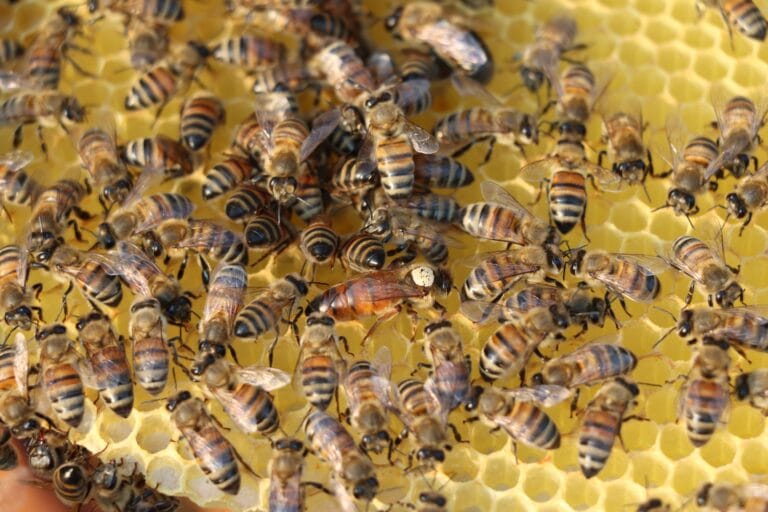
Even experienced beekeepers with good eyesight cannot reliably estimate a colony’s Varroa load by looking at bees. Adult female mites are small — approximately 1.1 mm wide and 1.6 mm long — and reddish-brown in colour. On a dark bee, they can be very difficult to spot, particularly during a routine hive inspection.
More importantly, a large proportion of mites in a colony with active brood are inside capped cells at any given time. You can examine every frame and see no visible mites on adult bees while the colony’s infestation level is already above the threshold that warrants treatment. Absence of visible mites is not evidence of a low or safe infestation.
Monitoring Before and After Treatment
Monitoring serves two distinct purposes in a Varroa management plan.
Before treatment: A baseline measurement helps you assess whether the current infestation level meets the threshold that applies to your colony, your province and the current season. Treating based on guesswork can mean treating too late, too early, or concluding that no treatment is needed when one actually is.
After treatment: A follow-up test confirms whether the treatment achieved the expected reduction. Not every treatment works as expected in every situation. Environmental conditions, product application, the presence of capped brood, and other factors can affect outcomes. Monitoring after treatment identifies cases where the infestation remains elevated and a reassessment may be needed.
The Main Methods for Monitoring Varroa Mites
Three methods are used most commonly by beekeepers to estimate Varroa infestation levels. They measure different things, require different equipment, and have different advantages and limitations.
| Method | What It Measures | Main Advantage | Main Limitation |
|---|---|---|---|
| Alcohol wash | Proportion of mites recovered from a sample of adult bees | Quantitative; allows consistent comparison over time | The sampled bees do not survive |
| Sticky board | Number of mites that fall onto a board over a set period | No bees are sacrificed; easy to set up | Mite drop does not directly measure infestation proportion |
| Sugar roll | Mites separated from bees using powdered sugar | Bees can be returned alive if the method is performed correctly | Results can be less consistent and are sensitive to technique |
How to Perform an Alcohol Wash for Varroa Mites
The alcohol wash provides a quantitative estimate of the proportion of phoretic mites in a colony. It is widely used because it is relatively straightforward to perform, requires minimal equipment, and produces a result you can compare across multiple tests and colonies.
What You Need for an Alcohol Wash
- A collection container or sampling jar
- A wash device with a mesh or screen lid for separating mites from bees
- Isopropyl alcohol (rubbing alcohol) or an alcohol wash solution as specified by the kit or protocol
- A light-coloured collection tray or container to count mites against
- A notebook or monitoring record sheet
How to Collect a Representative Sample
The quality of your result depends on where and how you collect the sample. A sample of approximately 300 worker bees from the brood nest is commonly used — this is the approach described in Ontario’s provincial monitoring guidance. Always follow the sampling protocol recommended for the kit or method you are using.
Collect the sample from a frame covered with nurse bees near the brood nest. These bees are more likely to carry phoretic mites than bees at the entrance or on honey frames. Shake or brush bees directly into the sampling container.
How to Count the Mites
After adding the alcohol solution, close the lid and shake gently for 30–60 seconds to separate the mites from the bees. Pour the liquid through the mesh into a light-coloured tray. The mites are small and reddish-brown; count them against the pale background of the collection tray. If counting in the field is difficult, collect the wash liquid in a sealed container and count later indoors.
How to Calculate the Varroa Infestation Percentage
Example B: 3 mites counted in a sample of 300 bees → 3 ÷ 300 × 100 = 1% infestation
This result is an estimate based on the sample collected, not a count of every mite in the colony. Sampling variation, timing within the brood cycle, and the proportion of mites currently inside capped cells will all affect what the sample reflects. A single measurement gives you a useful data point; repeated measurements across the season give you a trend.
Advantages and Limitations of the Alcohol Wash
- Advantages: Produces a consistent percentage result that can be compared across colonies and test dates; gives a clear, calculable figure; results are available immediately in the apiary.
- Limitations: The sampled bees do not survive; results depend on collecting an accurate and representative sample; the method detects mites on adult bees but does not count mites currently inside capped brood cells.
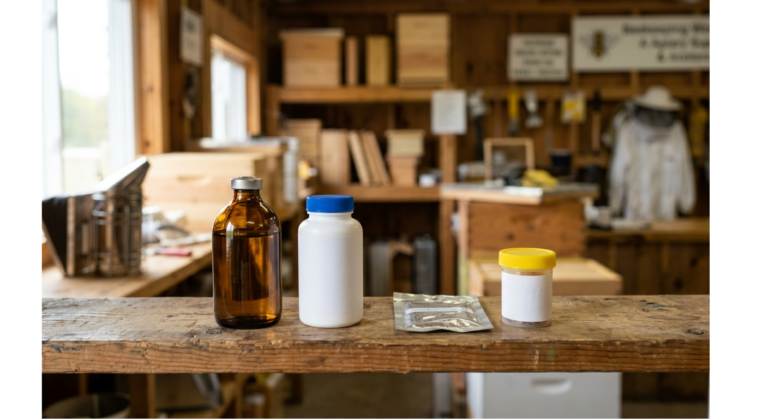
Monitoring Equipment — Alcohol Wash
How to Use a Sticky Board for Varroa Monitoring
What Is a Varroa Sticky Board?
A sticky board is a flat board with an adhesive surface that is placed beneath the hive’s brood box, usually below a screened bottom board. As mites fall naturally from adult bees — through grooming behaviour, movement, or the bee’s own activities — they drop onto the sticky surface and are held there for counting.
The board must be configured correctly for your hive. When used with a screened bottom board, a protective mesh between the bees and the sticky surface is typically needed to prevent bees from reaching and becoming stuck to the board.
How Long Should a Sticky Board Stay in the Hive?
Ontario’s provincial guidance describes monitoring periods of 24, 48, or 72 hours. Longer monitoring periods generally provide a more reliable estimate of mite drop, because daily variation in mite fall — due to weather, colony activity, and other factors — is averaged out over a longer interval.
Record the exact number of days the board was in place. This is essential for calculating the daily mite drop rate, which is the figure used to compare results across tests and colonies.
How to Calculate Mite Drop per 24 Hours
What Can a Sticky Board Tell You?
A sticky board count is useful for:
- Tracking trends in mite fall over multiple monitoring periods in the same colony
- Observing mite drop after a treatment (a significant increase in mite fall shortly after applying a treatment can indicate that the product is working)
- Identifying a sharp change that suggests the colony warrants closer investigation
What Are the Limitations of Sticky Boards?
Sticky board results are affected by several variables that make them harder to interpret in isolation:
- Colony size and population — a larger colony may show a higher mite drop simply because more bees are moving through the hive
- Bee grooming behaviour — some colonies groom more actively than others, which affects how many mites fall off
- Ants and other insects — they can remove mites from the sticky surface between when it is placed and when it is retrieved, which leads to undercounting
- Length of the monitoring period — a 24-hour count on a cold, quiet day may look very different from a 24-hour count during active foraging
Monitoring Equipment — Sticky Board
Is the Sugar Roll Method Reliable?
How the Sugar Roll Works
The sugar roll uses powdered icing sugar to coat a sample of bees, causing mites to detach. The bees are then rolled or shaken over a mesh screen or into a container, and the mites that fall through the mesh are counted. The bees can be returned to the hive after sampling, making this a method that does not require sacrificing the sample.
Sugar Roll vs. Alcohol Wash
The sugar roll is sometimes preferred by beekeepers who are reluctant to sacrifice bees or who are working with small colonies where sample loss is a concern. In those situations it can provide some indication of phoretic mite levels.
However, several factors limit the reliability of sugar roll results compared to alcohol wash:
- Mite detachment depends on the bees being adequately coated with sugar, the rolling technique, and the ambient temperature — results can vary considerably between tests and between individuals
- In warm conditions, the sugar may clump and coat the mites rather than dislodging them
- Studies comparing the two methods have found that the sugar roll generally recovers a lower proportion of mites than the alcohol wash, which can lead to underestimating the actual infestation level
Monitoring Equipment — Sugar Roll
How Often Should You Monitor Varroa Mites?
No single monitoring schedule works for all Canadian provinces. The timing that makes sense in British Columbia differs from Alberta, Manitoba, Ontario or the Atlantic provinces, because colony development, brood cycles and the timing of fall treatments all follow regional climate patterns. What matters is testing at points in the season where the results will inform a practical decision.
Spring Monitoring
Early spring monitoring, once the colony has resumed brood rearing and bee numbers have started to recover, gives you a baseline for the new season. If a fall treatment was applied before winter, a spring test can show whether mite levels were successfully reduced and whether the colony enters the season in good condition.
Summer Monitoring
During the main brood-rearing season, Varroa populations can grow quickly because abundant capped brood provides continuous reproductive opportunity for the mites. Regular summer monitoring — at least once during the peak brood period — helps you identify whether the infestation is increasing faster than expected and whether an intervention may be needed before the critical late-summer period.
Late-Summer and Fall Monitoring
The late-summer monitoring window is arguably the most important of the year. The worker bees that are raised in late summer and early fall will form the winter cluster and carry the colony through to spring. High Varroa infestation during this period — compounded by the additional mites entering from collapsing colonies in the surrounding area — can severely compromise the health and longevity of these bees.
Testing in late summer, before fall treatments are applied, tells you whether intervention is needed and helps you time the treatment correctly. Testing again after the treatment confirms the result.
Monitoring After Treatment
After applying a Varroa treatment, a follow-up test confirms whether the intervention achieved the expected result. The appropriate interval between treatment and follow-up monitoring will depend on the product used, the method applied, and current brood conditions — consult the product label and applicable provincial guidance rather than using a fixed number of days.
If mite levels remain elevated after treatment, the colony should be assessed further. Do not assume that the treatment worked without checking.
Understanding Varroa Treatment Thresholds in Canada
What Is a Varroa Treatment Threshold?
A treatment threshold is a reference point used to help decide when an infestation level is high enough to warrant a control intervention. It is not a biological absolute — a colony at exactly the threshold is not guaranteed to be in danger, and a colony just below the threshold is not guaranteed to be safe. The threshold is a decision-support tool based on research and field experience, not a fixed law of nature.
Why Thresholds Differ by Province and Season
Thresholds can vary depending on:
- The province or territory, because provincial beekeeping authorities set their own guidance based on local research and conditions
- The season — a mite level that may be acceptable in early summer may require immediate action in late summer, when the winter bee generation is being raised
- The monitoring method used — an alcohol wash percentage and a sticky board daily mite drop are not calculated or interpreted the same way
- The overall health of the colony and the presence of other stressors
Where to Find Current Canadian Recommendations
Treatment thresholds for Varroa management are set and updated at the provincial level. Rather than publish a single threshold table here — which could become outdated and does not account for provincial differences — we direct beekeepers to the current guidance for their region:
- Ontario: Ontario Ministry of Agriculture, Food and Agribusiness — Varroa Mites
- All provinces: Canadian Food Inspection Agency — Honey Bee Biosecurity Guide and your provincial beekeeping association or extension service
Common Varroa Monitoring Mistakes to Avoid
Relying on Visual Inspection Alone
Not seeing mites on your bees does not mean the colony has a low infestation. Mites inside capped brood cells are invisible during a routine hive inspection. Always use a sampling method to get a measurable result.
Sampling Too Few Bees
A sample that is smaller than the recommended size can produce a result that is not statistically representative. If you follow the Ontario protocol of approximately 300 bees, you can compare your results consistently across tests. Sampling 50 or 100 bees may produce misleading results that either overstate or understate the infestation.
Comparing Results From Different Methods
An alcohol wash infestation percentage and a sticky board daily mite drop are not directly comparable. Each method measures something different. Evaluate each result against the guidelines that apply to that specific method and the current season.
Testing Only Once a Year
A single measurement in spring, or a single measurement in fall, cannot describe the full arc of a colony’s Varroa history through the season. Mite populations change as brood production rises and falls. Testing at multiple points allows you to detect problems before they become critical.
Assuming the Treatment Worked Without Checking
A correctly applied treatment does not always achieve the expected result in every colony. Residual mites inside capped brood at the time of treatment, environmental conditions, and product efficacy can all affect the outcome. A follow-up monitoring test tells you whether the treatment worked — without it, you are relying on assumption.
Varroa Monitoring Record Sheet: What to Record
Recording your monitoring results consistently makes it much easier to detect trends, compare colonies, and evaluate the effectiveness of treatments over time. A simple paper record or spreadsheet is sufficient.
For each test, record at minimum:
| Field | Example |
|---|---|
| Date of test | August 12 |
| Hive ID or location | Hive 3 — North yard |
| Method used | Alcohol wash |
| Number of bees sampled | 300 |
| Number of mites counted | 6 |
| Infestation % or daily drop | 2% |
| Treatment applied (if any) | Apivar strips — August 13 |
| Follow-up test result | 0.7% — October 1 |
| Notes | Brood pattern normal; queen seen; 6 frames of brood |
Weather conditions, colony strength, and the presence of any other health issues at the time of testing are also worth noting. These details help you interpret future results in context, especially if you are comparing the same colony across multiple seasons.
Frequently Asked Questions About Varroa Monitoring
What is the most reliable way to test for Varroa mites?
The alcohol wash is the most widely used quantitative method and is recommended by Ontario’s provincial guidance as the primary sampling technique. It provides a consistent infestation percentage that can be compared across colonies and test dates. The sticky board provides useful complementary data about mite fall trends. The most important factor is using a consistent method and following an established sampling protocol so that your results are comparable over time.
How many bees do you need for a Varroa alcohol wash?
Ontario’s monitoring protocol describes a sample of approximately 300 worker bees collected from the brood nest. This sample size is used because it provides a statistically useful estimate while remaining practical to collect in the field. Always follow the sampling protocol specified by the kit or the monitoring guidelines you are using — different protocols may specify different sample sizes.
Can you monitor Varroa without killing bees?
Yes. A sticky board requires no bees to be collected or sacrificed — it counts mites that fall naturally from the colony. The sugar roll can also be performed without killing the sampled bees, provided the method is carried out correctly and the bees are returned promptly. However, neither of these methods provides the same quantitative precision as an alcohol wash, and their results are not directly comparable to an alcohol wash percentage.
How many Varroa mites are too many?
There is no single universal threshold that applies to all Canadian provinces, all seasons, and all monitoring methods. The threshold that applies in your situation depends on your province’s current guidance, the season, the method you used to measure, and the health of the colony. Consult the current guidance from your provincial beekeeping authority or extension service rather than using a single fixed number.
Should you test for Varroa after treatment?
Yes. A follow-up monitoring test after treatment tells you whether the intervention achieved the expected reduction in mite levels. Without it, you have no way of knowing whether the treatment was effective. The timing of the follow-up test will depend on the product used — consult the product label and applicable provincial guidance for the recommended interval.
Monitor First, Then Make an Informed Decision
Varroa cannot be managed effectively without measuring it. A colony that appears healthy may already carry a mite load that will compromise its winter bees. A treatment applied without a follow-up test may leave the infestation at a level that continues to cause harm.
The three key principles of Varroa monitoring are straightforward:
- Use a sampling method — visual inspection is not enough
- Different methods measure different things and cannot be directly compared
- Interpret your results using the current guidance that applies to your province and the current season
Once you know how to measure Varroa levels in your colonies, the next step is understanding why mite populations can rise again in late fall — even after an earlier treatment worked well.
Sources & Further Reading
- Ontario Ministry of Agriculture, Food and Agribusiness — Varroa Mites — alcohol wash and sticky board protocols, monitoring formulas, recommended methods for Ontario
- Canadian Food Inspection Agency — Honey Bee Producer Guide to the National Bee Farm-level Biosecurity Standard — federal monitoring guidance and the importance of provincial thresholds
- Ontario Government — Treatment Options for Honey Bee Pests and Diseases — provincial treatment thresholds and intervention guidance
- Canadian Association of Professional Apiculturists — Honey Bee Health Resources — national-level beekeeping health and monitoring resources
🐝 WiseBee Disclosure
Affiliate Disclosure: This article contains Amazon affiliate links. If you purchase through our links, we earn a small commission at no extra cost to you. Learn more →
Disclaimer: This article is for educational purposes only and does not constitute professional apicultural or veterinary advice. Always consult a qualified beekeeper for guidance specific to your situation. Full disclaimer →