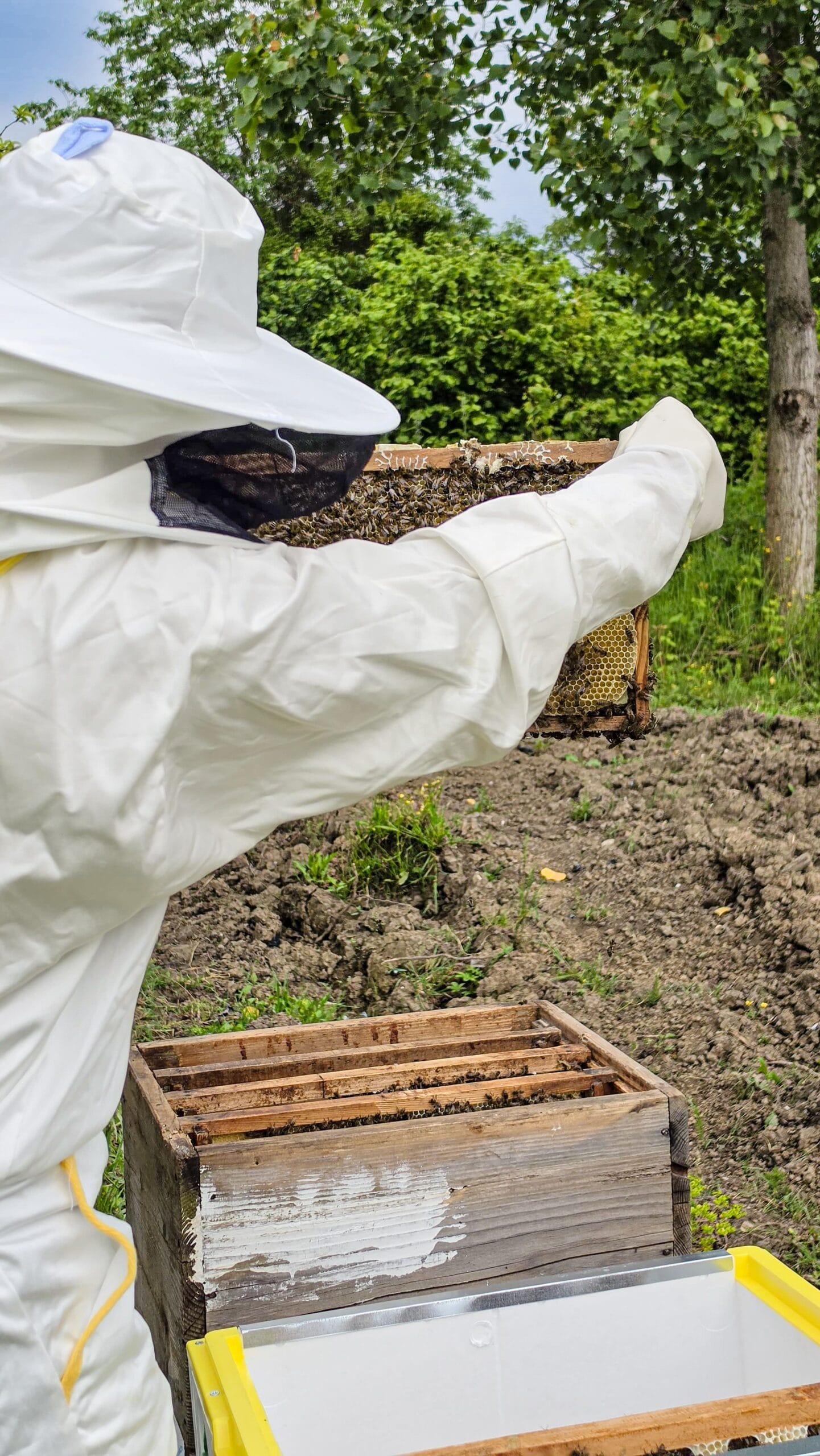
Best Varroa Treatments for Fall in Canada:
Oxalic Acid vs. Formic Acid
Neither is universally better — the correct choice depends on what is happening in your hive. Formic acid is more effective when the colony still has significant capped brood, because it penetrates cappings and reaches mites in sealed cells. Oxalic acid applied by drizzle or vaporization is most effective when the colony is broodless or nearly so — it kills mites on adult bees only and leaves capped brood populations unaffected. The new oxalic acid–glycerin strip method (Canada 2026) provides extended contact over several weeks and can be used with honey supers present, but still does not reliably penetrate capped brood the way formic acid does.
No — oxalic acid applied by drizzle or vaporization does not reliably penetrate capped brood cells. It kills mites on adult bees (phoretic mites) with high effectiveness — up to 90-95% in a broodless colony — but mites inside sealed cells are protected from the treatment until they emerge with their host bee. This is why timing the broodless window is critical for oxalic acid efficacy. The new glycerin strip method provides slower, sustained release over several weeks and may have some additional contact effect, but it is not registered or demonstrated to match formic acid’s brood penetration capability under the Canadian label.
Formic acid (Formic Pro / MAQS) requires specific temperature ranges defined on the Canadian label — generally a daytime high above a minimum threshold and below a maximum. In Ontario, this window is generally viable through early-to-mid August but becomes unreliable as days cool in late August-September. In Alberta, cold nights arrive by mid-August, narrowing the formic acid window significantly — many Alberta beekeepers switch to Apivar specifically because of this temperature limitation. Always check the 14-day forecast before applying formic acid in fall — a single day above the label maximum can cause queen loss; a sustained cold snap below the minimum reduces efficacy to near zero.
Yes — oxalic acid–glycerin cellulose strips were approved in Canada in February 2026 under Health Canada PMRA registration number 29575, held by the Canadian Honey Council. The registration is valid until December 31, 2031. The glycerin strip method uses oxalic acid dihydrate dissolved in food-grade vegetable glycerin at a 1:1 ratio, absorbed into natural cellulose strips. Strips are placed in the brood chamber for extended contact release. The Canadian label permits use while honey supers are present — a significant advantage over other treatments. However, the method requires DIY preparation by the beekeeper including precise measuring, careful heating (45-70°C), and appropriate personal protective equipment. It is not a packaged commercial product like Apivar or Formic Pro.
Yes — a post-treatment alcohol wash 5-7 days before removing Apivar strips, or 7 days after completing an oxalic acid or formic acid course, confirms whether the treatment worked. Target below 1% mite load (3 mites per 300 bees) before winter wrapping in both Ontario and Alberta. A post-treatment count above 2% despite a complete treatment course may indicate developing amitraz resistance (for Apivar), improper strip placement, or an incomplete broodless window for oxalic acid. Documenting pre- and post-treatment counts annually is the only reliable way to detect resistance trends before they become a colony survival crisis.
Yes — but with appropriate safety equipment and a clear understanding of the registered Canadian label requirements. Oxalic acid vaporization requires: a Health Canada–compatible vaporizer unit, nitrile gloves, a properly fitted N95 or P100 respirator (not a surgical mask), and full eye protection or a face shield. Oxalic acid vapour is corrosive to lungs and mucous membranes — short-term exposure without protection is genuinely dangerous. With correct PPE and a functioning vaporizer, the treatment itself is straightforward and well within beginner capability. Do not purchase an unregistered vaporizer or attempt to vaporize oxalic acid with improvised heating equipment.
If you are still deciding when to test and which treatment window applies to your colony, start with our complete Varroa Treatment Guide → This article focuses specifically on the product comparison — which Canadian-registered treatment is the better fit for your fall situation, and what monitoring and safety equipment you need to buy before you apply anything.
What Is the Best Varroa Treatment for Fall in Canada?
| Colony Situation | Better Option |
|---|---|
| Heavy capped brood — early August | Formic acid (Formic Pro) |
| Broodless or near-broodless window | Oxalic acid — drizzle or vapour |
| Temperature too hot for formic (>30°C) | Apivar strips (no temp limit) |
| Temperature too cold for formic (<10°C nights) | Apivar or OA vaporization |
| Honey supers still on — mid-season emergency | OA–Glycerin strips (2026, Reg. 29575) |
| Weak colony — fewer than 5 frames of bees | Consult provincial apiarist — label restrictions apply |
Oxalic Acid vs. Formic Acid — The One Difference That Actually Matters
Most beginners compare these two treatments on price or ease of use. The comparison that actually matters for treatment success is simpler: does formic acid reach mites inside sealed brood cells? The answer changes everything about which product to choose.
Formic acid vapour penetrates wax brood cappings — the single feature that defines when it is the superior choice. During peak brood season, up to 70-80% of all Varroa mites in a colony are inside sealed cells reproducing, completely inaccessible to contact-based treatments. Formic acid, evaporating through the hive air, enters those cells and kills reproducing mites that oxalic acid cannot reach.
This advantage is time-limited by temperature: the Canadian Formic Pro label specifies a maximum daytime temperature above which formic acid concentrations spike to queen-lethal levels. In southern Ontario the window is August through early September. In Alberta, cold nights eliminate reliable formic acid conditions by mid-August.
✓ Advantages
- Kills mites inside capped brood
- Faster treatment cycle (14-28 days)
- No residue concerns at correct temp
- No resistance known to develop
— Limitations
- Temperature-sensitive — queen risk above label max
- Must check 14-day forecast before installing
- Can stress colony and brood at high temps
- Ontario: viable Aug only · Alberta: early Aug only
Oxalic acid kills mites on adult bees with extraordinary efficiency — 90-95% in a single treatment when the colony is broodless. It does not penetrate capped brood. This distinction makes the broodless window the most important variable in any oxalic acid treatment decision: a colony that is fully broodless for oxalic acid treatment is a different situation from one with two frames of capped brood remaining.
Vaporization (sublimation) requires a compatible vaporizer and personal protective equipment — N95 or P100 respirator mandatory, not optional. The drizzle method requires less equipment but is more disruptive to the colony. Both are effective when the colony condition is correct.
✓ Advantages
- 90-95% kill rate in broodless colony
- Temperature-independent (vaporization)
- Lower cost per treatment than formic
- No resistance known to develop
— Limitations
- Does not penetrate capped brood
- Efficacy drops sharply with brood present
- Vaporization requires PPE + registered vaporizer
- Drizzle method disturbs the cluster
Approved in Canada in February 2026, glycerin strips deliver oxalic acid slowly through extended contact over approximately 42 days, rather than through acute vapour exposure. The Canadian label permits use while honey supers are present — a genuine practical advantage for mid-season Varroa emergencies when supers cannot yet be removed.
This is an open-source DIY method — not a packaged commercial product. Beekeepers prepare strips themselves by dissolving oxalic acid dihydrate crystals into food-grade vegetable glycerin at a 1:1 ratio, heating carefully to 45-70°C, and saturating cellulose strips. The process requires a digital thermometer, a stainless steel vessel, proper PPE, and careful label-exact dosing. It is not a casual beginner project — but with preparation, it is within reach of any careful beekeeper.
Important: glycerin strips provide extended contact suppression but do not replicate formic acid’s brood penetration capability. Think of them as a sustained low-intensity oxalic acid presence, not a replacement for targeted August treatment.
✓ Advantages
- Approved with honey supers present
- Extended release — 42 days contact
- Temperature-flexible application
- Registered in Canada Feb 2026
— Limitations
- DIY preparation required — not pre-made
- Precise measuring and heating required
- Does not penetrate capped brood reliably
- Not a packaged retail product
Side-by-Side: Oxalic Acid vs Formic Acid for Fall Canada
| Criterion | Formic Acid | Oxalic Acid |
|---|---|---|
| Best fall timing | Early fall — brood present | Late fall — broodless window |
| Penetrates capped brood | ✅ Yes | ❌ No (drizzle / vapour) |
| Temperature sensitive | ⚠️ High — label limits apply | Low (vaporization) |
| Treatment duration | 14–28 days | Single treatment (vaporization) |
| Equipment needed | Usually none (strip product) | Vaporizer + PPE required |
| Beginner-friendly | Simple product, temp-sensitive | Simple when broodless, PPE needed |
| Typical cost per colony | Higher | Lower |
| Queen risk | If temp exceeds label max | Very low |
| With supers on | ❌ Not permitted | ✅ Glycerin strips only (2026) |
| Resistance reported | None known | None known |
What Beginners Should Buy Before Treating — Canada 2026
The most important purchase before any Varroa treatment is not the treatment itself — it is the monitoring equipment that tells you whether treatment is actually needed and whether it worked. The second most important is the safety equipment that makes treatment application safe. Here is what to buy, in order of priority.
Do Not Buy These on Amazon for Varroa Treatment
Generic “Varroa strips” without a Canadian registration number, unbranded formic or oxalic acid sold without an apicultural label, vaporizers claiming to handle both oxalic acid and formic acid simultaneously, and any product that does not display a Health Canada Pest Control Products Act registration number. A product without Canadian registration is not legally authorized for use on honey bee colonies in Canada — and more importantly, its dosing and application directions may be incorrect or untested for Canadian conditions.
A Simple Fall Varroa Decision Guide — Six Steps
The Bottom Line
There is no universal winner between oxalic acid and formic acid for fall Varroa treatment in Canada. Formic acid is more relevant when the colony has substantial capped brood and temperatures allow safe application. Oxalic acid is more relevant when a broodless window exists or can be created. The 2026 glycerin strip registration adds a genuinely useful option for mid-season situations where supers cannot be removed — but it requires careful DIY preparation and should not be treated as a simpler alternative to established products.
What matters more than product selection is the sequence: measure first with an alcohol wash, choose a registered product matched to your colony’s actual condition and local temperature forecast, apply exactly as the label directs, and verify success with a post-treatment count before October. The beekeepers who consistently achieve below 1% mite loads going into winter are the ones who follow that sequence — not the ones who chose the most expensive or most popular product. 🐝🪲🍯
Not sure which treatment fits your colony? 🐝
Describe your mite count, brood frames, and temperature to our AI assistant — and get a specific treatment recommendation for your situation.
🐝 Ask Bee Now — It’s Free🐝 WiseBee Disclosure
Affiliate Disclosure: This article contains Amazon affiliate links. If you purchase through our links, we earn a small commission at no extra cost to you. Learn more →
Disclaimer: This article is for educational purposes only and does not constitute professional apicultural or veterinary advice. Always consult a qualified beekeeper for guidance specific to your situation. Full disclaimer →