Varroa Treatment Guide: Choosing the Right Control Strategy
Oxalic acid, formic acid, synthetic miticides and OA strips — how to choose, when to apply, and how to confirm the treatment worked
Why Varroa Treatment Requires a Plan
Applying a Varroa treatment is not the end of the process — it is one step within a management cycle. A colony may look healthy and productive while carrying a mite load high enough to compromise the health of the bees being raised for winter. By the time visible symptoms appear — deformed wings, reduced brood viability, poor cluster strength — the damage to the current generation is already done.
Effective Varroa control is built on three practices working together: monitoring mite levels before deciding to treat, choosing the right product for the conditions, and confirming the result with a follow-up test. A single treatment applied once a year, without monitoring, is unlikely to keep infestation levels in check across a full season.
No treatment option suits every colony, every season or every province. The correct choice depends on:
- The current infestation level and the threshold that applies in your province
- Whether the colony has capped brood, and how much
- Ambient temperature during and after application
- Whether honey supers are on the hive
- The products registered for use in your province
How to Choose the Right Varroa Mite Treatment
Start With a Reliable Mite Count
The starting point for any treatment decision is an accurate measurement of the current infestation level, obtained through a validated sampling method. Choosing a treatment based on visible symptoms — deformed wings, spotty brood — means the colony is already significantly impaired. An alcohol wash or a sticky board test taken before treatment gives you a baseline that you can compare to post-treatment results and to the applicable provincial threshold.
Do not select a treatment based on what other beekeepers in your area are doing at a given time. The infestation level in each colony is different, and the treatment timing that works for one operation may not be appropriate for yours.
Check Brood Status and Colony Conditions
The presence and quantity of capped brood directly affects which treatments are most effective. Oxalic acid applied by trickle or vaporization works primarily on mites on adult bees. A colony with a large amount of capped brood at the time of treatment will have most of its mite population inside sealed cells, where standard OA applications do not reach them reliably.
Formic acid products, and oxalic acid glycerin strips (see below), can reach mites under capped brood in specific conditions. Consult the product label for temperature requirements and colony size restrictions before selecting either option.
Check Honey Supers and Product Restrictions
The presence of honey supers intended for human consumption limits which treatments you can legally apply. Most synthetic acaricides, and some organic acid products, cannot be used while honey supers are in place. Using a product in a way that the label does not permit is a legal violation and may result in honey that cannot be sold.
Do not assume that two products containing the same active ingredient have the same restrictions. Application method, formulation and carrier material can change what conditions apply. Always read the current label for the specific product you are using, not a summary or a label from a previous purchase.
Main Types of Varroa Mite Treatments
Varroa treatments used in Canada fall into three broad categories: organic acids (oxalic acid and formic acid), synthetic acaricides, and extended-release delivery formats. Each has a different mechanism, different conditions for use, and different limitations.
| Category | Active ingredient | Acts on brood mites? | Honey super use? | Temperature sensitivity |
|---|---|---|---|---|
| OA trickle / vapour | Oxalic acid dihydrate | No (standard methods) | Label-dependent | Moderate |
| OA glycerin strips | Oxalic acid + glycerin carrier | Partial — suppresses over time | Permitted (label conditions) | Lower sensitivity |
| Formic acid | Formic acid | Yes, under suitable conditions | Product-specific | High — follow label limits |
| Synthetic miticides | Amitraz, fluvalinate, others | Varies by product | Restricted | Low to moderate |
Oxalic Acid Treatments
Oxalic acid dihydrate (Api-Bioxal) is registered in Canada (DIN 02466570) and the United States for Varroa control. It is an organic acid that kills phoretic mites — mites on adult bees — on contact. It does not reliably reach mites inside capped brood cells, which is its primary limitation when brood is present.
Trickle application involves drizzling a dilute solution directly onto the bees between frames. It is most effective during a broodless or near-broodless period, when the proportion of phoretic mites is highest. See Part 3 for a detailed discussion of winter broodless-period treatment.
Vaporization (sublimation) heats oxalic acid crystals to produce a vapour that disperses through the hive. It can be repeated more easily than trickle applications across multiple brood cycles and is well-suited for use during the fall and broodless period.
- Most effective when capped brood is absent or minimal
- Requires full personal protective equipment — use only as directed on the label
- In Canada, a veterinary prescription may be required depending on the province — verify with your provincial authority
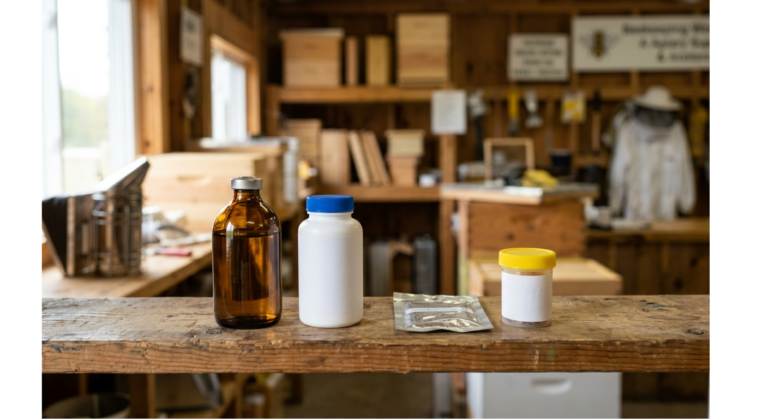
Equipment — OA Vaporization
Extended-Release Oxalic Acid Strips
Extended-release oxalic acid strips use a glycerin carrier to deliver oxalic acid slowly over an extended period — typically 42 days. Because the active ingredient is released continuously rather than in a single application, these strips can suppress mite populations even when brood is present, and can be used across a wider seasonal window than standard OA applications.
In Canada, oxalic acid glycerin strips were approved by the PMRA (Pest Management Regulatory Agency) under Registration No. 29575 in early 2026, valid through 2031. This approval also permits use when honey supers are in place — provided all label conditions are met.
- This is a registered commercial product — not a DIY formulation. Homemade OA+glycerol strips are not authorized in Canada and are not the same as the registered product.
- Follow the Canadian label — instructions from videos or websites based on New Zealand or US labels may differ in concentration, dosage, and conditions of use
- Strips remain in the hive for 42 days; follow label instructions for placement and removal
Formic Acid Treatments
Formic acid is an organic acid with the ability to penetrate capped brood cells under appropriate conditions, making it one of the few authorized options that can reach mites inside capped brood. It is available in Canada through commercial products such as MAQS (Mite Away Quick Strips) and Formic Pro, which deliver the acid in a controlled-release format.
- Temperature restrictions are strict — application outside the temperature range specified on the label risks killing the queen, damaging brood, or causing colony losses. Follow the label range for your product
- Some formic acid products can be applied when honey supers are present — verify with the specific product label
- Strong colonies tolerate formic acid treatments better than weak ones; consult the label for minimum colony strength requirements
- Formic acid is an irritant; follow all PPE requirements on the label
Synthetic Miticides and Other Registered Options
Synthetic acaricides — including amitraz-based products such as Apivar — are registered in Canada and have demonstrated efficacy against Varroa. They are often used in fall treatments after honey supers are removed, where their restriction on honey super use is no longer a concern.
- Do not use with honey supers unless the product label specifically permits it — this restriction applies to most synthetic miticides
- Follow the full treatment duration specified on the label; removing strips early reduces efficacy and increases the risk of resistance development
- Resistance to synthetic acaricides has been documented in Varroa populations worldwide; rotating active ingredients is an important part of long-term management
- Changing the brand name is not the same as rotating the active ingredient — amitraz is amitraz, regardless of the product name
When Should You Treat Varroa Mites?
Treatment timing cannot be reduced to a single calendar date for all of Canada. A schedule that works in southern Ontario may be inappropriate for central Alberta or northern British Columbia. The guiding principle is: test first, then decide based on your results and current provincial guidance.
Spring Treatment Considerations
After winter, assess the colony’s condition before mite populations have a chance to build through the spring brood cycle. An early-season alcohol wash establishes a baseline and reveals whether a treatment is needed before the colony grows into peak brood production. Choose a product compatible with the current colony state, the temperature, and whether early honey supers are present.
Mid-Summer Treatment and Honey Flow
During active nectar flow, most colonies have a large amount of capped brood, which limits the options for standard OA applications. If monitoring shows mite levels rising during summer, check the applicable products and their label conditions before deciding whether to treat. A product that cannot be used with honey supers cannot be applied to a colony in full production. Plan and monitor early rather than being forced into a difficult decision mid-flow.
Late Summer and Fall — Protecting Winter Bees
The worker bees raised in late summer and early fall are the ones that will overwinter and support the colony until spring. High Varroa infestation during this period affects the development and longevity of these bees, often without producing obvious symptoms until the colony fails to build up in spring.
A late-summer treatment, applied before the critical winter-bee-rearing window, is one of the most impactful interventions in the Varroa management calendar. Do not wait until you can see symptoms — monitor, compare to applicable thresholds, and act before the damage is done.
Winter Treatment During a Broodless Period
When a colony has no capped brood, the proportion of phoretic mites — mites on adult bees, accessible to OA treatments — reaches its highest point. A well-timed oxalic acid application during this window can achieve a high reduction in mite load. However, a broodless period should not be assumed based solely on the calendar date or the fact that it is winter. In mild climates or warm spells, some colonies maintain brood production into December or later. Inspect before treating to confirm brood status.
How to Reduce Varroa Treatment Resistance
Varroa mite populations can develop reduced sensitivity to acaricides when the same active ingredient is used repeatedly or applied in ways that expose mites to sub-lethal doses. Resistance does not develop immediately, but it is a real concern in beekeeping operations that rely exclusively on a single product class over many seasons.
- Rotate active ingredients across seasons — for example, an organic acid in spring or fall and a synthetic acaricide in another season, following provincial guidance on authorized products and timing
- Never change the brand name without changing the active ingredient — two products with different names may contain the same molecule
- Use the full treatment duration — removing strips or ending treatment early exposes surviving mites to a sub-lethal dose, which selects for resistance
- Do not exceed label dosage — applying more product than specified increases risk to bees without improving efficacy against resistant mites
- Do not reuse strips unless the label explicitly permits it
- Monitor after treatment — a high post-treatment mite count may indicate reduced product efficacy, and should be investigated rather than treated with the same product again
Safety Precautions When Treating Honey Bees
All Varroa treatments — including organic acids — require handling precautions. The specific PPE required varies by product and application method. The current product label and its associated safety data sheet (SDS) specify the required equipment for your treatment. Read both before you start.
- Use the respiratory protection specified for the product — for OA vaporization, a half-face respirator with an OV/P100 cartridge is typically required; requirements for other products differ
- Wear the gloves specified on the label — organic acids and some synthetic products require chemical-resistant or nitrile gloves
- Work in well-ventilated conditions; if vaporizing OA inside an enclosed structure, ensure air circulation
- Keep children and bystanders away from the treatment area
- Do not apply more product than the label specifies
- Store and dispose of products and residual materials as directed — do not pour unused solution into drains or compost
Safety Equipment for Varroa Treatments
How to Check Whether a Varroa Treatment Worked
Monitor Before and After Treatment
The pre-treatment mite count is your baseline. Without it, you cannot interpret whether the post-treatment result is an improvement or whether it is still above a concerning threshold. Record the date, method, sample size, mite count, and calculated result for every test.
After the treatment period specified on the label, repeat the test using the same monitoring method. Compare the results. The timing of the follow-up test depends on the product — consult the label or your provincial guidance for the recommended interval.
What If Mite Levels Remain High?
If the post-treatment result is not significantly lower than the pre-treatment baseline, consider several possible explanations before acting:
- Application issues: Was the product applied according to the label? Was it within the temperature range? Were all label conditions met?
- Brood at time of treatment: If significant brood was present when a standard OA product was applied, many mites may have been protected inside capped cells during treatment and emerged afterward
- Reinfestation: Mites from collapsing colonies in the surrounding area can repopulate a treated hive quickly in late summer and fall
- Reduced efficacy: In some situations, mite populations may show reduced sensitivity to the product used
Consult your provincial beekeeping authority or extension service before deciding on a follow-up intervention. Applying a second treatment without understanding why the first was insufficient may repeat the same result or increase unnecessary chemical exposure in the hive.
Why a Sticky Board Alone May Not Prove Success
An increase in mite fall on a sticky board shortly after applying a treatment is often taken as a sign that the product is working. This is a reasonable observation, but a sticky board count alone does not tell you whether the overall mite population in the colony is now below a safe threshold. A follow-up alcohol wash, compared to your pre-treatment baseline, gives you a more complete picture of the treatment outcome.
A Practical Varroa Treatment Checklist
- Measured the current mite infestation level using a validated method (alcohol wash or sticky board)
- Compared the result to current provincial recommendations for the season
- Selected a product registered and authorized for use in my province
- Confirmed that temperature, brood status and honey super conditions are within the product label’s requirements
- Read the current product label and prepared the required PPE
- Recorded the date, product name, registration number, and application method
- Planned the follow-up monitoring test and scheduled it at the interval appropriate for the product
- Considered whether reinfestation from nearby colonies is a factor in my management plan
Frequently Asked Questions About Varroa Treatment
What is the best treatment for Varroa mites in honey bees?
There is no single best treatment. The right product depends on the current infestation level, the season, whether brood is present, the ambient temperature, whether honey supers are on the hive, and the products registered in your province. A combination of monitoring, choosing the product that fits current conditions, and verifying the result is more reliable than any single product choice.
Is oxalic acid enough to control Varroa mites?
Standard oxalic acid applications (trickle or vaporization) work well during a broodless period, when most mites are on adult bees. They are less effective when significant capped brood is present, because mites inside sealed cells are not reliably reached. Extended-release OA glycerin strips work differently and can suppress mite populations when brood is present, but the mechanism and outcome differ from a single application. What is “enough” depends on the infestation level, the product used, the conditions of application, and whether reinfestation occurs after treatment.
Can you treat Varroa mites while honey supers are on?
Only if the product label explicitly permits it under the conditions present. Most synthetic acaricides prohibit use when honey supers are in place. Some formic acid products allow it under specific conditions. The OA glycerin strips registered in Canada in 2026 (Reg. No. 29575) permit honey super use when label conditions are met. Read the current label for the exact product you plan to use — do not rely on general information about the active ingredient.
How often should you treat for Varroa mites?
There is no universal answer. The number of treatments appropriate for a given season and apiary depends on monitoring results, treatment efficacy, the risk of reinfestation from neighbouring colonies, and current provincial guidance. Some beekeepers in Canada treat twice a year (spring and fall); others may need to treat additional times based on monitoring. The frequency should be driven by mite counts, not by a fixed calendar.
Should you test for Varroa after treatment?
Yes, always. A post-treatment test, taken at the interval appropriate for the product you used, tells you whether the treatment achieved a significant reduction. Without it, you cannot distinguish between a treatment that worked, a treatment that failed to reduce the population, and a situation where reinfestation has already replenished the mite load. Use the same monitoring method you used before treatment and compare the results against your baseline and the applicable provincial threshold.
Make Varroa Control a Year-Round Plan
Varroa management is not a single event. A colony treated once in fall with no follow-up monitoring may still fail the following spring if reinfestation occurred, if the treatment window was poorly timed, or if the mite population was already at a level that the treatment could not adequately reduce.
Effective Varroa control rests on a repeating cycle:
- Monitor — measure mite levels before making a treatment decision
- Choose the right product — match the treatment to the current conditions, brood status, temperature, and applicable provincial guidance
- Apply correctly — follow the label for dosage, timing, PPE, and treatment duration
- Verify the result — test after treatment and compare to the baseline
- Account for reinfestation — especially in late summer, when mites from collapsing colonies can repopulate treated hives
No single product or schedule solves the Varroa problem permanently. The goal is to keep mite populations low enough, consistently enough, that the colony can raise healthy bees through every season — including the winter bees that carry it through to spring.
Sources & Further Reading
- Ontario Ministry of Agriculture, Food and Agribusiness — Treatment Options for Honey Bee Pests and Diseases — authorized products, treatment thresholds and application guidance for Ontario
- Ontario Beekeepers’ Association — Oxalic Acid Glycerin Registration (Reg. No. 29575) — Canadian approval of OA glycerin extended-release strips, February 2026
- Government of Alberta — The Beekeeper’s Role: Caring for and Protecting Alberta’s Honey Bees — regional guidance on colony management and treatment conditions
- Health Canada — Formic Acid and Its Associated End-use Products — regulatory evaluation of formic acid formulations for Varroa control
- Canadian Food Inspection Agency — Honey Bee Biosecurity Guide — federal framework for Varroa monitoring and management in Canada
- Ontario Beekeepers’ Association — Honey Bee Pests & Diseases — registered treatments and label compliance resources for Ontario
🐝 WiseBee Disclosure
Affiliate Disclosure: This article contains Amazon affiliate links. If you purchase through our links, we earn a small commission at no extra cost to you. Learn more →
Disclaimer: This article is for educational purposes only and does not constitute professional apicultural or veterinary advice. Always consult a qualified beekeeper for guidance specific to your situation. Full disclaimer →